First Glance – Introduction & Atmosphere
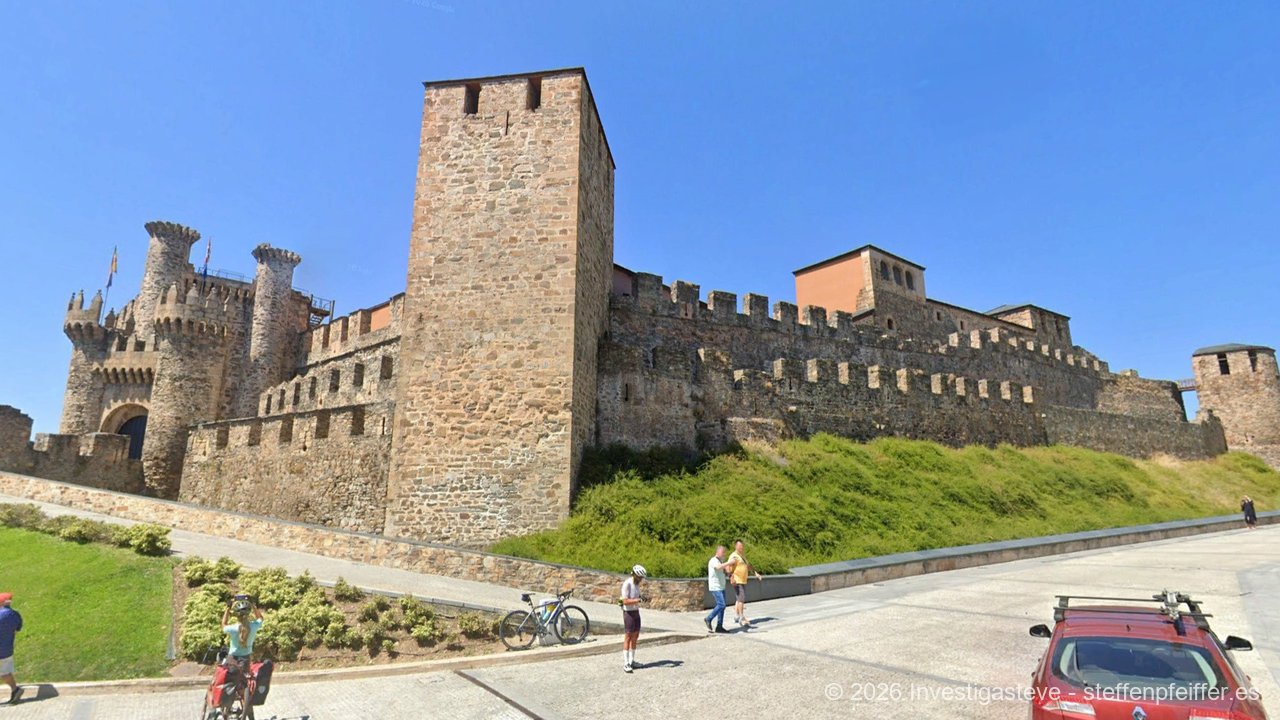
When the sun begins to sink over the peaks of the Sierra de la Encina in the west and the masonry of the mighty Templar fortress is bathed in a deep, glowing orange, the pilgrim feels that in Ponferrada he has reached far more than just a city. It is a place of thresholds, a monumental gateway to the Bierzo that, like no other point on the Camino Francés, bridges the gap between martial protection, spiritual refuge, and primal industrial power. You stand on the bank of the Sil, where the roar of the water has set the same rhythm for almost a millennium, and beneath your feet vibrates the echo of millions of steps that crossed the “Pons Ferrata,” the iron bridge, before you. The air here is heavier than on the wide plains of the Meseta; it is saturated with the scent of damp earth, the tart aroma of the nearby chestnut forests, and a metallic hint that tells of the region’s mining history.
Arriving in Ponferrada is a haptic experience of opposites. Your boots find grip on the smoothly polished cobblestones of the old town, while your fingers involuntarily stroke the rough, cold granite blocks of the castle walls, which rise four to five meters thick from the ground like unshakeable guardians. It is an auditory journey: the distant, metallic ringing of the bells of the Basílica de la Encina mingles with the international babble of voices in the alleys of the Calle del Reloj. You hear the rhythmic tapping of pilgrim staffs, which here, in the shadow of the clock tower, creates an almost sacred echo. Psychologically, Ponferrada is a moment of deep relief for the pilgrim. The exhaustion of the descent from the mountains of León gives way to awe-filled admiration. Here you become aware that you no longer need the protection of the Templars in a martial sense, but their stone presence gives you a mental fortitude that you will need for the upcoming ascent to Galicia. It is the visual force of a fairy-tale castle, combined with the honest roughness of an industrial city, that makes Ponferrada a distinctive stage on your way.
What This Place Tells
Ponferrada is a city born of the necessity of protection. Its identity is inextricably linked to the year 1082, when Bishop Osmundo of Astorga ordered the construction of an iron-clad bridge over the Sil. This bridge, the eponymous “Pons Ferrata,” was a technical sensation of the Middle Ages and the decisive impetus for the settlement of this strategically valuable point at the confluence of the Sil and Boeza. Where pilgrims could safely cross the river, marketplaces, hospitals, and finally a flourishing enclave developed. But it was the year 1178 that elevated the city to the status of legend: King Ferdinand II of León handed over the strategic hub to the Order of the Temple. The Templars, those mythical monk-warriors, had a clear mission: they were to protect pilgrims from banditry and secure the territory in the border conflicts between León and Castile.
What followed was the construction of one of the most impressive fortresses in Christendom. The Castillo de los Templarios, completed between 1178 and 1282, is today a stone archive of that era. Every bastion, every loophole, and the irregular, terrain-adapted ground plan tell of an order that combined military perfection with deep spirituality. Legends still persist that the Templars held the Holy Grail and the Ark of the Covenant here under their protection – narratives that come alive during the annually celebrated “Noche Templaria” in July, when the knights symbolically return to the castle. Yet the history of Ponferrada did not end with the dissolution of the order in 1312. The city transformed from a religious bulwark into a regional administrative center and experienced a second birth in the 20th century as Spain’s industrial heartland.
The founding of the “Minero Siderúrgica de Ponferrada” in 1920 made the city the center of coal mining and power generation. This era created its own proud identity, now preserved in the energy museum “La Fábrica de Luz.” Here you feel the historical causality: the hard faces of the miners of yesterday are the ancestors of the hospitable inhabitants of today. Ponferrada has learned to reinvent itself again and again – from the Celtic castro, through the Roman citadel and the Templar golden age, to the modern wind energy industry. When you walk up the Calle Gil y Carrasco to the castle today, you walk on layers of time, all of which share one thing: the will to maintain a safe and prosperous place at the crossroads of the ways.
Addresses & tips in Ponferrada
Camino Distances
Ponferrada forms the great center of the Bierzo and is the strategic anchor point between the mountains of León and the Galician Ancares.
| Previous Location | Distance (km) | Next Location | Distance (km) |
|---|---|---|---|
| Molinaseca | approx. 8.0 km | Columbrianos | approx. 2.8 km |
| Rabanal del Camino | approx. 32.5 km | Villafranca del Bierzo | approx. 24.0 km |
Sleeping & Arriving
Arriving in Ponferrada is associated for the pilgrim with deep psychological relief. When the mighty towers of the castle appear on the horizon, it signals the end of a long and often exhausting march from Rabanal or Foncebadón. The haptic experience of setting down the heavy backpack after 30 kilometers in your bones in a hostel like the Albergue de Peregrinos San Nicolás de Flüe is unparalleled. This church hostel, with 183 beds one of the most important stops on the entire way, is ideally located in the historic center directly behind the basilica. Here it smells of freshly washed linen, disinfectants, and the distant scent of coffee brewing in the communal kitchen. The silence in the large halls is broken only by the soft rustle of sleeping bags and the distant chiming of church bells.
For those seeking a more modern, private environment, the Albergue Guiana offers a luxurious alternative. Here you feel the coolness of the air conditioning and the haptic quality of smooth surfaces, which form a sharp contrast to the medieval world outside. Staying overnight in Ponferrada also means having the choice between the simplicity of a donation-based hostel and the comfort of hotels like the Aroi Bierzo Plaza, housed in a historic building directly on the town hall square. Psychologically, the overnight stay here is preparation for the next phase: you leave the city behind and immerse yourself the next morning in the green sea of the vineyards. Ponferrada’s capacity is large, but in the high season between June and September, the hostels often fill up by early afternoon. It is a moment of metamorphosis: you wash the dust of the mountains from your skin and feel for a night as part of this venerable urban society.
Eating & Drinking
The gastronomy in Ponferrada is a powerful declaration of love to the earth of the Bierzo. When you sit down at one of the heavy wooden tables in a mesón on the Plaza del Ayuntamiento, the first sensory impression is overwhelmingly olfactory: the scent of Botillo, the spicy meat specialty of the region, fills the air. It is a heavy, meaty, and spicy smell that immediately promises warmth. Botillo is a ritual meal, a stew of various cuts of pork, seasoned with paprika, best served with potatoes and cabbage. The taste is intense, smoky, and deeply satisfying – exactly the calorie bomb your body needs after the mountains. You drink it with a robust red wine of the Mencía variety, which shimmers in the glass like liquid velvet and carries a fine note of blackberries and the mineral slate soil of the surroundings.
For a smaller appetite, the tapas scene around the Calle Gil y Carrasco offers an auditory and gustatory journey of discovery. The clinking of glasses, the loud, hearty laughter of the locals during aperitivo, and the hiss of beer taps form the backdrop for classics like Cecina de León – the wafer-thin, air-dried beef whose smoky saltiness harmonizes perfectly with a cool beer. Haptically, you experience the quality of regional products during a visit to “El Bodegón,” where the patatas bravas and mussels are legendary. Those who prefer modern cuisine will find at the “7 Sillas” restaurant a kitchen that combines tradition with innovation. Eating in Ponferrada means tasting the fertility of the Bierzo – from the conference pears to the hand-harvested chestnuts whose roasting scent wafts through the alleys in autumn.
Supplies & Logistics
Logistically, Ponferrada is the last great bastion of full supply before the way becomes more solitary and the paths steeper. As the capital of the Bierzo, the city offers an infrastructure that leaves nothing to be desired. The strategic location of a Carrefour Express directly on the Avenida del Castillo allows you to replenish your supplies for the day without detours. It is a busy place where the smell of fresh fruit mingles with the functional hustle of the new town. Here you find pharmacies specialized in pilgrim needs, providing blister plasters or magnesium with practiced eyes. The psychological security of knowing a modern health center like Ponferrada I is nearby gives injured hikers the necessary courage.
The city is also a significant transport hub. The Ponferrada train station connects you by rail to Madrid or Santiago, while the bus station offers connections in all directions of northwestern Spain. For pilgrims using luggage transport, services like Camino Forward operate here with the highest precision. It is a logistical machine running in the background so you can focus entirely on your spiritual experience. Everywhere in the city you find public fountains, whose ice-cold water comes from the mountains and offers a haptic pleasure when you hold your bottle under the stream.
Shopping: Carrefour Express on Av. del Castillo (open 9 AM–10 PM) and Tienda del Peregrino on Plaza de la Encina for equipment. Health: Centro de Salud Ponferrada I on Paseo San Antonio offers medical care until 9 PM. Information: Oficina de Turismo on Calle Gil y Carrasco provides maps, stamps, and advice. Money: Numerous banks and ATMs are available 24/7 in the city center.
Don’t Miss
– Castillo de los Templarios: The crown of the city. Visit the library and the defensive walls, protected as a national monument since 1924. – Basílica de la Encina: A Renaissance building from 1527, housing the Black Madonna, the patron saint of the Bierzo. – La Fábrica de Luz: The energy museum in a former coal power plant offers fascinating video testimonies from over 200 former workers. – Torre del Reloj: The historic clock gate from the 16th century, marking the transition to the actual old town. – Museo de la Radio: A unique collection of the famous journalist Luis del Olmo near the castle. – Calle del Reloj: One of the most picturesque alleys, ideal for photographic perspectives of the castle. – Plaza del Ayuntamiento: The lively town hall square, forming the social heart of the city between the Middle Ages and modern times.
Insider Tips & Hidden Places
Beyond the main tourist routes, Ponferrada reveals its quiet, almost meditative corners. One such place is the riverside path along the Sil, north of the Templar castle. While the crowds swarm in the alleys of the old town, this green path offers visual and auditory recreation. The roar of the water here drowns out every urban noise and leads you into a world of willows and deep green. It smells of river water and fresh grass, an ideal place to order your thoughts after the rigors of the mountains. Here, in the soft light of dusk, the castle viewed from below appears even more monumental and aloof.
Another hidden treasure is the small bar in the old clock tower (Torre de Reloj). It is a tiny establishment frequented almost exclusively by locals. Here you feel the authentic atmosphere of the city, far from pilgrim menus and tourist staging. You sit between old stone walls and drink your vermouth while the stream of pilgrims passes by outside. For those who dare an excursion, Santiago de Peñalba, 25 kilometers north, is a Mozarabic jewel often overlooked by the masses. In this mountain village at 1,100 meters, time seems to have stood still since the 10th century. The mystical Cueva de San Genadio offers a spiritual depth there that is a perfect counterpart to the martial Templar heritage in the valley. Also, Las Médulas, the ancient Roman gold mines, glow in an almost unnatural red at sunrise before the tourist buses reach the lunar-like landscape.
Moment of Reflection
In Ponferrada, you encounter your own inner guardian. The massive presence of the castle challenges you to think about your own protective walls. Psychologically, this is the place of consolidation. You have left the barren solitude of the mountains behind and are now confronted again with the complexity of a city. Do you feel the contrast between medieval spirituality and the industrial reality of the new town? The historical causality that created Ponferrada – the iron bridge for the weak – reminds you that help often comes in technical form but must be spiritually supported.
Perhaps, as you look at the castle walls, you feel how your own resilience has changed over the course of the journey. You are no longer the person who started in Saint-Jean-Pied-de-Port or Burgos. In Ponferrada, under the gaze of the Templars, you integrate your experiences. The city teaches you that progress (industry) and tradition (the Camino) are not contradictions but support each other. Take the time to sit on a bench on the Plaza de la Encina and absorb the international humming around you. It is the sound of hope that has never fallen silent here since 1082. You are ready for the finale, strengthened by the iron constancy of this place.
Camino of the Stars
This place lies on the Camino Francés, on the stage between the mountains of León and the Galician highlands. The sequence of locations is:
Rabanal del Camino → El Acebo → Riego de Ambrós → Molinaseca → Ponferrada → Columbrianos → Fuentesnuevas → Camponaraya → Cacabelos → Pieros → Villafranca del Bierzo
Have you already experienced the nighttime magic of the illuminated Castillo de los Templarios or found peace in the Basílica de la Encina? Perhaps you had a conversation in one of the hidden bars of the old town that changed your way? Share your experiences from the capital of the Bierzo with us – which Templar legend fascinated you most? Your story is another stone in the walls of this eternal city.
About the Author