A First Glimpse – Arrival & Atmosphere
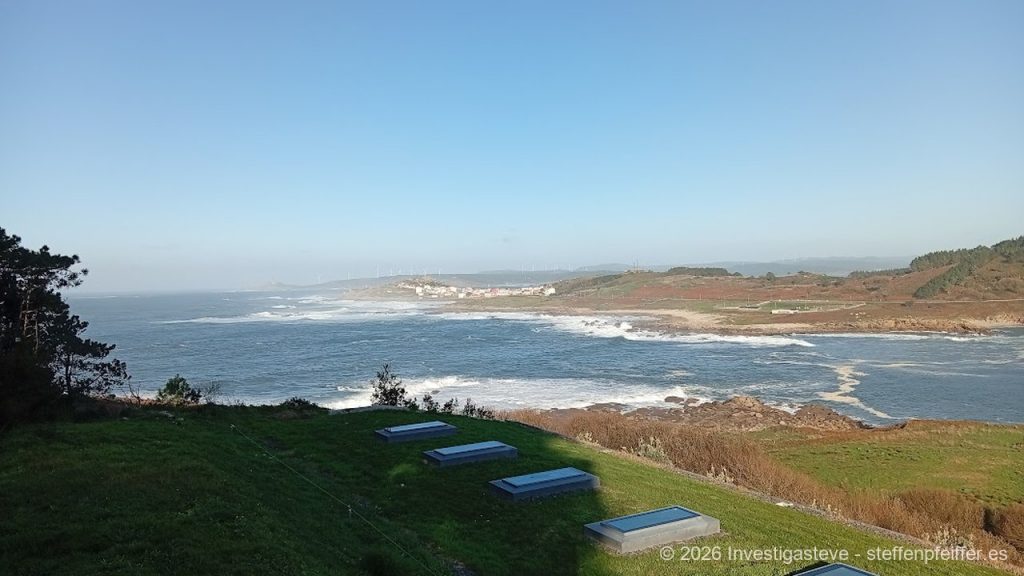
There are moments on the Camino when the world doesn’t simply end, but transitions into a completely new, almost incomprehensible dimension. As you approach Muxía, that narrow finger of granite pushing defiantly into the raging white of the Atlantic, you feel it first in your lungs. The air here is heavier than in the hills of Galicia; it is saturated with the finest sea dust, a salty spray that settles like an invisible film on your skin and your lips. It is the taste of freedom, but also that of an inexorable primordial force. Muxía doesn’t welcome you with the gentle ringing of bells like Santiago, but with the orchestral growl of the surf hammering against the rocks of the Costa da Morte – a deep, vibrating bass that you perceive less with your ears and more with your diaphragm.
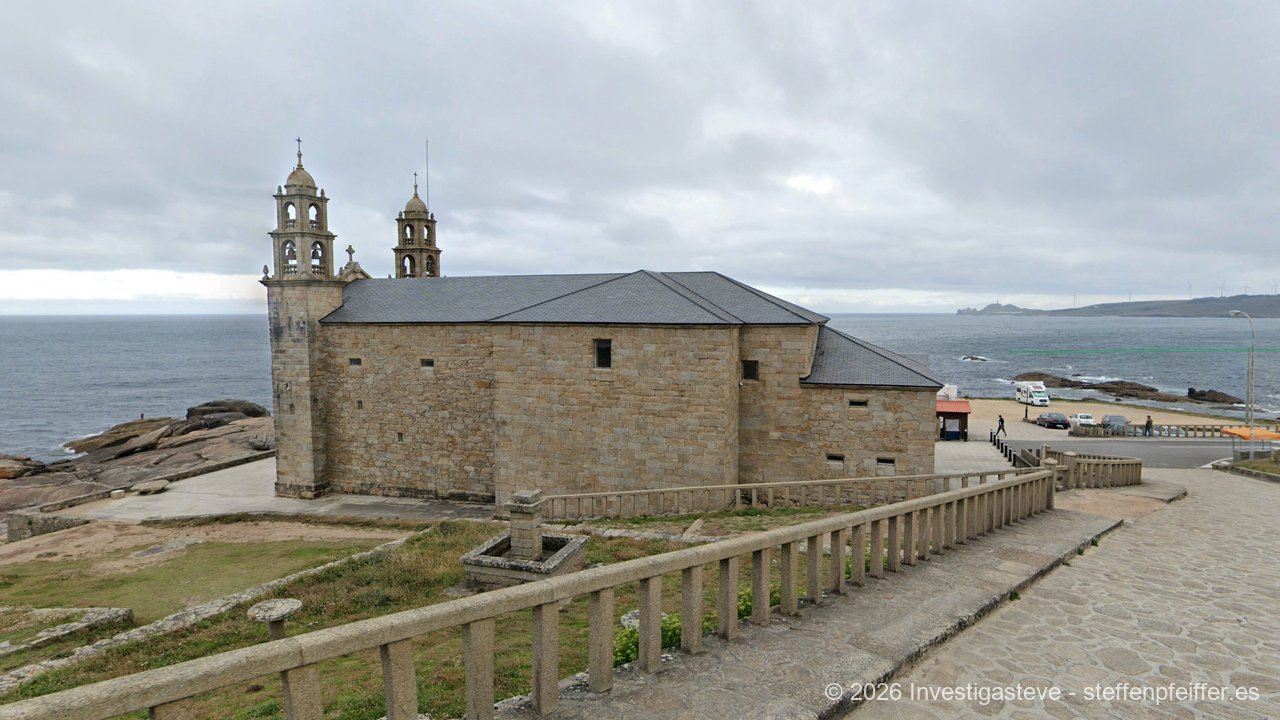
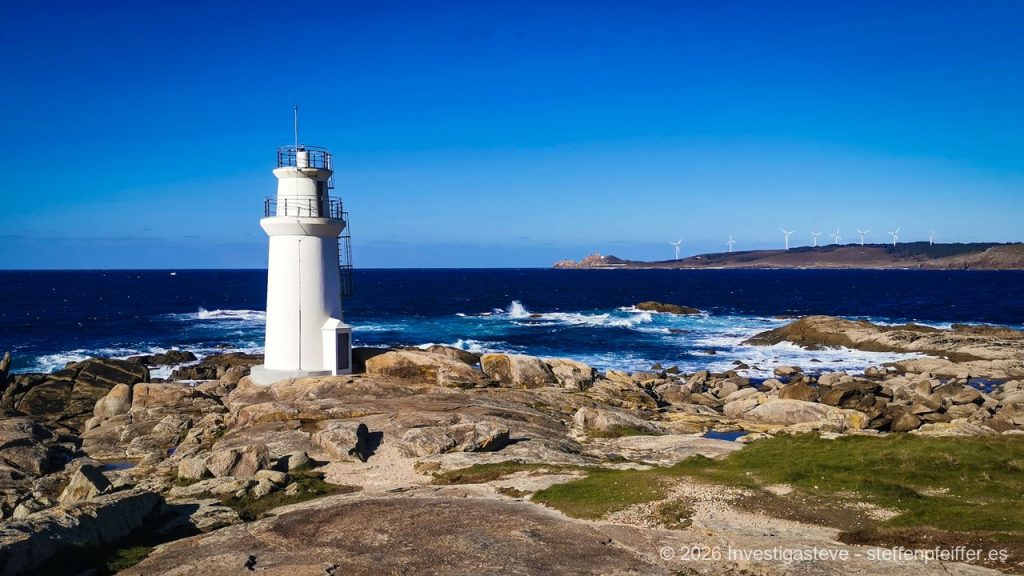
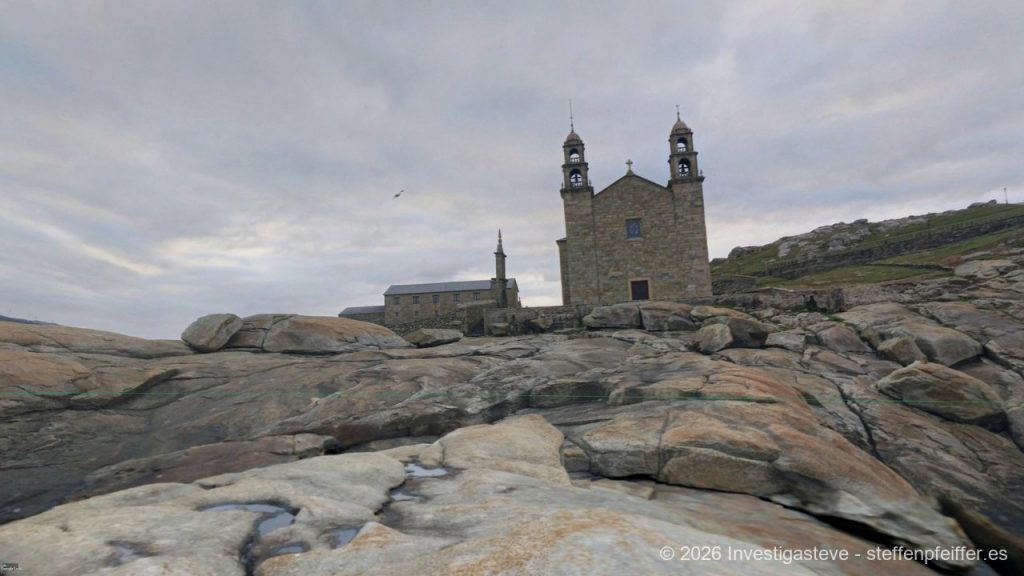
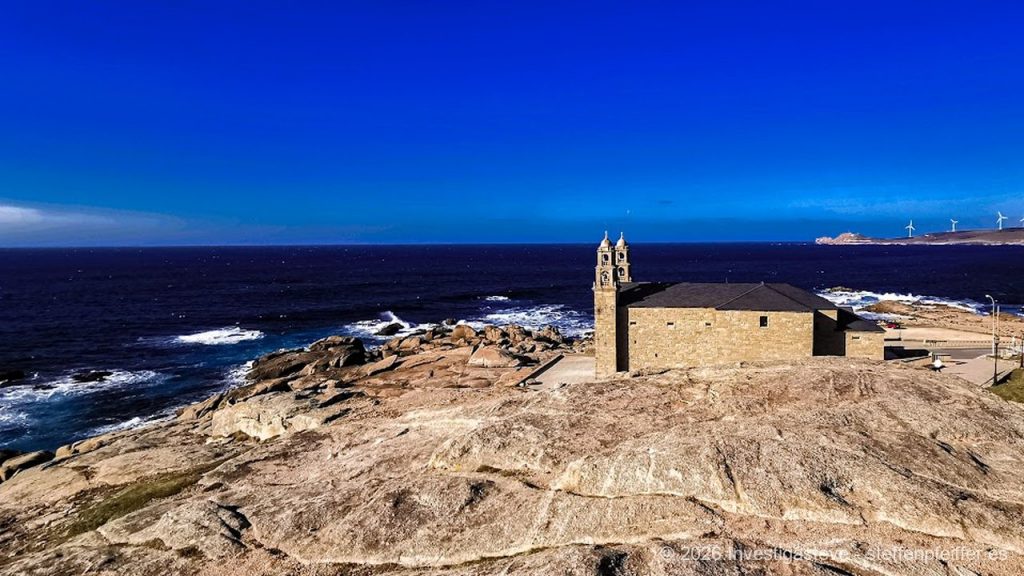
As soon as you cover the last few meters through the narrow alleys of the port town and step out onto the open headland, the Punta da Barca, not only does your view expand, but your entire soul. Here in front, where the land seems to shatter beneath your feet, stands the Santuario Virxe da Barca, a lonely guardian of stone that has faced the ocean for centuries. The light up here has a clarity that can be almost painfully beautiful; when the sun stands low over the horizon, the Atlantic transforms into a surface of liquid silver, while the huge granite blocks in front of the church glow in a warm ochre. You stand in a place that feels as if it had been carved directly from the myths of the Celts and the prayers of the first Christians. It is a place of extreme contrasts: The fragile silence inside the sanctuary meets the brute loudness of nature right on the doorstep. Arriving here means exchanging the rhythm of walking for the rhythm of the waves and understanding that you have not arrived at an end, but at a beginning – the beginning of a deep, inner peace.
What This Place Tells Us
The history of Muxía and the Virxe da Barca is so deeply interwoven with the granite of the coast that you can hardly separate one from the other. We are standing here on the ground of one of Christendom’s oldest legends, which at the same time builds a bridge into the distant, megalithic past. Tradition tells us that the Apostle James, exhausted and discouraged by his arduous work of conversion in Hispania, sat right here on the cliffs, looking out to sea. In his deepest despair, the Virgin Mary appeared to him in a stone boat, steered by angels, to give him new courage. This apparition is the spiritual anchor point of Muxía. But anyone looking at the huge, smoothly polished rock slabs in front of the church quickly realizes that this land was sacred terrain long before James. The “Pedras da Barca” – the stones of the ship – are far more than geological formations; for the people here, they are the petrified remains of that celestial vehicle: The sail, the mast, and the hull, anchored forever in the Galician rock.
The Santuario itself, in its current baroque form mainly dating from the 18th century, is a testimony to unshakeable faith in the midst of a hostile environment. The church was damaged several times by the force of nature, but the heaviest blow hit it on Christmas morning 2013, when a lightning strike triggered a devastating fire that completely destroyed the magnificent chancel and the roof. The grief of the inhabitants of Muxía was boundless at the time, but with an almost defiant determination, the sanctuary was rebuilt. When you step through the portal today, it smells of fresh stone and the faint note of incense, mixed with the permanent saltiness of the sea air. The simplicity of the interior directs your gaze to the essentials and brings the legend of the Virgin who watches over the seafarers to life. Everywhere in the church, you’ll find votive offerings – small ship models hanging from the ceiling, telling of the deep gratitude of those who escaped the storms of the Costa da Morte.
Muxía itself, whose name probably derives from the Latin “Monachia,” was for centuries a strategically important post under the rule of the powerful monastery of San Xulián de Moraime. It was a place of fishermen, whalers, and pilgrims who already knew in the Middle Ages that Santiago was only one half of the journey. The town breathes a harsh, maritime history; the houses in the old core are built close together to provide each other with shelter from the wind, and their facades are often coated with a protective salt patina. Whoever wanders through Muxía encounters history not in museums, but in the faces of the people and in the way they constantly direct their gaze towards the horizon. It is a place that has learned to live with death – the “Costa da Morte” – by celebrating life and the protection of the Virgin all the more passionately. This duality of Christian devotion and ancient nature worship makes up the DNA of Muxía and makes every visitor feel that they are standing here at a portal between worlds.

Camino Distances
The following distances refer to the stage of the Camino Fisterra y Muxía (CFM 3b and the transition to CFM 4):
| Previous Location | Distance (km) | Next Location | Distance (km) |
|---|---|---|---|
| Os Muiños | approx. 6.3 km | Santuario Virxe da Barca | approx. 1.2 km |
| Muxía (town center) | approx. 1.2 km | Xurarantes (direction Fisterra) | approx. 3.5 km |
Addresses & tips in Muxía
Opening hours
Opening hours
Opening hours
Opening hours
Opening hours
Opening hours
Opening hours
Opening hours
Accommodation & Arrival
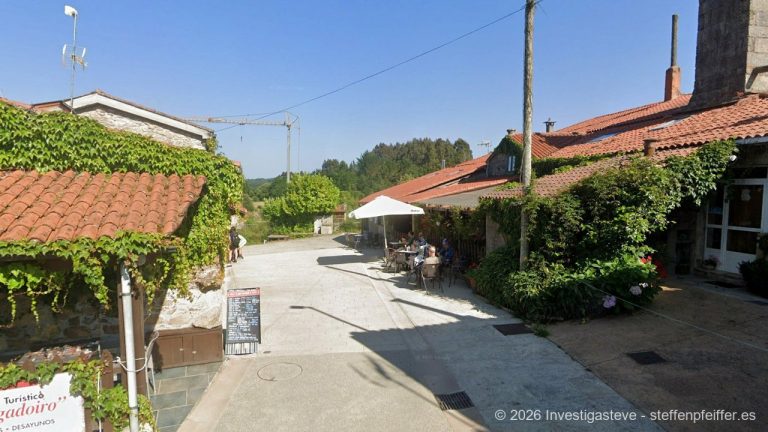
Arriving in Muxía marks a deep psychological turning point on the pilgrimage. While you are often swept along by the masses in Santiago, Muxía allows for an individual, almost private finale. When you take the last bend before the port, the panorama opens up onto the pier, and the feeling of truly being “at the destination” manifests itself with every step on the hard pavement. The infrastructure for pilgrims here is excellent and has become highly professionalized in recent years, without losing its family charm. There is a variety of hostels, both public and private, often offering direct views of the sea. Arriving in such a hostel, putting your heavy backpack in the corner, and swapping your hiking boots for flip-flops for the first time is a ritual act of liberation.
The public hostels in Muxía are often characterized by modern, functional architecture that lets in a lot of light and air – a stark contrast to the often dark, medieval accommodations on the Camino Francés. Those seeking more privacy will find shelter in the numerous small guesthouses and “Casas Rurales” in the town center. Many of these accommodations are housed in old fishermen’s houses, whose wooden floorboards creak underfoot and breathe the history of generations of seafarers. It is advisable to book in advance, especially in the summer months, as Muxía is becoming increasingly popular as an endpoint, and spots with a view of the sunset are highly coveted.
A special quality of staying overnight in Muxía is the acoustic backdrop. At night, when the village comes to rest, the ocean takes over. The rhythmic rushing of the waves acts like a natural sleeping pill, gently washing away the hardships of the past weeks. Many pilgrims choose Muxía as a place for a two-day stay to let the “Muxía stillness” take effect before continuing their way to Fisterra or starting their journey home. It is a place that invites you to stop time, to let your laundry dry in the salty sea breeze, and to simply sit and be.
The social fabric in the hostels of Muxía is often characterized by a deep, almost silent connection. People often know each other from the previous stages, but here, at the destination, words fall away. A shared glass of wine in the evening, looking at the incoming fishing boats – arriving here is not a loud celebration, but a quiet understanding of what you have accomplished. An atmosphere of relief prevails in the “Albergues,” which is almost tangible. You feel that everyone has brought their own story in their backpack, which may finally be unpacked here, on this last rock of Galicia.
Food & Drink
Eating in Muxía means signing a declaration of love to the Atlantic. The gastronomy of this place is radically honest and inseparably linked to the daily catch of the fishermen. When you sit on the harbor promenade at lunchtime, you can watch the boats unloading their cargo – boxes full of glittering sardines, massive stone bass, and the coveted “Percebes” (goose barnacles), which are harvested from the surf cliffs at the risk of their lives. There are hardly any places in the world where seafood arrives fresher on the table. An absolute must is the “Caldeirada de Peixe,” a traditional fish stew prepared with potatoes, onions, and a strong pinch of Pimentón (paprika powder). The flesh of the fish is firm and juicy, the sauce literally demands to be soaked up to the last drop with a piece of coarse Galician bread.
Besides the treasures of the sea, Muxía also offers the classic delicacies of Galician cuisine. Those who have a need for something hearty after weeks of hiking should try the “Pulpo á Feira.” The octopus is cooked to be meltingly tender in large copper kettles and served on wooden plates with olive oil and coarse sea salt. A young Ribeiro wine, often served in the typical white ceramic bowls (Cuncas), goes excellently with it. The wine is sparkling, slightly acidic, and perfectly neutralizes the richness of the oil. For a sweet finish, there is the “Tarta de Muxía,” a local variation of almond cake, often refined with a dash of Orujo, the Galician pomace brandy.
The food culture in Muxía is unpretentious. You often sit at simple wooden tables, the cutlery is functional, but the taste is fit for a king. In the bars around the port, you meet the fishermen who sit together after their shift over a “Café Solo” or a small “Caña” (beer). It is an authentic atmosphere in which the pilgrim is not perceived as a foreign body, but as a welcome guest for a time. It is this down-to-earthness that makes eating here a holistic experience: You taste the wind, the salt, and the hard work that goes into every dish. If you dare, ask for “Longueiróns” – razor clams prepared on the grill with garlic and parsley, whose aroma represents an essence of the Costa da Morte.
Supplies & Logistics
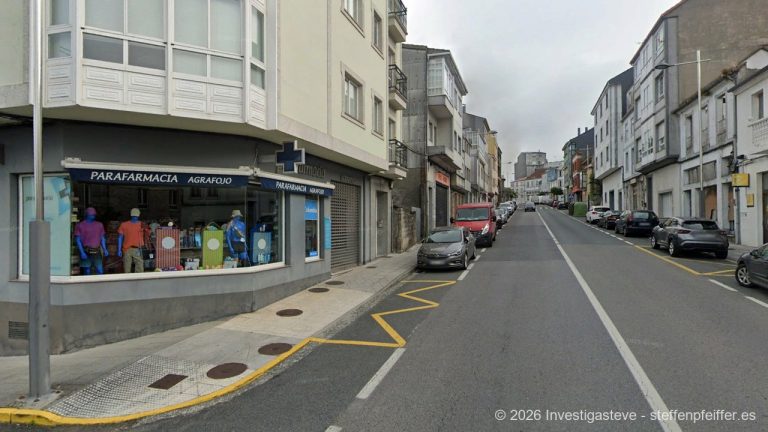
Logistically speaking, Muxía is an excellently equipped base that offers everything the pilgrim’s heart desires and the tired body needs. In contrast to the smaller hamlets on the way there, Muxía has several supermarkets, small grocery stores, and a well-stocked pharmacy right in the center. Those who need to supplement or replace their equipment – after 800 kilometers, socks or hiking poles often give up the ghost – will find solid basic goods in the local shops. There are also several ATMs and a post office, which is particularly important for those who want to send souvenirs home or organize their luggage for the return flight.
The public transport connections are surprisingly good for a place on the edge of Europe. There are regular bus connections to Santiago de Compostela and A Coruña, making Muxía an ideal place to finish the journey. Many pilgrims use the bus to return to Santiago after their stay in Muxía and from there start their flight home. There are also taxi services specifically tailored to the needs of pilgrims – be it for backpack transport to the next stage to Lires or for transfer to the airport. The tourist information office at the port is a valuable point of contact; here you can get not only city maps but also the coveted “Muxiana,” the official certificate documenting the pilgrimage to Muxía.
Shopping: Several medium-sized supermarkets (e.g., Eroski or local markets) offer a full selection of food and drugstore items. There are also specialized shops for fishing supplies and local handicrafts, especially the famous bobbin lace (Encaje de Muxía).
Gastronomy: The selection ranges from affordable pilgrim menus in hostels to upscale fish restaurants on the harbor front. Numerous bars offer coffee and “Tostadas” (toasted bread) from early morning onwards.
Accommodation: A high density of beds in public and private hostels, hotels, and vacation rentals covers every budget. The quality is consistently high, often with modern standards.
Public Facilities: A medical center (Centro de Saúde) is available for emergencies. There is a library with internet access and public laundromats, which are a blessing, especially in bad weather.
In summary, it can be said that despite its exposed location on the Atlantic, Muxía is a place where you don’t have to worry about the practical things in life. Everything is within walking distance, conserving the pilgrim’s typical radius of movement. The logistics here are designed to make the transition from “being on the road” to “arriving” as smooth as possible for the hiker.
Don’t Miss
The Pedras da Barca: Try to find the “Balancing Stone” (Pedra de Abalar) – according to legend, it only moves for those who are pure of heart.
The Sunset at the Santuario: There is no more dramatic place in all of Galicia to watch the sun sink into the Atlantic while the spray foams around the rocks.
The Monument “A Ferida”: A gigantic, split granite block above the church that commemorates the oil spill of the “Prestige” and symbolizes the vulnerability of nature.
The Ascent to Monte do Facho: From up here, you have the ultimate 360-degree view over Muxía, the Ría, and the endless blue of the ocean – a place for absolute stillness.
The Monastery of San Xulián de Moraime: Located just a few kilometers before Muxía, this Romanesque gem with its fantastic portals is a must for anyone interested in culture.
The Fish Auction (Lonja): If you have the opportunity, watch the busy activity at the port when the fresh catch is auctioned off amidst loud shouting – a piece of real Galicia.
The Chapel of San Roque: A small, fine chapel in the upper part of the town, often overlooked but radiating a wonderful tranquility.
Secret Tips and Hidden Places
Away from the large pilgrim streams, which mostly move directly to the Santuario, Muxía hides corners of almost eerie beauty. One of these places is the town’s small cemetery, which nestles against the slope in terraces. Here the dead lie with a view of the sea – an image of such melancholic aesthetics that you inevitably reflect on transience. The white grave houses glow in contrast to the deep blue of the water, and the constant wind carries the prayers of the bereaved directly out to the ocean. It is a place of deep respect and silence, where you understand what it means to live on a coast that has taken sailors for generations and given legends in return.
Another secret tip is the “Paseo Fluvial” along the small river that flows into the harbor basin. While the coast is rough and stony, you’ll find a green refuge here with lush vegetation and small, old bridges. It’s a wonderful retreat when the wind lashes too strongly at the cape and you want to feel the gentle side of Galicia for a moment. Here you hear the chirping of birds instead of the growl of the surf, and the air smells of ferns and damp earth. If you follow the paths further, you come to small, hidden swimming spots that are barely visited even in high summer and whose crystal-clear, albeit ice-cold, water invites you to refresh yourself.
Muxía is particularly magical in the early morning hours, even before the first pilgrims leave their hostels. When the “Brétema” – the typical Galician coastal fog – lies over the place like a white sheet and the outlines of the church are only vaguely recognizable, the Santuario looks like a ghost ship. In these moments, when only the distant foghorn of a ship can be heard, you feel the spiritual power of this place most intensely. It is as if time were completely suspended, and you could expect at any moment that the stone boat of the Virgin might actually emerge from the fog.
For culinary explorers, in the side streets away from the promenade, there are tiny bars that have no menu. Here you eat whatever the mother of the house has cooked – often this is “Chinchos” (small fried fish) or a simple “Caldo Gallego” (Galician cabbage stew). These places are the true treasure troves of hospitality. You sit on wobbly stools, communicate with the locals using gestures and a few words, and learn stories about the sea that are not in any travel guide. It is this unfiltered encounter that makes Muxía a place that burns itself deeply into your heart.
A Moment of Reflection
Legend has it that the Virgin Mary appeared to the Apostle James around 40 AD on the Galician coast in Muxía to encourage him during his arduous missionary work. At that time, according to tradition, James was physically present as a living missionary in Spain, while Mary – who was also still alive at the time – performed the miracle of bilocation to travel to him in a stone boat (the “Barca”). This narrative served in the Middle Ages to extend the Way of St. James beyond Santiago de Compostela to the “Costa da Morte.” In doing so, the Church used the strategy of Interpretatio Christiana: Pre-Christian, Celtic cult sites and striking rock formations in Muxía were simply reinterpreted as the remains of Mary’s stone boat in order to solidify the transition from paganism to Christianity.
As you now sit on the Pedras da Barca, with your feet above the abyss, and watch the tireless waves crash against the granite, a question inevitably arises: What remains with you from this journey? Muxía is the place of the great decompression phase. The destination of Santiago is days behind you, the hustle and bustle of the city has faded, and here, on the outermost edge of the continent, there is no more “further west” in the geographical sense. Except southwards, where you will then encounter the end of the world in Fisterra, with its sun altar, the Ara Solis. In the church of Santa Maria das Areas, you will find the Christ with the golden beard (Santo Cristo con Barba Dorada). So before your further march to the end, which simultaneously means turning back, you are forced to pause. The force of nature here at the front puts every problem you may have carried around in your backpack into perspective. In the face of the Atlantic, our worries become small, almost insignificant. And the redeeming sunset of Fisterra is still 30 kilometers away.
Historically, the so-called Breviarium Apostolorum from the late 6th or early 7th century was the decisive “stroke of luck” and a foundation for the later establishment of the cult. This text provided the theoretical blueprint by explicitly assigning a mission field in Spain to James for the first time. Particularly significant was the later linguistic reinterpretation of the term “Marmarica”: What originally designated a region in Libya was interpreted by Galician clerics as Arca Marmorica (marble sarcophagus). This theological groundwork made it possible that the discovery of a Roman tomb in the Libredón forest by the hermit or shepherd Pelayo living there around 813 AD could be credibly attributed to the Apostle James.
The literary embellishment and elaboration of the James legend reached its peak in the 12th century with the Codex Calixtinus. Here, figures like the pagan Queen Lupa appeared, who stands as a symbol for wild, untamed Galicia and whose orally transmitted stories and myths were only merged with the Christian narrative in the High Middle Ages. The conflict with the Roman governor in Duio (near Fisterra) also belongs in this context of later historiography. While Fisterra was considered the physical end of the world and place of death (sunset), Muxía was stylized by the Marian apparition as the place of divine hope and spiritual new beginning, which massively promoted the stream of pilgrims to both places and simultaneously resulted in a rivalry within the clergy with Santiago de Compostela. You will find more on this in the location description of Fisterra and its lighthouse (Faro de Fisterra).
Although James’ mission, according to legend, took place shortly after Christ’s Ascension, his figure had its greatest political impact over 1400 years later. During the Reconquista, the reconquest of Spain from the Moors, James was reinterpreted as “Santiago Matamoros” (Moor-slayer) and served as a powerful military motivational symbol for the Christian armies. Thus, the circle closes from an early, rather spiritual legend of encouragement in Muxía to the harsh political reality of the fall of Granada in 1492. The legend is thus a fascinating product of centuries of projections, combining ancient Celtic roots with medieval power claims.
The clerical power struggle from the time between Santiago and Fisterra also had far-reaching consequences for Muxía, as the small coastal town was almost completely overshadowed by the large centers in the course of these centralization efforts. While Santiago consolidated its supremacy, the Reformation and the devastating consequences of the Thirty Years’ War caused the international stream of pilgrims to collapse massively.
In a Europe that was bleeding out after decades of religious fanaticism and warlike exhaustion, the focus lay on re-civilization and the painstaking reconstruction of state order, rather than on peripheral miracle narratives on the Galician coast. This explains historically why the specific legend of the Marian apparition in Muxía experienced a renaissance only in the 19th and 20th centuries after a long period of silence. Only in this modern era, shaped by a new search for regional identity and the rediscovery of the Way of St. James as a cultural heritage, was the narrative of the stone boat re-incorporated more strongly into official memory and literature.
And just as people did back then, in the wake of changing world orders and rediscoveries, such as that of the American double continent, many pilgrims feel a strange form of melancholy here, which, however, is not sad, but clarifying. It is the realization that outer paths may eventually end or simply hit borders, but the inner path is only just beginning to take shape. The Balancing Stone, the Virgin’s Boat – these symbols invite you to reflect on your own life as a journey across stormy seas. Muxía gives you permission to be proud of yourself. You have completed the journey, you have defied the elements, and now you are simply allowed to be part of this immense scenery. It is a moment of absolute presence: Just you, the stone, the wind, and the endless sea.
When you walk away from here, you take a piece of Muxía’s indomitability with you into your everyday life.
Camino of the Stars
This place is located on the Camino Fisterra y Muxía (Stage CFM 3b / End and Beginning of CFM 4). The sequence of locations is:
Olveiroa → Hospital → Dumbría → Trasufre → Senande → Quintáns → Moraime → Os Muiños → Muxía → Xurarantes → Morquintián → A Canosa → Guisamonde → Frixe → Lires → Castrexe → Buxán → San Salvador de Duio → Hermedesuxo → San Martiño de Arriba → Fisterra
Did you experience that moment when the growl of the waves at the Virxe da Barca drowned out your own thoughts? Or did you discover a fish shop in Muxía’s alleys whose aroma you will never forget? Share your story from the “end of the world” with us. Maybe you have a photo of the “Ferida” or a very personal tip for a hostel with a sea view? Your experiences are what truly bring this guide to life for all the pilgrims who follow. Write us a comment!
About the Author