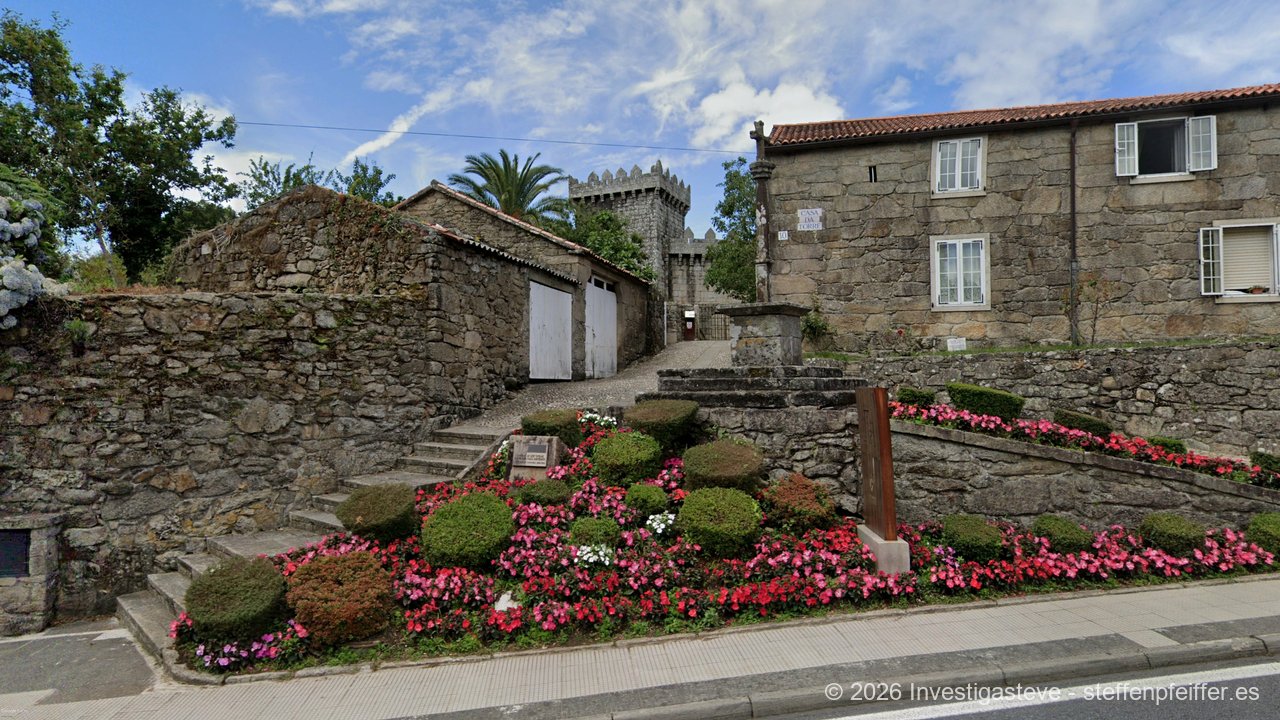
The Costa da Morte, Galicia’s Coast of Death, does not owe its name solely to the raging Atlantic. Anyone seeking the truth behind the Breton mists and granite fortresses will discover that the most dangerous storms raged on dry land, unleashed by men with too much iron in their blood and too many titles in their pockets. The Castelo de Vimianzo, a ring of rock with four towers, is more than just an architectural monument; it is a stone chronicle of human vanity, chronified stupidity, and a feudal farce that is second to none.
When we wander through the walls today, we do not see the cisterns or the arrow slits; instead, we gaze into a grand medieval play. The script is by Shakespeare, the cast is the Galician high aristocracy, and the punchlines all come from the pen of reality – or perhaps from that of the German author Kurt Tucholsky, had these ambitious gentlemen only known him back then.

Of Sirens, Wolves, and the Family Tree Problem
Let us begin with a little lesson in aristocratic etiquette, very much in the style of “National Geographic,” but with a wink. After all, every respectable family needs a founding legend so far removed from reality that it inevitably appears credible. The early owners of Vimianzo, the Mariño de Lobeira, delivered a masterpiece here. Their legend, immortalized in the Nobiliario of the 14th century: the noble line descends from a mermaid named Mariña, whom Count Froilán married away from the seashore. A siren as an ancestral mother! What a delicious aberration! Tucholsky would have applauded: if one must be noble, then please with such fantastic nonsense in the coat of arms. In light of this, the entire subsequent power struggle appears only as ridiculous squabbling among half-fish.
But reality was more prosaic and bloodier. In the late 14th century, after the change of government to Enrique II of Trastámara, the power of the old Traba line disintegrated. It was the moment for hungry upstarts like the Mariño and, above all, the Moscoso. The latter, whose name will accompany us like a dark shadow over the following centuries, wrote their history not with water, but with blood. Their coat of arms speaks volumes: a grey-brown wolf’s head, snarling, severed bloodily at the neck. They were called the “Black Shadow” of the Archbishops of Santiago – and that was not even meant as an exaggerated kindness.
The rise of the Moscoso is a lesson in Galician power politics. It began with Rui Sanches de Moscoso (1402–1456), called “O Bravo” (The Brave) and, somewhat less flatteringly, “O Torto” (The Cross-Eyed or One-Eyed), as he lost an eye in a skirmish. A man who saw more with one eye than all others with two. His goal: to dominate the Terra de Santiago, the vast feudal territory of the Archbishopric.
The Archbishop in the Iron Cage
The confusion of jurisdictions in medieval Galicia was legendary. The Archbishop of Santiago was not only a shepherd of souls but also a powerful feudal lord. In his domain, the “Señorío de Santiago,” not even royal justice was allowed to prosecute serious crimes. For that, there was the “Pertigueiro Maior” (Chief Staff-Bearer), a secular advocate of order, who was, in turn, sworn to the Archbishop.
And whom did the Archbishop appoint as this Chief Staff-Bearer in 1441? Rui Sanches de Moscoso! A mistake that would be bitterly avenged. Rui and his clan used their position to infiltrate the church’s estates.
After Rui Sanches’s death, his son Bernaldo Eáns de Moscoso († 1466) inherited the office and the grudge against the ecclesiastical authority. Bernaldo was the archetype of the daring but violent knight, a man who knew protocol but ignored it whenever it suited him. When the new Archbishop, Alonso II de Fonseca, arrived haughtily in 1464 and denied Bernaldo the lucrative office of Staff-Bearer, all hell broke loose.
What happened next is a climax in the absurdity of European feudalism and a case for the scandal history books: In July 1465, as the chroniclers describe, Bernaldo ambushed the Archbishop in Noia and took him prisoner – “prendiolo por la barba” – seized him by the beard – and abducted him!
The destination of this forced vacation: the dungeons of Vimianzo and Mens. But Bernaldo did not leave it at a simple dungeon. He humiliated the haughty prelate by locking him in an iron cage for a full 28 months and displaying him publicly throughout his lands.
Imagine this: For two years, the Moscoso clan curated a traveling circus attraction whose main act was an imprisoned Archbishop. “The Clergyman in the Can. Admission 5 maravedís!” – which would today correspond to about 30 euro cents and equaled the lower daily wage of a day laborer. “See the high lord pray and wail as he waits for his ransom!”
This incident, attested in detail in the Preito Tavera-Fonseca documents, shows the full splendor and misery of the power relations of the time. The Archbishop, temporarily held captive in a chimney in Vimianzo, in miserable conditions, could only be ransomed for 500 gold dobras – an immense sum, comparable to a present-day “Net Worth” of around 75 million euros or the equivalent of about 4,500,000 maravedís back then. Bernaldo Eáns was no romantic hero, but a brutal extortionist who literally locked away the divine right of his enemies.
His end? This, too, was typically medieval. During the siege of Santiago against the Archbishop’s mother (who, in turn, was trying to ransom her son), Bernaldo, self-assured, removed the chin strap of his helmet. A marksman of the Archbishop’s saw his chance and struck him in the neck with an arrow. Thirty days later, the Wolf of Moscoso was dead. A bullet for the king of crudeness. The moral of the story: Power is fine, but vanity kills.
The Brotherhood of the Wrecking Ball
But before the Moscoso clan could continue their feuds, the Galician people made themselves heard. And not with a polite petition, but with axes and rage. In 1467, the Second Irmandiño Revolt broke out.
The Irmandiños – the “Brothers” – were a motley bunch of peasants, clerics, citizens, and even lower nobles, united by one thing: they were fed up with the tyranny, the raids, the torture, and the endless, arbitrary taxes of the feudal lords. Their battle cry: “¡Abaixo as fortalezas!” – Down with the fortresses!
As historians would emphasize here: this was a revolutionary act of European dimension, 300 years before the storming of the Bastille. Over 130 castles were razed to the ground, including the recently rebuilt fortress of Vimianzo. For two short, glorious years, the “Brotherhood” reigned in Galicia. The great lords, like Lopo Sanches de Moscoso, who had just returned from Castile, hid in monasteries or fled to neighboring realms.
But as so often in history, the joy was short-lived. The revolution devoured its children, or in this case: the feudal counter-reaction devoured the revolutionaries. With the help of Castilian and Portuguese troops, the counts returned, vengeful and well-armed.
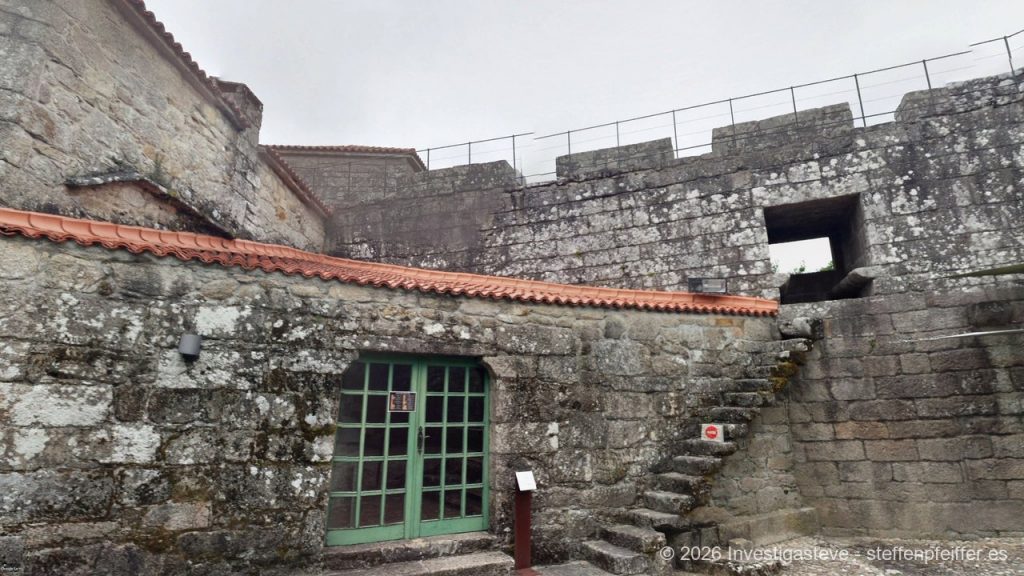
The irony of fate, which a Kurt Tucholsky would have had to describe in his most caustic form, manifested itself in the punishment: the defeated rebels were forced to rebuild the fortresses they had destroyed! Two to three days a week they had to perform forced labor, bring their own carts and oxen, and on top of that, shell out two reales (approx. 30 maravedís) to pay the construction supervisors. A cynical architectural monument of oppression: the Castle of Vimianzo, rebuilt with the sweat and fury of those who had torn it down.

The Escape into Title Inflation
After this episode of national unity (in resistance against the authorities), the Moscoso learned their lesson: Galicia was too restless. It was wiser to live at the court of the Catholic Monarchs in Castile, where one collected titles instead of dealing with rebellious peasants and arrogant archbishops. Rodrigo Osorio de Moscoso, the II Count of Altamira (the name of the ancestral seat, which was near Brión), was the first to take this path.
Satirists of the modern age would have called him an idealistic fool: the “last medieval knight,” of good stature, talented in music and poetry (his name appears in the Cancionero General of 1511), but dissatisfied with the “façer façañas” (performing deeds) of the time. He yearned for adventure and found death in 1510 in North Africa, not heroically in battle against Moors, but “in a stupid way” through an accident, when a squire’s arrow struck him in the leg. An undignified end for a Quixote who lagged far behind his time.
From then on, the great absence began. The Counts of Altamira became “Grandes de España” and accumulated titles until the XIII Count, Vicente Pío Osorio de Moscoso y Ponce de León, in the 19th century, was thirteen times a Grande de España and possessed countless duchies, marquisates, and counties. An impressive list that proves that in the Spanish nobility, the main thing was to make the list of one’s own possessions longer than the neighbor’s.
While the Count flaunted his splendor and hoarded titles in Madrid, Vimianzo was left behind. It was ruled by meiriños (administrators) and alcaides (castellans).
The Burdens of the Serf (The “National Geographic” Detail of Cruelty)
The documents from this time – true finds for historical research – reveal the full brutality of manorial rule. They show how the feudal lords, absent in their Spanish splendor, bled their Galician estates dry, down to the shirt.
- The Hunting Obligation: The vassals had to “run and hunt” to the wolf hunt. Anyone who did not slay a wolf still had to pay a one-year-old wether or one and a half reales. A clear case of risk redistribution: the adventure for the peasant, the levy for the count.
- The “Luctuosa” (Death Tax): The cruelest tribute. When the head of the family died, the family had to give the count “la mejor cosa de cuatro pies que tuviere el difunto” – the best four-legged animal the deceased possessed, be it the best cow, the best ox, or the best horse. Chroniclers would have dropped their quills here, for such cruelty surpasses any satire. The widows were left ruined.
- The Construction Obligation: The peasants had to maintain the dungeons, the bridge, and the mill of the fortress. They delivered wood, stones, carts, and oxen. In return, they were exempted from “carcelaxe” (dungeon fees), should they themselves ever be imprisoned in the castle. What a deal! You build your own prison in order to live there free of charge in case of incarceration. At least no rent for lodgings was due in the event of imprisonment. As for the board – well, let us content ourselves with knowing. One wouldn’t want to give modern-day officials any foolish ideas.
Vimianzo was thus not only a center of administration and jurisdiction but also a place of permanent extortion. The meiriños went around, took prisoners, collected taxes, and under the protection of the thick walls, the justice of the lords took place, or what was understood as such back then – a parody of law and order. And similarities to present-day presidents are entirely coincidental.
The Last Act: The Banner of Freedom and the Shot of History
The castle changed ownership in 1870 when it was sold to the Martelo family. The new owner, Evaristo Martelo Paumán del Nero, was a romantic, anachronistic poet who transfigured the medieval Gothic ideal and, by means of poetry, wrote his own family into the ancestral line of the Moscoso. A touching attempt to lend heroic dignity to a profane present.
But history still had a finale in store that was far more tragic than any feud between nobles. In 1936, shortly after the military coup that led to the Civil War, the town council of Vimianzo decided to symbolically “conquer” the castle. On July 22, 1936, a crowd, led by Mayor José Alborés Gándara, stormed the towers and hoisted four flags: the republican, the socialist, the communist, and that of the UGT.
It was a bloodless, symbolic act of liberation from the old tyranny. The consequences, however, were terrible. Franco’s troops came, took down the flags, and sentenced the leaders to death or a long flight through the mountains for “subversive activities.”
Thus ended the story of Vimianzo Castle: not with the glorious victory of a knight or the cunning of a count, but with the courageous yet tragic protest of ordinary people whose only crime was to seek freedom under old walls. The fortress that once served as a dungeon for an archbishop became the scene of the last, bloody uprising against authoritarian power.
Today, the Castelo de Vimianzo serves as a peaceful place of culture and remembrance. It is a museum where one can admire bobbin lace and craftsmanship. A gentle conclusion to a history marked by wolves, archbishops, mermaids, and the eternal squabble over power and privilege. The German author Kurt Tucholsky would probably have said: The rage and greed of the powerful pass away, but stupidity remains – and the people must always clear away the rubble.
About the Author