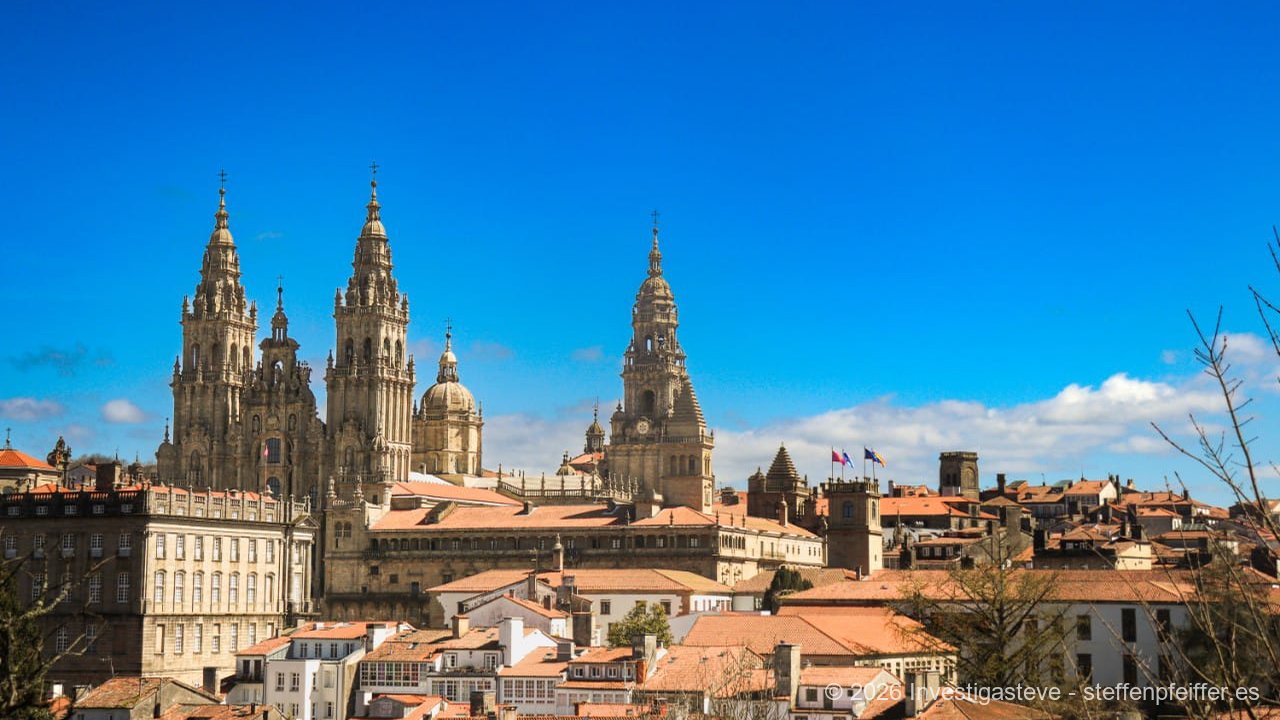
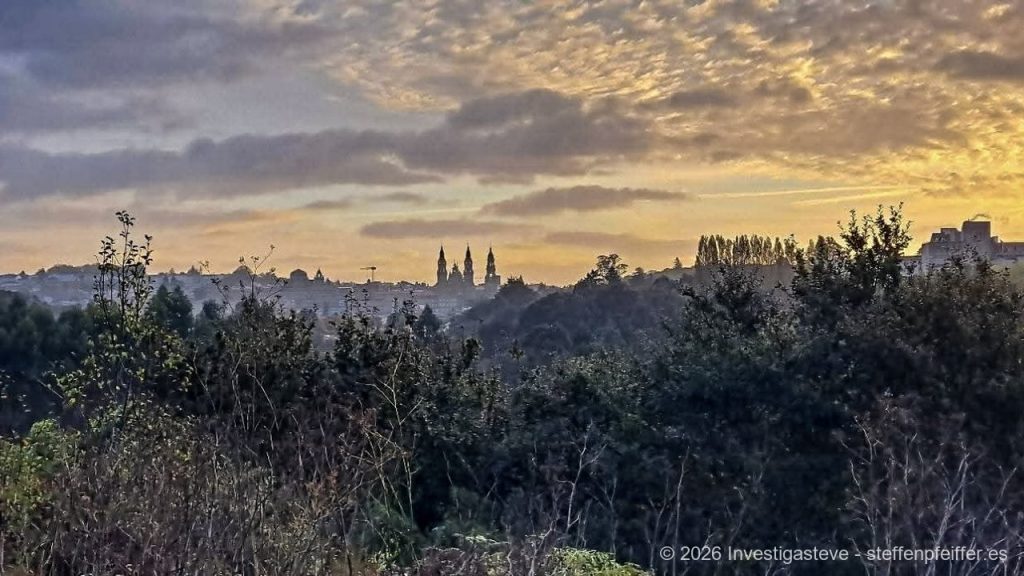
You stand on Monte do Gozo, the “Mount of Joy,” and in this moment, the world seems to stand still for a heartbeat. Below you, nestled into the gentle, mist-shrouded green of the Galician hills, rise the towers of the Cathedral of Santiago de Compostela. After hundreds of kilometers, after the heat of the Meseta, the downpours of the Montes de Oca, and the steep ascents of the Galician mountains, there it lies before you: the goal of all longings. The sight of the city is a deeply emotional moment for every pilgrim, transforming physical exhaustion into an almost surreal lightness. It is the moment when the destination is no longer just an idea on a map but a tangible reality made of granite and history.
The descent from Monte do Gozo is no longer mere walking; it is a gliding into the fulfillment of a promise. While your boots maintain their familiar rhythm on the asphalt, the atmosphere around you changes. The solitude of the rural paths gives way to the pulsating life of a city that has lived on the breath of seekers for over a thousand years. You smell the scent of damp stone, the distant aroma of grilled octopus, and that very special, salty breeze that drifts over from the nearby Atlantic, announcing the end of the European continent. Santiago does not welcome you with loud clamor but with a dignified, almost melancholic grandeur that sits deep in the pores of the grey walls.
Every step through the suburbs feels like leafing through the last pages of a thick book. Anticipation mixes with a gentle melancholy, because you know: with every meter that brings you closer to the Praza do Obradoiro, the chapter of your journey is ending. The city is a gigantic archive of prayers, sighs, and tears of joy, chiseled into the hard Galician granite. Here, at the end of the way, you are no longer just a walker; you become part of an infinite procession that transcends time and space.
The Psychological Transition: San Lázaro and the Entry into the City
The district of San Lázaro marks the official, urban beginning of Santiago de Compostela for the pilgrim on the Camino Francés. It is a place of transition that played an essential role in history. Here, far from the gates of the medieval city wall, once stood the Leprosarium, the leper Hospital. It was the place of cleansing and the social boundary. Today, San Lázaro is a modern neighborhood that has, nevertheless, preserved its historical DNA. When you enter the Rúa de San Lázaro, you feel the contrast between the functional architecture of the present and the spiritual weight of the past.
The small Chapel of San Lázaro, dedicated to Saint Lazarus, stands as a silent witness by the wayside. It reminds us that the way to Santiago was always a path of healing—physical as well as spiritual. For the modern pilgrim, this area offers a first opportunity to pause and switch “modes.” The wide fields of Galicia now lie definitively behind you, and the city begins to close in around you. It is a phase of recalibration: your gaze widens from the narrow trail to the broad streets of civilization, while your heart focuses ever more tightly on the point where the cathedral waits.
The passage through As Fontiñas leads you further into the urban fabric. Here, Santiago shows its everyday side. Laundry hangs on balconies, people hurry to work, children play in the squares. This contrast is important—it grounds the pilgrim. It reminds us that the sacred exists in the midst of the profane. The city is not a museum; it is a living organism that has integrated the Camino as its main artery. As you walk through these neighborhoods, you become part of the normal cityscape; the locals offer you a knowing smile or a brief “¡Buen Camino!” which here has a completely different, deeper meaning than anywhere else along the route.
Through the Veins of the Old Town: Rúa dos Concheiros and Porta do Camiño
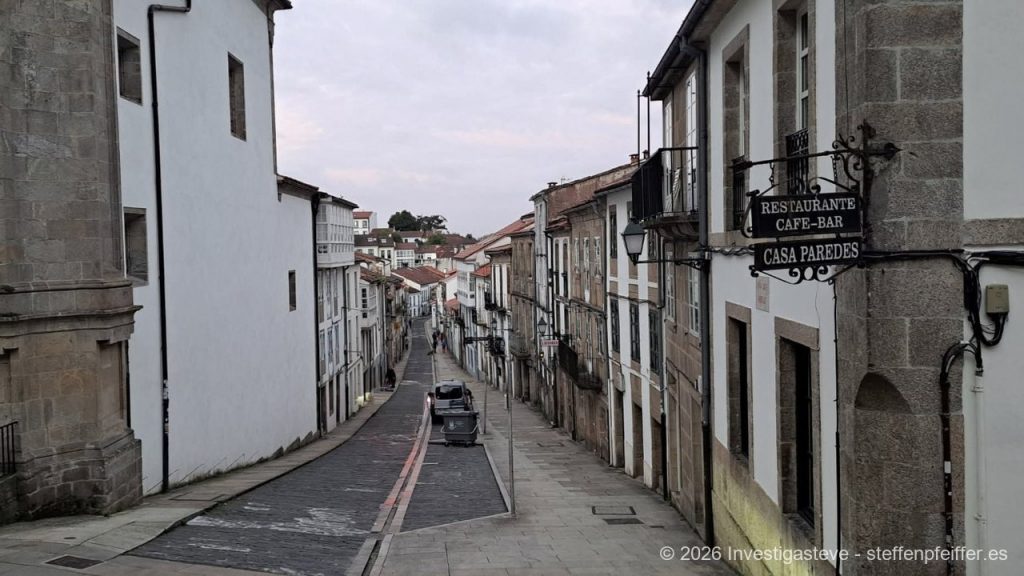
After you have crossed the modern districts, you reach the Rúa dos Concheiros. The name tells its story: this is where the sellers of scallop shells (Conchas) settled in the Middle Ages. It was the place where the pilgrim acquired his official badge, the sign that he had reached his goal. Even today, you can feel the spirit of trade and anticipation here. The street leads slightly uphill, as if it wants to challenge you one more time before releasing you into the bosom of the old town. The facades become older, the alleyways narrower, and the echo of your footsteps on the cobblestones begins to tell the stories of centuries past.
At the end of the Rúa dos Concheiros, you reach the Porta do Camiño, the historic gate through which the Camino Francés has entered the fortified city since time immemorial. Even though the physical city wall has largely disappeared, the boundary here is atmospherically absolutely tangible. As soon as you cross this point, you are in the UNESCO World Heritage Site. Time seems to slow down. The Rúa das Casas Reais welcomes you with its stately buildings and leads you deeper into the labyrinth of granite.
You pass the Praza de Cervantes, a square that was once the administrative center of the city. Proclamations were read and markets were held here. Today, the cafés under the arcades invite you for a final rest, but the magnetic pull of the cathedral is now so strong that most pilgrims move on without stopping. The Rúa da Acibechería finally leads you directly to the north side of the cathedral. The name recalls the “Azabacheros,” the artisans who crafted jewelry from jet (black amber)—another traditional craft inextricably linked to the Way of St. James.
The Cathedral of Santiago – Monument of Faith and Art
And then the space opens up. You step onto the Praza do Obradoiro, and the sheer monumentality of the cathedral’s western facade nearly overwhelms you. It is a forest of stone, a Baroque masterpiece that soars into the sky. The Cathedral of Santiago de Compostela is not just a building; it is a stone theology. Its construction began in 1075 under Bishop Diego Peláez and continued for centuries, resulting in a fascinating mix of Romanesque, Gothic, and Baroque.
The heart of the Romanesque church is the Pórtico de la Gloria, created by Master Mateo in the 12th century. This portico with its more than 200 sculptures is considered one of the most significant treasures of Christian art. The prophets, apostles, and the central figure of Christ enthroned welcome the pilgrim with a vividness that is unparalleled in stone. It was once tradition to place your fingers in the indentations of the central column, which represents the family tree of Jesus—millions of hands have carved deep hollows into the hard granite over the centuries, a silent testimony to the continuity of faith.
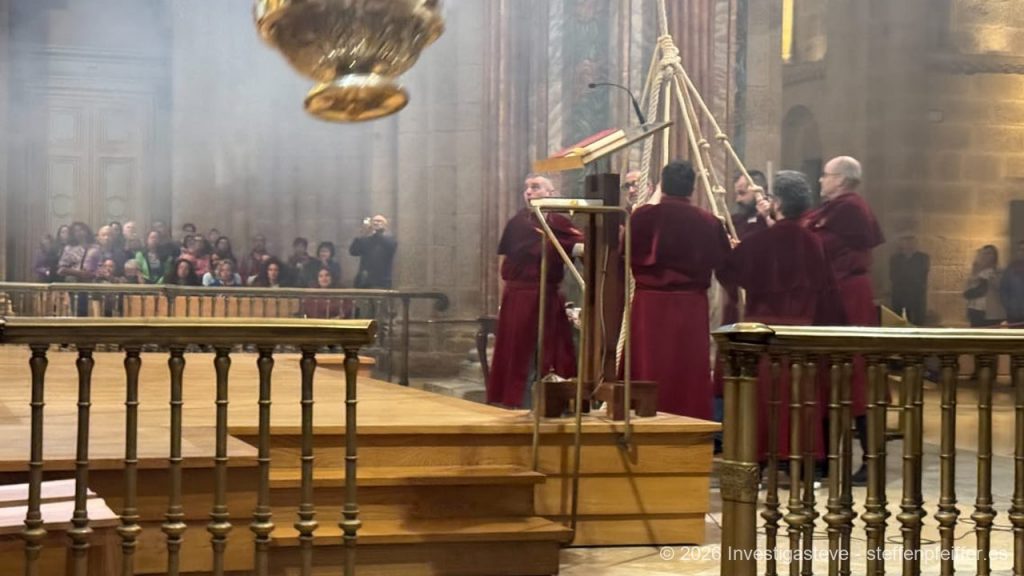
Inside the cathedral, there is a very special silence that even the streams of tourists cannot entirely break. The path inevitably leads you to the high altar, under which, in the crypt, lies the silver shrine with the relics of the Apostle James. Embracing the gilded statue of Saint James behind the altar is the ritual highlight for many pilgrims—a moment of closeness and gratitude. When you then return to the central nave and perhaps have the luck to witness the Botafumeiro in action, the emotional overwhelm is complete. The huge thurible, which swings on thick ropes through the transept at breathtaking speed, once not only purified the air of the exhalations of unwashed crowds of pilgrims but symbolizes to this day the rising of prayers to heaven.
The Squares of the City: A Stage of Granite
Santiago defines itself through its squares, each of which has a character all its own. The Praza do Obradoiro is the place of triumph. Here, pilgrims lie on their backs, stare into the sky, and let the burden of the last weeks slide from their shoulders. The square is surrounded by buildings that reflect the power claims of church and state: the Pazo de Raxoi (the town hall), the Colegio de San Xerónimo, and the magnificent Hostal dos Reis Católicos, the former pilgrim Hospital that now serves as one of Spain’s most luxurious Paradores.
Walking around the cathedral, you reach the Praza da Quintana. It is divided into the “Quintana de Vivos” (of the Living) and the “Quintana de Mortos” (of the Dead), as it was built on a former cemetery. This square radiates a deep melancholy, especially when it rains and the wet granite reflects the light of the lanterns. Here is the Porta Santa, the Holy Door, which is only opened in the Holy Years (Jacobeo). A special legend surrounds the “Shadow of the Pilgrim,” an optical illusion on one of the wall pillars that looks like a ghost with a walking staff at night—it is said to be the spirit of a priest waiting there for his lover.
The Praza das Praterías (Square of the Silversmiths) on the south side is the only place where the cathedral still shows its original Romanesque facade. The Fountain of the Horses (Fuente de los Caballos) in the middle of the square is a popular meeting point and offers one of the most beautiful views of the clock tower, the Torre da Berenguela. Here you feel the intimacy of the city most clearly; the cafés under the arcades are a perfect spot to watch the hustle and bustle of street musicians and arriving groups.
Historical Background & The Legend of the Starry Field
Santiago’s existence is founded on a discovery in the early 9th century. The hermit Pelayo saw strange lights over a wooded hill—a rain of stars. Bishop Teodomiro of Iria Flavia investigated the site and found a tomb attributed to the Apostle James the Greater. The name “Compostela” likely derives from “Campus Stellae” (Field of Stars), underlining the city’s mystical foundation.
King Alfonso II declared James the patron saint of his kingdom and himself set out as the first pilgrim on the way from Oviedo to Santiago (the present-day Camino Primitivo). At a time when the Iberian Peninsula was largely under Moorish rule, the discovery of the apostle’s tomb became a powerful symbol of the Reconquista. James was transfigured as “Matamoros” (Moor-slayer), a depiction that is viewed critically today, but which significantly shaped the medieval dynamics of the Way.
Santiago quickly developed into one of the three great pilgrimage destinations of Christendom, alongside Rome and Jerusalem. In the 12th century, the Codex Calixtinus, the first “travel guide” of the Way of St. James, was written, containing not only religious instructions but also practical tips and warnings about thieving innkeepers or poisonous rivers. The city flourished; monasteries like San Martín Pinario became centers of scholarship and wealth. Despite wars, plague epidemics, and phases of oblivion, Santiago has never lost its power of attraction and has been experiencing an unprecedented renaissance since the 1980s.
Culinary Delights in Santiago – A Feast for the Senses
After the privations of the way, Santiago is a culinary paradise. Galician cuisine is famous for its quality and simplicity, based on the treasures of the sea and the fertile hinterland. A visit to the Mercado de Abastos is a must. This market hall is the second most visited sight in the city. Under the stone arches, you will find everything that defines Galicia: huge wheels of Queso de Tetilla (a heart-shaped cow’s milk cheese), fresh Percebes (goose barnacles) that look like little dragon feet, and of course, freshly caught fish from the Rías.
The culinary landmark is Pulpo á Feira. The octopus is cooked until tender in copper cauldrons, cut into slices, and served on wooden plates with coarse salt, the best olive oil, and plenty of Pimentón (paprika powder). It is traditionally accompanied by an Albariño, a crisp white wine, or a red Ribeiro drunk from the typical white ceramic bowls (Cuncas).
In the alleyways of the old town, especially in the Rúa do Franco and the Rúa da Raíña, one tapas bar follows the next. Here, it is customary to move from bar to bar, eat a little something, and enjoy the atmosphere. For dessert, the Tarta de Santiago is a must, a moist almond cake dusted with powdered sugar showing the Cross of Saint James as a negative form. There is hardly a more beautiful gift for loved ones at home—or for yourself as a reward for the hardships.
A Place of Silence and Reflection
Despite the hustle and bustle, Santiago offers many quiet places. The Parque da Alameda is the green living room of the city. A walk along the “Paseo da Ferradura” offers probably the most famous postcard view of the cathedral, rising majestically above the rooftops of the old town. Here you also encounter the statue of the “Dos Marías,” two sisters who strolled through the city in colorful dresses every day at two o’clock sharp in the 50s and 60s—a symbol of the gentle stubbornness of this city.
Another place of silence is the Convent of San Domingos de Bonaval, which today houses the Museum of the Galician People. The triple helix staircase inside is an architectural marvel. The adjacent park is an ideal place to review the days of walking while overlooking the city’s rooftops. Here, it becomes clear to you: Santiago is not just a point on a map, but a state of mind. The city gives you the space to sort through what you have experienced before you return to everyday life.
Special Recommendations for Your Stay
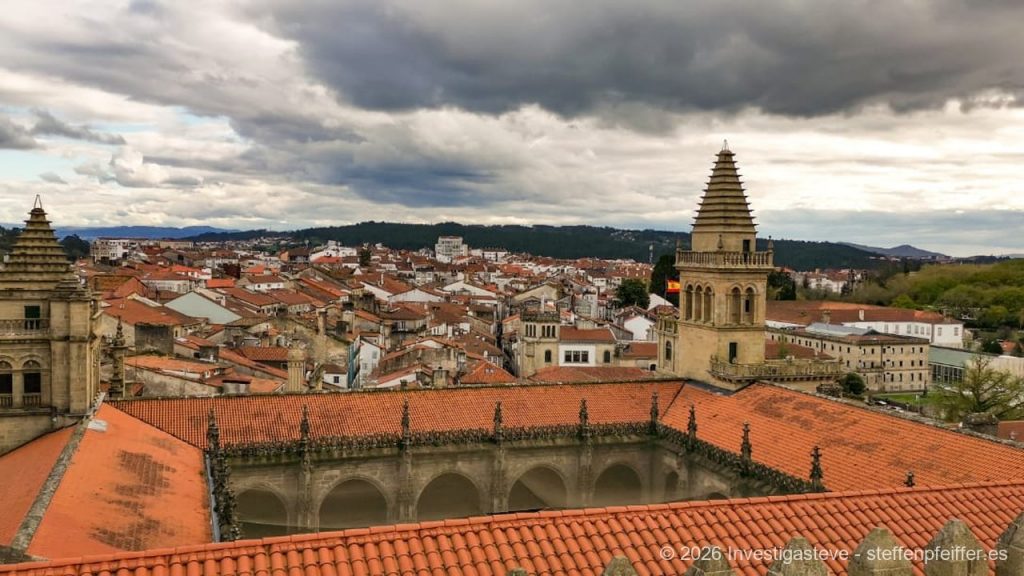
The Cathedral Rooftop Tour: A tour over the stone roofs offers a completely new perspective. You stand directly under the towers, look out over the surrounding squares, and understand the structural masterpiece of this building. Moreover, the wind up there is a wonderful refreshment.
The Pilgrim Museum (Museo das Peregrinacións): Located directly on the Praza das Praterías, it offers an excellent examination of the history of the Way of St. James worldwide. It helps to place your own experience in a larger historical context.
Evening Concerts: Free or inexpensive organ concerts or choir performances often take place in the many churches and monasteries. The acoustics in the centuries-old walls are incomparable.
The University: Santiago is a student city. A visit to the old university library or a look into the hidden cloisters of the faculties is worthwhile to get to know the youthful, lively Santiago that exists far from religious tourism.
Camino Distances
The following table shows the final sections and distances within the urban structure of Santiago de Compostela, based on the official route guides.
| From | To | Distance (km) | Characteristics |
|---|---|---|---|
| Monte do Gozo | San Lázaro | 1.5 | Descent and entry into the city area |
| San Lázaro | As Fontiñas | 1.2 | Urban transition, modern infrastructure |
| As Fontiñas | Rúa dos Concheiros | 0.9 | Beginning of the historic city center |
| Rúa dos Concheiros | Porta do Camiño | 0.5 | The historic entry gate to the old town |
| Porta do Camiño | Cathedral (Obradoiro) | 0.6 | The grand finale through the UNESCO heritage |
| Total | City Passage | 4.7 | The way into the heart of the city |
Addresses & tips in Santiago de Compostela
Overnight Stays & Arriving
Arriving in Santiago de Compostela means choosing a moment of tranquility. The selection of accommodations is vast, but the atmosphere varies greatly.
Hostal dos Reis Católicos (Parador): For those who want to end the way with a bang. It is one of the oldest and most beautiful hotels in the world. The inner courtyards and the breakfast room in the old chapel are breathtaking.
Seminario Menor: Located on a hill above the city. It is a huge pilgrim hostel in a former seminary. The long corridors and simple rooms exude a monastic calm, and the view of the illuminated cathedral at night is priceless.
Monastery Hostels: Places like San Martín Pinario offer pilgrim rooms. It is a special experience to sleep behind the thick monastery walls where monks have lived and prayed for centuries.
Small Guesthouses in Rúa do Vilar: Here you live right in the middle of the action. The creaking wooden floorboards and the high window sills of the historic houses let you experience old Santiago up close.
No matter where you sleep: take your time for the ritual at the Pilgrim’s Office in the Rúa de Carretas. Queuing for the “Compostela” is part of the process. Here you meet the faces again that have accompanied you for weeks. The moment your name is entered in Latin on the certificate is the official authentication of your hero’s journey.
Camino of the Stars
Santiago de Compostela is the endpoint of the Camino Francés (CF) and, at the same time, the zero point for the Camino a Fisterra e Muxía (CFM). The sequence of the last and first places is:
Monte do Gozo → San Lázaro → As Fontiñas → Rúa dos Concheiros → Porta do Camiño → Santiago de Compostela → Sarela de Abaixo → Moas de Abaixo → Augapesada → Carballo → Ponte Maceira → Negreira.
Santiago is more than a point on the map—it is a feeling that lasts. Which place in this city touched you the most? Was it the silence in the crypt, the laughter at the Obradoiro, or the first bite of Pulpo? Share your experiences with us and become part of the infinite story of this way. Write to us in German, Spanish, or Galician—every voice counts.
About the Author