A First Look – Entry & Atmosphere
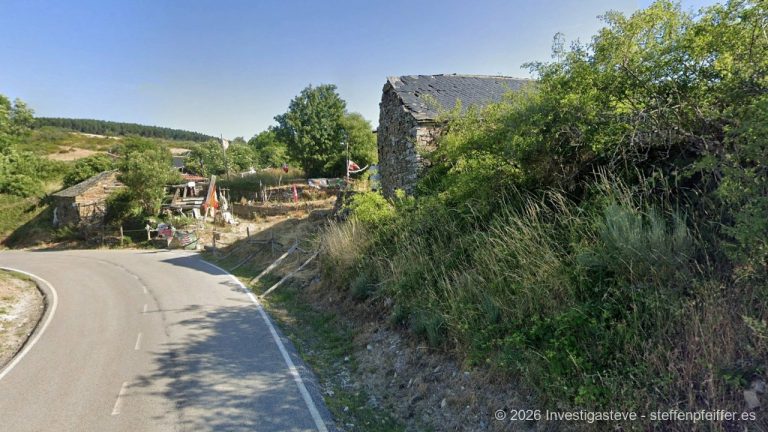
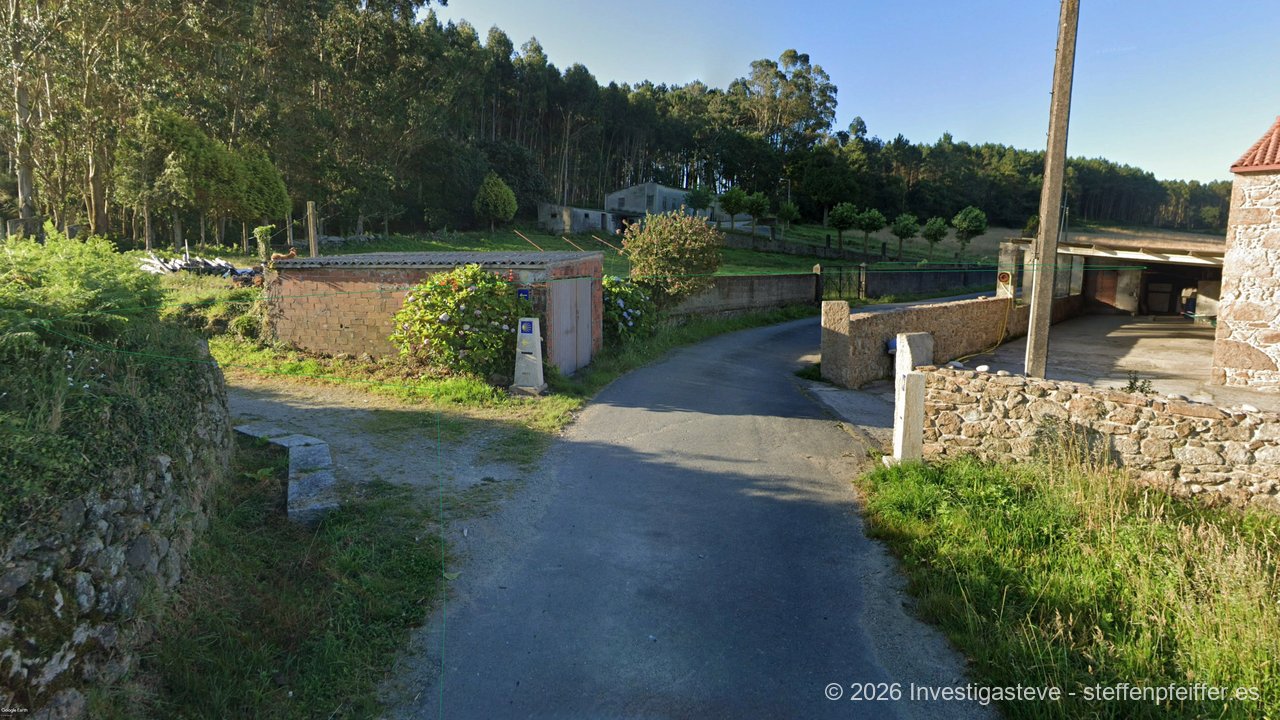
When you have left behind the last, weather-beaten houses of Frixe and the asphalt beneath your feet slowly transforms into a narrower, almost intimate-looking path, something happens to your senses that you have not yet experienced on the journey along the coast. The vast, often merciless Galician sky, which hangs over the Costa da Morte like an infinite, gray-blue shroud, is suddenly filtered. You enter the realm of the Galician pines – Pinus pinaster – whose crown-shaped canopy stretches over the pilgrim’s path like a living, green atrium. Guisamonde is not a place that loudly screams its presence; it is rather a whisper in the deep woods, a soft murmur in the treetops that envelops you like a warm blanket. The hamlet, which counts barely more than a dozen souls – currently there are officially about 12 inhabitants – lies nestled within this dense forest belt, which acts like a natural buffer, a kind of climatic and spiritual sluice between civilization and the wild, untamed heights of the Facho de Lourido.
It is an olfactory revelation: the salty, often sharp sea breeze that has accompanied you since Fisterra gives way here to a heavy, almost intoxicating bouquet of essential oils. It smells of fresh pine resin, damp forest floor, and the bitter aroma of rotting ferns. When the wind brushes through the branches, it does not create a whipping noise like it does at the cliffs, but rather a deep, soothing rustle – an ocean of trees whose waves break in the needles. You instinctively feel your heartbeat slow down. The haptics of your path change radically; where hard slate or rough asphalt previously challenged your joints, a carpet of reddish-brown needles now often cushions your steps. It is as if the earth itself is trying to bring you to rest in these final miles. Guisamonde is the calm before the storm, the last moment of relative level ground and shadow before the topography of Galicia takes its toll and sends you up into the exposed expanse of the mountain.
What This Place Tells
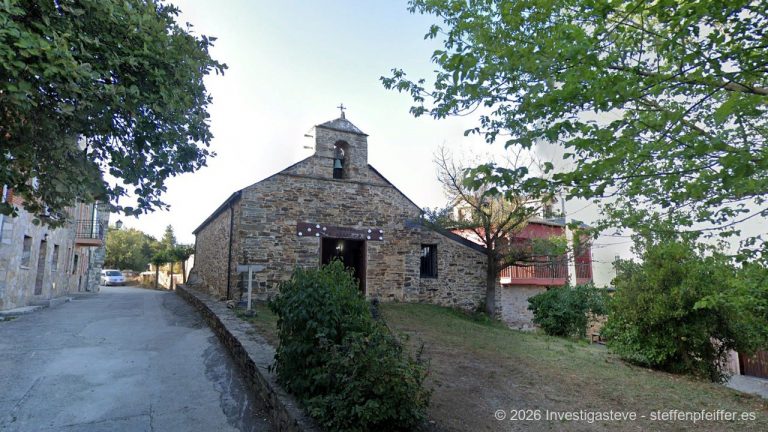
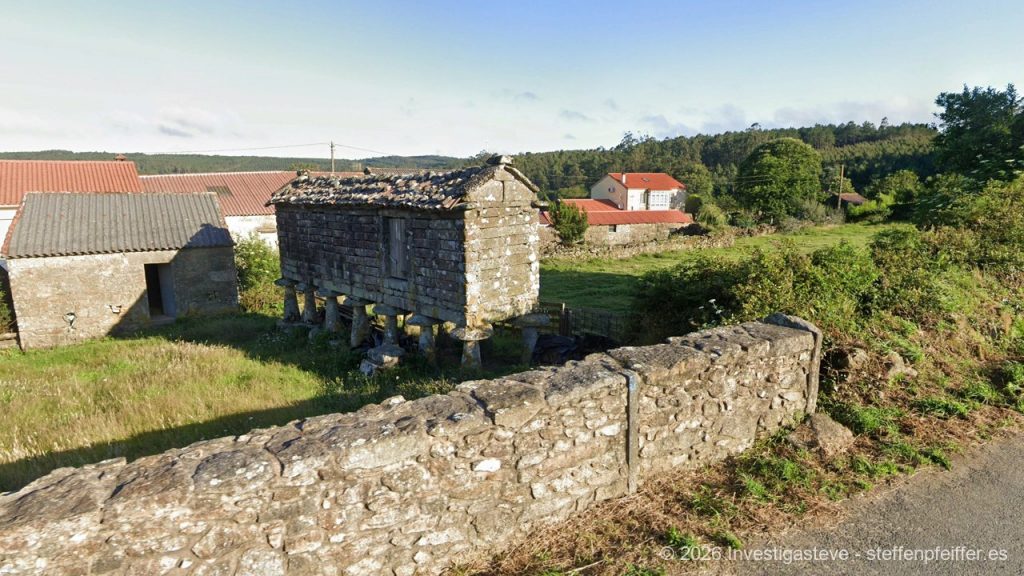
Guisamonde tells the story of Galician subsistence – that tough, silent struggle for survival that does not look toward the great historical headlines, but toward the eternal, relentless cycle of nature. Administratively, this tiny hamlet belongs to the parish of Morquintián within the municipality of Muxía. This integration is no coincidence, but the result of centuries-old ecclesiastical and secular structures that ensured the protection and administration of this remote stretch of land. The place is an archetypal example of the Galician “minifundio” system: tiny plots of land that were laboriously reclaimed from the dense forest, here and there a small cornfield or a patch of cabbage, framed by massive stone walls that are anchored so firmly in the ground as if they were a natural part of the geological foundation. Here in Guisamonde, you feel the deep connection of the people to their soil – a form of resilience that acts almost like an anachronism in today’s fast-paced world.
But for you as a pilgrim, this place carries an even more specific, almost vital narrative: the story of water and solidarity. The central element of local lore is the Casa de López, a private homestead at a strategically significant crossroads. For generations, this house, with its nearby forest spring, functioned as a sacred anchor point of refreshment. In those distant times, when there were no modern plastic hydration bladders or convenient vending machines in nearby Frixe, the water of Guisamonde was the proverbial “liquid gold.” It was the fuel that decided the success or failure of the upcoming, grueling ascent. Historically speaking, Guisamonde marks the psychological boundary between the cultivated land of the farmers and the wild, untamed zone of the coastal mountains. Whoever passed through here knew exactly: now the serious part of the journey begins.
The elders in the village still whisper stories to this day that the dense pine forest preserves the secrets of those passing through. Guisamonde is not a place of great hagiographies or monumental cathedrals; it is a place of small, deeply human needs – the struggle against thirst, the search for a patch of shade, and the mental preparation for physical exertion. This honest, almost naked humanity lends the hamlet a spiritual depth that is often more impressive than the splendor of gilded altars. It is the spirituality of pausing, reminding us that the St. James Way consists above all of small gestures: a cool sip of water, a moment of silence, and the knowledge that one is not alone on this path. Guisamonde is the silent witness to your own transformation, the space in which you finally leave the noise of the world behind.

Camino Distances
In Guisamonde, you reach the last shady camp before the mountain trial. The path now leads you inevitably from the plain into the demanding gradients that will challenge your body and mind.
| Previous Location | Distance (km) | Next Location | Distance (km) |
|---|---|---|---|
| Frixe | approx. 2.0 km | A Canosa / Morquintián | approx. 1.7 km |
Sleeping & Arriving
We must be completely honest at this point, as honest as the weathered face of a Galician farmer after a long day in the field: in Guisamonde, there are no official beds for pilgrims. No municipal albergue, no private hostel, and no hotel enticing you with amenities. Those who “arrive” here usually do so not to spend the night, but to find their inner center. Arriving in Guisamonde is not a logistical act, but a purely psychological process. It is that moment when you might lean your heavy backpack against one of the ancient stone walls for a few minutes, loosen your hiking boots, and perceive the absolute isolation of the forest. You feel the silence, which is so thick here that it lies almost like a physical weight on your shoulders – free from the noise of the coastal roads and the voices of other hikers.
The only “accommodation” Guisamonde has to offer is the protective roof of the pine forest. A short rest on the springy floor of needles, surrounded by the security of the trees, can however be more restorative than many a restless night in a crowded dormitory hostel. Many pilgrims in the year 2026 use this place as a moment of radical self-sorting. It is the “base camp of the soul.” The next fixed overnight option lies either about five kilometers behind you in idyllic Lires or about five kilometers ahead of you in the port town of Muxía, which will finally welcome you with the luxury of warm showers and soft sheets. In Guisamonde, you learn an important lesson of the Camino: comfort is not always defined by four walls and a roof, but often by a cool stone in the shade and the permission to do nothing at all for a moment.
This conscious arrival in “nothingness” prepares you for the “morriña” – that untranslatable Galician mixture of homesickness, longing, and melancholy that grips almost every pilgrim shortly before the end of their journey. In Guisamonde, you feel that the path is soon coming to an end. The trees stand here like silent guardians of your journey, and their slow growth reminds you that your own development also takes time. When you rise again to move on, you often do so with a new lightness, even if the hardest ascent is still ahead. You take the peace of the forest with you, like an invisible supply pack for the coming hours in the blazing sun.
Eating & Drinking
In Guisamonde, the kitchen remains cold for the traveler – it simply does not exist in a commercial form. There is no bar, no small café, and no way to buy a quick sandwich. The scent hanging in the air here is not the familiar aroma of freshly brewed café con leche or fried chorizo, but the pure, unadulterated nature of Galicia: resin, damp moss, and in the summer months, the spicy smell of wild fennel. The culinary experience in Guisamonde is the purist picnic that you have brought with you in your own backpack. It is an act of humility to eat a simple piece of bread or an apple under the dense canopy.
Special attention is given to the water, the life-giving element of this place. The historic forest spring near the Casa de López is a legendary point for generations of pilgrims. It is a tactile experience to dip your hands into the cool, often only sparsely flowing water. But be warned: the reliability of this spring is heavily dependent on Galician weather whims and the season. In the height of summer, it can dry up to a mere trickle, while after the heavy rains of autumn, it gushes powerfully from the ground. A wise pilgrim in the year 2026 does not blindly rely on this natural resource but ensures full water bottles already in Frixe or Lires. If you are lucky enough to be here on a day when the spring gives, then drink this water with the reverence of one who knows that nature is not a guaranteed service provider, but a temperamental donor.
The absence of gastronomy in Guisamonde radically directs your focus to the quality of your own provisions. Each piece of cheese that you have chosen with care tastes more intense in this sacral forest silence than in any busy restaurant. The anticipation of the culinary delights of Muxía – the freshly caught octopus, the crispy empanadas, and the sparkling Albariño – serves here as a mental motor. Guisamonde teaches you that hunger and thirst are the best spices. It is an ascetic break that cleanses the body and sharpens the spirit for the finale of the pilgrimage.
Supply & Logistics
When we speak about logistics in Guisamonde, we are moving in a “desert in the forest.” There are no shops, no vending machines, no pharmacies, and certainly no ATMs. You are completely dependent on your own preparation here. For the modern person of the 21st century, accustomed to the constant availability of goods and services, this void can seem almost frightening. But on the Camino de Fisterra y Muxía, it is a healing lesson in autarky. Guisamonde mercilessly tests your management: have you planned enough water for the upcoming, shadowless ascent to the Facho de Lourido? Do you have a bar or nuts ready for a quick energy boost when your strength fades on the mountain?
However, this infrastructural void also creates a space for genuine human encounter and solidarity among pilgrims. One often sees hikers helping each other out with a handful of nuts or a sip of water at this point of the path. It is the place where the “we” triumphs over the “I.” If you notice that you have forgotten something essential, it is already too late to buy it in Guisamonde – but it is the perfect time to ask for help or to become a giver yourself. The next supply point of note remains Frixe behind you or the stage destination of Muxía, about five kilometers away. Therefore, use Guisamonde as a logistical checkpoint for your own equipment.
Shopping: There are no shops of any kind in Guisamonde. The last chance to restock supplies was in Frixe (approx. 2 km back).
Gastronomy: No bars or restaurants available; absolute self-catering is required.
Accommodation: No albergues or accommodations in the village; Muxía is the nearest destination for an overnight stay.
Public Facilities: No public toilets or medical stations. The only “facility” is the natural spring at the Casa de López.
In summary, it can be said that Guisamonde forces you to detach from the role of the consumer and become a true hiker again. It is a place that offers you nothing but protection from the sun and peace for the soul. But in the logic of the Camino, that is often more than enough.
Don’t Miss
The Casa de López: Even though it is a private estate today, this place breathes history. It stands symbolically for the centuries-old tradition of pilgrim care at this decisive waypoint.
The Historic Forest Spring: A small altar of refreshment. Listen for the soft gurgling of the water – it is the soundtrack of relief for countless generations before you.
The Pine Forest (Pinus pinaster): These trees are the true guardians of Guisamonde. Take the time to touch the gnarled trunks and feel the rough bark beneath your fingers – it is a tactile reflection of Galician resilience.
The Play of Light in the Undergrowth: When the sun is high, the light breaks through the needles and draws golden patterns on the dark, soft forest floor. A moment of almost sacral beauty that needs no artificial filter.
The Autumnal Bird Migration: If you are here between August and October, turn your gaze upward. Guisamonde lies directly beneath a significant migratory bird route. The rustling of the wings of thousands of cranes and geese over the treetops is an acoustic experience you will never forget.
The Río Castro Bridge: A modern engineering work from 2011 that facilitated access to the region and forms an exciting contrast to the ancient nature of the hamlet.
Insider Tips and Hidden Places
Beyond the marked path that cuts through Guisamonde, there are small, almost invisible corners that are revealed only to those ready to slow down. One of these places is the “Bird Hall” – a small clearing south of the hamlet where the acoustics of the forest act like a natural amphitheater. Here, the calls of the forest dwellers are concentrated so intensely that you think you are standing in the middle of an orchestra. It is an auditory experience of the highest class, far removed from any artificial noise.
Another insider tip is the search for the “springy path.” In some parts of the village, old, almost forgotten side paths lead deep into the thicket, where the ground consists not of hard asphalt, but of pine needles accumulated over decades. These paths are a true blessing for pilgrim-weary joints and offer a tactile walking pleasure reminiscent of walking on clouds. Here you can experience “forest bathing” (Shinrin-yoku) in its most original, Galician form.
For the photographers among the pilgrims, there are “sea-view windows” in Guisamonde. If you direct your gaze selectively between the massive trunks of the pines, small, azure cutouts of the Atlantic flash in the distance. This contrast between the dark, earthy brown of the trunks and the glistening blue of the ocean is a visual gem that is often only noticed at second glance. It is these small, unpretentious discoveries that make Guisamonde such a valuable place.
A final tip concerns the Casa de López itself: look for the small stonework on the outbuildings. They bear witness to a time when craftsmanship and the aesthetics of the useful still went hand in hand. These details are not great monuments, but silent declarations of love for the homeland and the material stone that has shaped Galicia for thousands of years.
Reflection Moment
Guisamonde presents you with an existential question: are you ready for the mountain? In the security of the forest, it is easy to feel safe. The trees give you shade, the wind is slowed, and the path is relatively level. But you know that directly behind this green cocoon, the strenuous ascent to the Facho de Lourido awaits. Guisamonde is the psychological turning point of your pilgrimage. Here you must decide whether to leave the comfort zone of the forest to expose yourself to the full force of the elements and physical exertion.
Breathe deep into your belly and consciously perceive the resinous scent of the pines one last time. This place is a gift of silence, a breathing space before the grand finale begins. You might ask yourself: “Do I have the strength for the final meters? Is my inner supply of endurance enough?” Guisamonde does not answer you with words, but with its constancy. The trees have survived storms far more violent than your small ascent. When you step out of the shade of the pines, you take a piece of their peace with you. You realize that the goal – the sanctuary of the Virxe da Barca – is not reached by avoiding effort, but by passing through exactly these transition zones. In Guisamonde, you find the courage to take the next step.
Camino of the Stars
This place lies on the Camino Fisterra y Muxía, on the stage from Fisterra via Lires to Muxía. The chain of places on this stage leads you through a varied landscape of coastal proximity, deep forests, and exposed ridges:
Fisterra → San Martiño de Arriba → Hermedesuxo → San Salvador de Duio → Buxán → Castrexe → Lires → Frixe → Guisamonde → A Canosa → Morquintián → Xurarantes → Muxía
Have you experienced the special acoustics in the pine forest of Guisamonde or found a moment of refreshment at the Casa de López? Perhaps you have seen the massive flocks of birds passing over the treetops in autumn and felt that very unique sense of freedom? Tell me your story – whether in German, English, Spanish, French, or Galician via the contact form. Your memory gives this quiet place a voice and helps other pilgrims understand the magic of the forest!
About the Author