A First Look – Introduction & Atmosphere
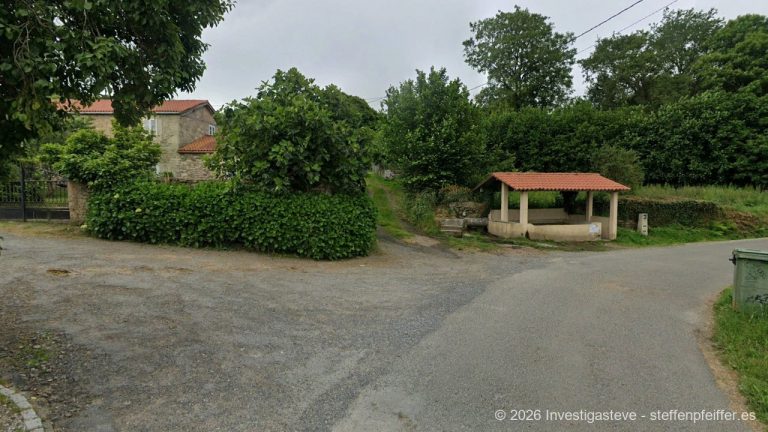
As you walk the narrow path that leads you deeper into the heart of Galicia’s coastal landscape, you reach A Canosa, one of those places that feels like a forgotten verse in an ancient song. It is a tiny hamlet, almost a ghost of stone and moss, nestled into the gentle hills of the municipality of Cee, just before the route reaches the estuary of Lires. Here, on stage CFM 4 of the Camino Fisterra y Muxía, you encounter a silence so deep and substantial that it almost seems like a physical object in the space around you. The fine Galician misty drizzle, the orballo, settles like a silvery veil over the gray granite walls of the houses and makes the already lush green of ferns and grasses glow with an almost unreal sheen. It is a light that knows no hard shadows, but instead bathes everything in a soft, melancholy aura that lets you feel at once: you are in an in-between realm.
You become acutely aware of the ground beneath your boots—the path here is often damp, lined by low stone walls that have separated fields and lanes for generations. The air smells intoxicatingly of a mix of decaying leaves, the freshness of the nearby sea, and the heavy, ethereal aroma of the eucalyptus groves that dominate the higher ground. The only soundtrack to your walk is the distant, almost imperceptible rush of water and the rhythmic clicking of your walking poles on the uneven surface. In A Canosa, civilization seems far away, even though modern amenities await just a few kilometers on. It is a place of transition, where you absorb the solitude of the Costa da Morte in its purest form before the landscape opens again and releases your gaze toward the river valley.
What This Place Tells You
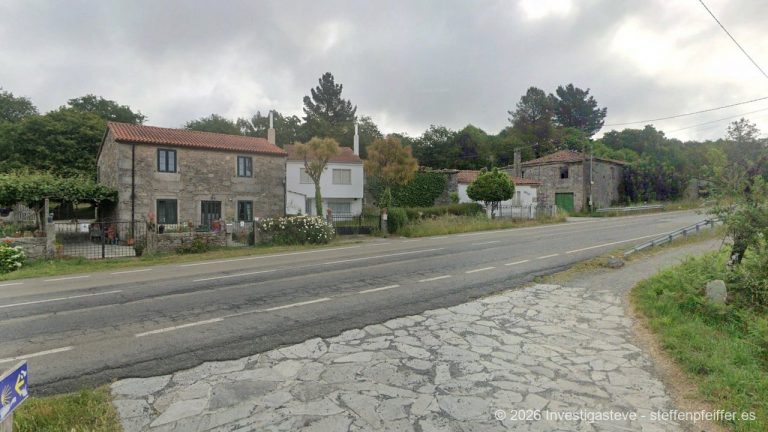
A Canosa is a textbook example of Galicia’s archaic settlement pattern, a hamlet that seems to have grown organically out of the earth. Its history is not recorded in grand chronicles, but in the silent language of its architecture. The houses, mostly built of solid granite, have withstood the harsh Atlantic winds that can sweep across the land here unimpeded for centuries. They are witnesses to a time when life was shaped exclusively by nature’s rhythm and the hardship of agriculture. The village lies strategically at a point that marks the transition from rugged coastal stretches to the gentler river landscape of the Lires estuary. This is a land of minifundismo, where every small plot is painstakingly tended, and where the boundaries between farms are marked by those characteristic stone walls that today run through the landscape like petrified memories.
Culturally, A Canosa is closely tied to the tradition of the hórreos. These distinctive granaries on stone stilts are not only storage places for corn and grain here, but symbols of survival in a region where the ocean’s humidity was a constant enemy of supplies. The construction of the hórreos in A Canosa, with their round stone plates—the muelas—as protection against rodents, is an expression of clever rural engineering that has been refined over generations. Here you feel the people’s deep bond with their land, a steadfastness that gained an additional spiritual dimension through the Christian pilgrim tradition. A Canosa has always been a transit point, a place where pilgrims on their way to Muxía paused briefly to enjoy the cool calm of the stones before continuing on to the next chapel or the next river crossing.
In this region of Galicia, the boundaries between this world and the next are often fluid. Folklore tells of will-o’-the-wisps and the spirits of ancestors that are said to drift through the sunken lanes of A Canosa on foggy nights. These myths are not mere ghost stories; they reflect the residents’ deep respect for nature’s unpredictable force. As you walk through the hamlet, you step into a space that has hardly changed its shape over the centuries. The tactile quality of the surroundings—the rough, cold granite, the soft cushions of moss on the walls, and the feeling of isolation—connects you directly with the pilgrims of the Middle Ages who may have felt the same exhaustion and spiritual anticipation right here, in this very place.


Camino Distances
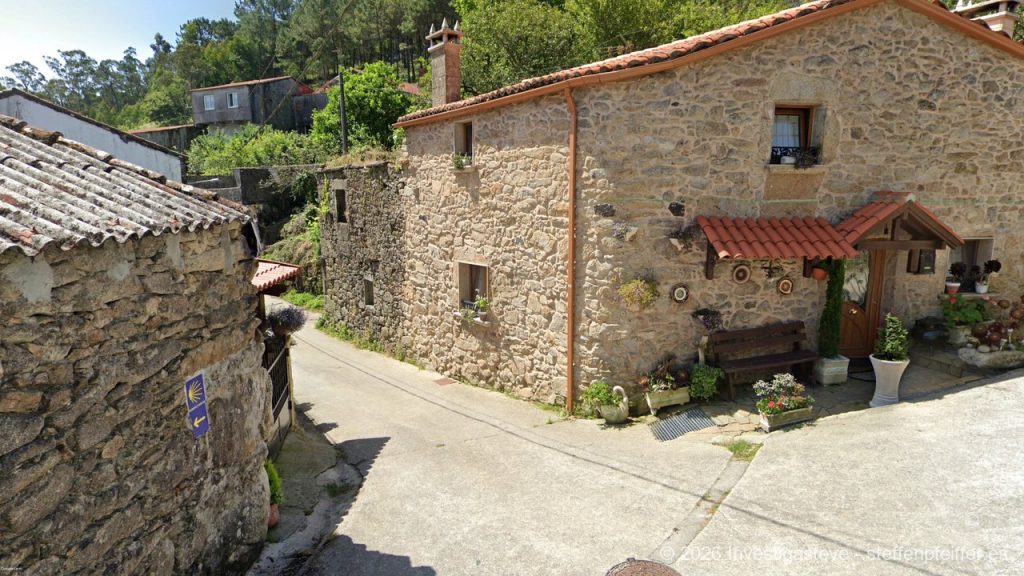
After about 2 kilometers of steady walking through the wooded, often wind-sheltered valleys from Castrexe, the view opens here onto the rural structures of A Canosa.
Overnight Stays & Arriving
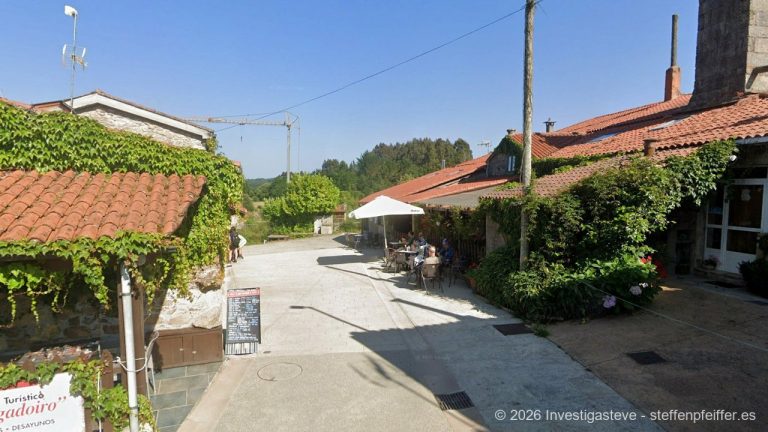
Arriving in A Canosa means accepting silence as a welcome gift. There are no glittering signs promising you a “pilgrim menu,” and no modern bed complexes to receive you. The place is a pure transit hamlet, a microscopic cluster of stone houses that almost completely escapes the tourist flow. The atmosphere is shaped by a shy hospitality that shows itself more in a resident’s silent nod or in the sight of a well-kept bench beneath an old oak. It is a place to breathe, a moment of isolation that forces you to engage with your own rhythm before the infrastructure of larger towns pulls you back under its spell.
If you’re looking for an overnight stay here, you’ll find that there are no hostels or hotels in the hamlet itself. The absence of commercial accommodations, however, is not a drawback but an essential part of the A Canosa experience. It teaches you to plan your stages so that you understand this place’s silence as an energetic recharge. The next reliable places to sleep are in Lires, just a little over two kilometers away, where private hostels and charming country houses are waiting for you. The short walk there leads you through a landscape that takes on an almost magical quality at dusk, when the trees’ shadows grow longer and the scent of the sea becomes ever more intense.
Arriving in A Canosa is often accompanied by a feeling of relief. After the climbs and the exposed stretches of the previous kilometers, the hamlet’s sheltered position in the hollow offers a natural oasis. The place’s tactile character is defined by granite and the wood of old barns. When you place your hand on one of the stone walls, you feel the stored coolness of the last rain showers. It is a place that imposes nothing on you except the moment of pausing. This psychological break matters for you as a pilgrim, helping you process the impressions of the Costa da Morte before the journey moves toward its climax.
Food & Drink
Culinarily, A Canosa is a place of asceticism and self-sufficiency. There are no bars, restaurants, or cafés in the hamlet. For you as a pilgrim, this means the focus is radically shifted to your own provisions and your most basic needs. The air often carries the scent of fresh hay or the smoky smell of a fireplace, creating an atmosphere of homely comfort that stands in stark contrast to the lack of public dining options. This is a rural world in which the gardens behind the houses form the basis of the kitchen—potatoes, cabbage, and corn are the main players here.
A picnic on one of A Canosa’s old stone walls can become one of the most intense taste experiences of your journey. If you eat a piece of bread and Galician cheese here while the wind carries in the salty sea breeze, you taste the region in its purest form. It is a moment of mindful enjoyment without distraction from menus or other guests. The anticipation of Lires’ excellent food or nearby Cee, where fresh seafood and hearty stews await, becomes a motivating companion for the last kilometers of your day. In A Canosa, you learn that true luxury often lies in simplicity and in the quality of the surroundings.
Supplies & Logistics
In terms of infrastructure, A Canosa is a place of doing without. There are no supermarkets, no pharmacies, and no ATMs. This reality is an essential part of stage CFM 4, which repeatedly confronts you with the rugged reality of the Galician coast. If you arrive in A Canosa, you should have already replenished your supplies in larger towns such as Fisterra or Cee. The hamlet serves as a reminder that on the Camino you are often a guest in a working world that is not primarily geared toward tourism.
The next chance to pick up supplies is not until nearby Lires or the larger town of Cee. For medical emergencies or logistical problems, the hamlet is only partially prepared due to its remote location. This underscores the need for good preparation and appropriate gear. A Canosa teaches you self-reliance—you depend on what you carry in your backpack. This brief lesson in humility, so close to your destination, is a valuable experience that sharpens the character of the pilgrimage.
Shopping: No shops in the hamlet; supplies are only available via Lires or Cee.
Dining: No bars or restaurants; you must be self-catered.
Overnight stay: No hostels in the hamlet; the next accommodations are in Lires (approx. 2.1 km).
Public facilities: No notable public buildings; the Fonte do Bico is strategically important as a drinking-water source for the way ahead.
In summary, A Canosa is a logistical challenge, but one that is more than made up for by the landscape’s beauty and the place’s calm. It is a stop for pilgrims who understand the Camino not as simply ticking off kilometers, but as experiencing the landscape.
Don’t Miss
The traditional hórreos: Pay attention to the different construction styles of the granaries in the hamlet. They are silent witnesses to Galician agricultural history and make excellent photo subjects.
The stone walls of the sunken lanes: The centuries-old walls lining the path through A Canosa are a tactile experience. Feel the rough stone and observe the micro-ecosystems of mosses and lichens.
The view toward the Lires estuary: Shortly after leaving A Canosa, the landscape opens up and reveals the valley and the mouth of the River Lires—a moment of great scenic openness.
The Fonte do Bico spring: Use this strategically placed water point at the edge of the hamlet to top up your supplies for the final stretch to Muxía.
Insider Tips and Hidden Spots
Beyond the marked path, A Canosa reveals small, almost invisible treasures that only the attentive pilgrim will notice. One such spot is a small, weathered cruceiro, a stone wayside cross that often lies half hidden in the shadow of old oaks. These crosses stand at old intersections to protect travelers and ward off evil spirits. Place your hand on the rough, lichen-covered granite and feel the cool weight of the centuries. It is a place where you can forget time for a moment and feel connected to the long chain of those who stood here before you.
Another hidden point is the old connecting road toward Lires, which in places still has its original paving. If you step off the main path here, you often discover small, half-collapsed walls that have been completely overgrown with bright green moss and ferns. These ruins are silent witnesses to demographic change and provide a melancholy backdrop for a brief pause away from the pilgrim flow. Here you can physically grasp the transience of human striving as nature reclaims the space bit by bit.
In the late afternoon sun, when the light hits the mica in the granite of the houses at a low angle, the whole village begins to sparkle as if billions of tiny diamonds were embedded in the stone. It is a magical moment experienced only by those who do not hurry past the stones. Find a place on one of the walls and watch how the stone’s colors shift from gray to a warm golden tone—a visual spectacle that no expensive camera in the world can capture perfectly.
One last insider tip is to observe the local flora in the small gardens between the houses. You may often find ancient grape varieties or medicinal plants grown in the traditional way. The air in these corners of A Canosa is often even purer and carries the scent of wild thyme and mint. It is an invitation to open your senses wide and notice the small wonders along the way—often revealing more about a place’s soul than the big sights ever could.
Moment of Reflection
In A Canosa, your pilgrimage reaches a point of inner stillness that has become rare. You are standing in a village whose existence is defined almost entirely by its permanence, while you yourself are only a fleeting shadow passing through this world. This contrast between the place’s immovability and your own restlessness is the core of reflection in A Canosa. Here, in the hamlet’s isolation, the hardships of the past days are put into perspective. You ask yourself: What is truly necessary? How much ballast am I carrying—not only in my backpack, but also in my head?
In A Canosa, the rhythm of your breathing aligns with Galicia’s slow heartbeat. The landscape’s psychological impact is immense. As you wander through the quiet lanes, you can almost feel the weight of everyday worries dropping from your shoulders. It is a time of radical inward turning. The sight of the simple, sturdy stone houses reminds you that shelter and home often do not need grand façades, but only a solid foundation. In A Canosa, you understand that the journey doesn’t end with reaching a certificate, but in the transformation within you—one that begins in places of quiet like this.
Camino of the Stars
This place lies on the Camino Fisterra y Muxía, on the stage from Fisterra via Lires to Muxía. The sequence of places is:
Fisterra → San Martiño de Arriba → Hermedesuxo → San Salvador de Duio → Buxán → Castrexe → Lires → Frixe → Guisamonde → A Canosa → Morquintián → Xurarantes → Muxía
Did the archaic silence in A Canosa’s lanes move you just as deeply, or did you spot a detail on one of the hórreos that we should absolutely add here? Share your personal impressions—and maybe even a photo of this hidden gem—with us. Your experiences make this guide even more valuable for all pilgrims!
About the Author