A First Look – Entry & Atmosphere
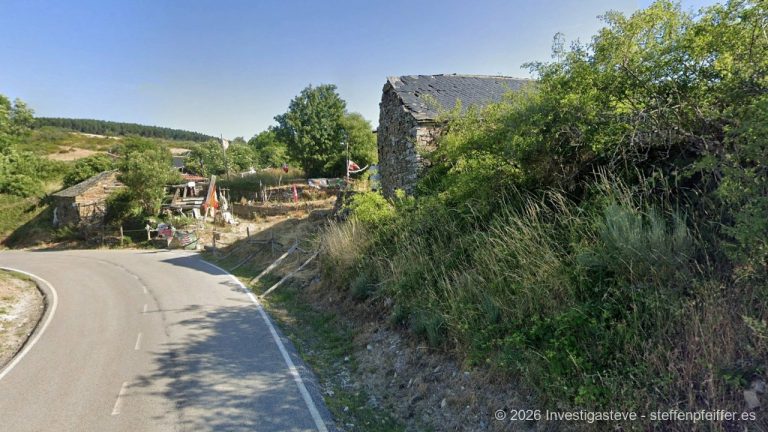
When you work your way out of the dense, almost tunnel-like eucalyptus forests of the Montes de Raposa and the path slowly opens up to reveal the view of the rolling high plateau, you reach Quintáns. It is not a place that welcomes you with triumphant gates or magnificent facades. Quintáns is an “Aldea,” a hamlet that nestles into the landscape between Senande and the approaching sea with an almost defiant humility. Here, at an altitude of about 300 to 350 meters above sea level, the air possesses a clarity that, on cool mornings, seems almost as if it could shatter like glass. You inhale the tart, ethereal scent of eucalyptus leaves, mixing with the heavy, damp earthiness of Galicia. It is a place that smells of hard work – of freshly mown grass, of the stable, and of the distant, barely perceptible promise of salt carried over by the west wind from the Costa da Morte.
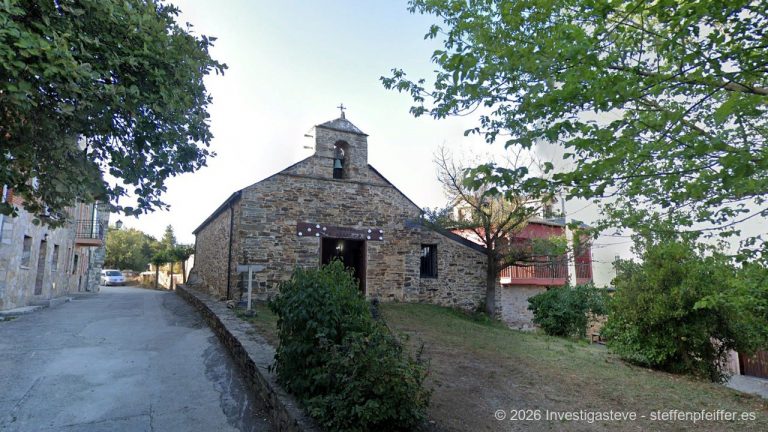
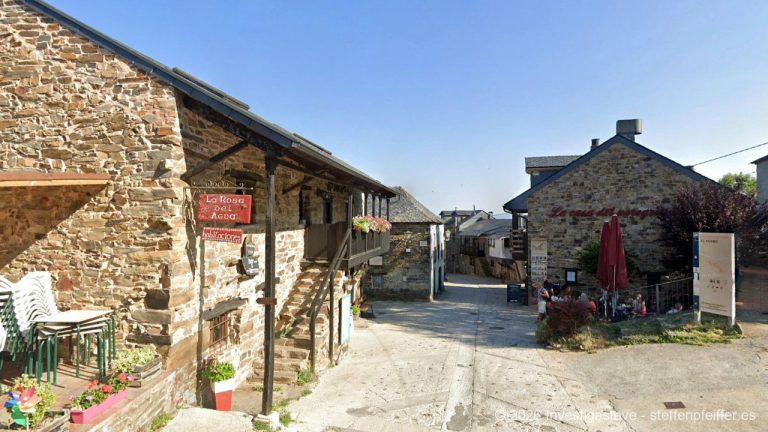
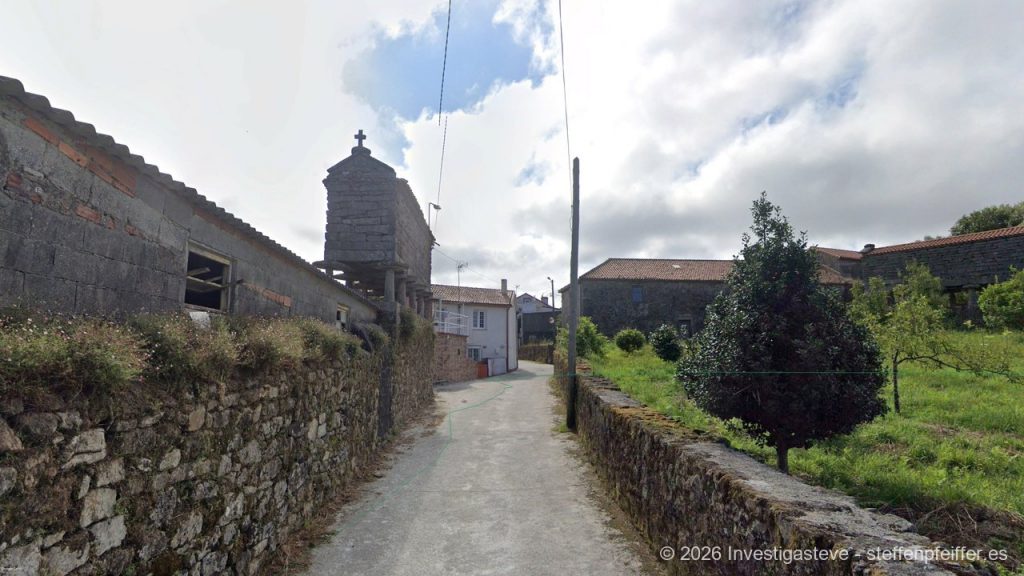
The atmosphere in Quintáns is dominated by a stillness that can seem almost eerie to the modern city dweller. It is not an absence of noise, but a symphony of the rural: the rhythmic clacking of your own trekking poles on the rough asphalt of the village street, the distant, melancholy ringing of a cowbell, and the constant, soft whisper of the wind in the stone walls. The houses here are built of solid granite, often covered with a dense carpet of luminous yellow and silvery lichens, testifying to the high humidity and the purity of the surroundings. Quintáns seems like a stone anchorage in the green sea of Galicia. Here, you feel the “Terreña,” the deep connection of the people to their soil, in every joint of the old walls. It is a place of transition, where legs grow heavy, but the heart already senses the proximity of the Moraime monastery and the coast of Muxía.
What This Place Tells
The history of Quintáns is inseparably linked to the neighboring Parroquia San Martiño de Ozón, whose mighty shadow reaches into this small hamlet. We find ourselves here in a region shaped for centuries by agriculture and clerical administration. Quintáns itself is a prime example of the Galician settlement structure of the “Aldeas” – small, functional communities that survived self-sufficiently while world history passed them by. The terraced fields around the village, lined by centuries-old stone walls, tell of the toil of wresting daily bread from the barren soil. Every stone in these walls was moved by hand, every furrow drawn with the strength of man and beast.
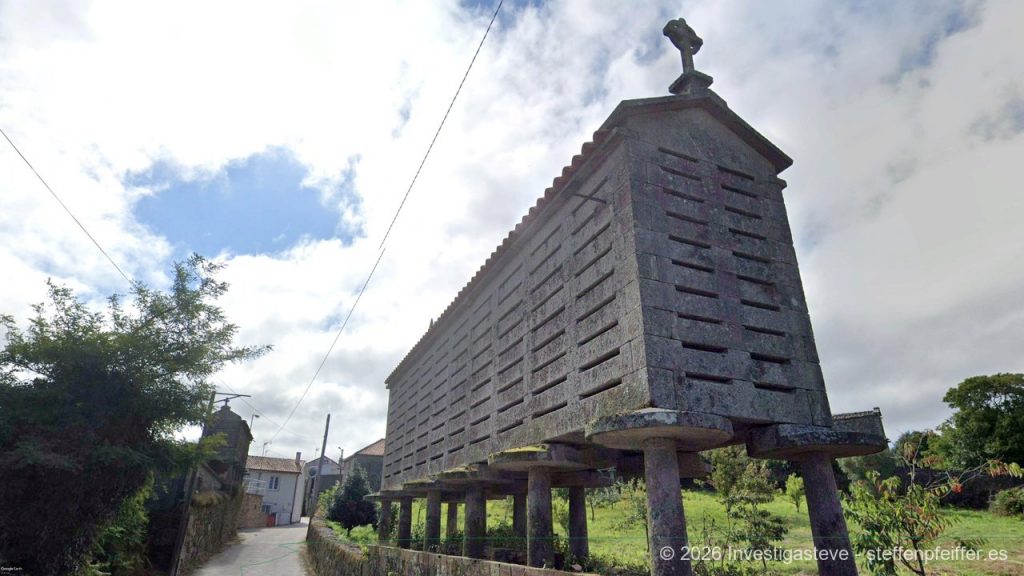
In Quintáns, you encounter the soul of rural Galicia, which manifests itself in the architecture of the “Hórreos.” These grain stores, found here on almost every farm, are much more than just storage places; they are status symbols and guarantors of survival. Particularly impressive is the connection to nearby San Martiño de Ozón, where one of the largest Hórreos in the entire region is located – a monumental stone construction that once received the tithes of the farmers. Quintáns was part of this supply network, a cog in the wheel of medieval agriculture, which stood under the patronage of the Benedictine order of Moraime and Ozón. When you wander through the narrow lanes, you step into the footsteps of generations of farmers who lived by the same rhythm of sowing and harvesting that still determines the pace of the village today.
But the hamlet also tells of depopulation and the tenacity of those who have stayed. Many of the old granite houses stand empty, their windows fixed on the road like blind eyes, while ivy slowly reclaims the facades. It is a melancholic beauty, typical of the “España vaciada,” the empty Spain. But Quintáns refuses to disappear. In the small gardens, hydrangeas bloom in unreal blue, and in the kitchens, chimneys smoke when the “Caldo Gallego” is on the fire. The place is a testimony of perseverance. It reminds the pilgrim that the Way consists not only of great cathedrals, but of the small, often overlooked communities that form the backbone of the Jacobean culture. Here, history is not carved in marble, but anchored in the lichens on the granite and in the daily greeting of the inhabitants.

Camino Distances
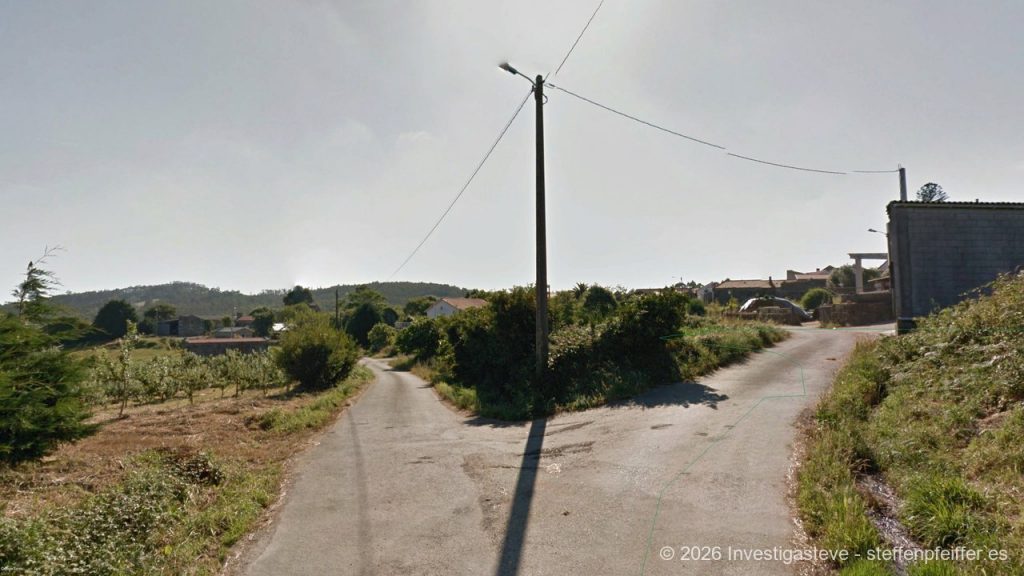
Here you find the distances for the current stage on the Camino Fisterra y Muxía (variant CFM 3b):
Addresses & tips in Quintáns
Opening hours
Sleeping & Arriving
Arriving in Quintáns is a moment of absolute deceleration. There is no magnificent square to be welcomed in, and no tourist information office distributing brochures. Instead, the forest path simply ends at the first houses, and you find yourself in a world where time seems to play no role. For the pilgrim, Quintáns is often the place where the realization ripens that the journey is almost over. The village lies like a peaceful rest stop between the strenuous Montes de Vilastose and the final descent to the sea. Anyone who arrives here often feels a deep physical exhaustion, which is, however, accompanied by a mental clarity that only the solitude of the Galician hills can produce.
Accommodation directly in Quintáns is virtually non-existent. The hamlet is too small for its own hostel infrastructure, which makes it a place of passage – but a passage with weight. Most pilgrims use Quintáns for one last short rest before tackling the remaining kilometers to Moraime or directly to Muxía. The lack of bed bunkers ensures that the stillness of the place remains undisturbed. Those who linger here usually do so only for the duration of a coffee or a short meditation on one of the old stone walls. Arriving here is an inner process; you don’t put down your backpack, but you arrange your thoughts for the impending end of the journey.
The few houses that are still inhabited often appear closed up, but behind the heavy wooden doors lies a reserved but honest hospitality. Occasionally, you see a resident working on his Hórreo or tending to the garden. A short greeting – a “¡Buen Camino!” or a curt nod – is enough to feel welcome. Quintáns demands no interaction from the pilgrim, but offers a space for observation. It is a place that allows you to simply be, without having to achieve anything. In the simplicity of this arrival lies a dignity that touches many pilgrims more than the organized cordiality of the large stage destinations. It is the arrival in the reality of Galicia, far from any staging.
Food & Drink
The culinary heart of Quintáns beats in the “Bar As Mimosas.” For the pilgrim, this place is much more than just a tavern; it is an oasis in the “supply desert” between Senande and Muxía. When you cross the threshold of the bar, you are greeted by the unmistakable scent of freshly brewed coffee, mixed with the slightly acidic aroma of local wine and the sweetish note of homemade almond cake. It is a place where time seems to stand still. Here, the locals sit with their “Vino de Cunca,” the wine from the ceramic bowl, discussing the harvest or the weather, while pilgrims stretch their tired legs under the wooden tables and try to replenish their spent calories.
The offering in the Bar As Mimosas is simple, but of a quality that only the freshness of local products can provide. A “Bocadillo con Queso,” filled with the creamy, slightly tangy Queso de Tetilla, or a piece of hearty Tortilla de Patatas are the classics here. The potatoes here still taste of earth and sun, the eggs are from chickens that you can often still hear scratching in the backyard. If you are lucky, you catch a day when a fresh Empanada was baked. The crust is crispy, the inside juicy and characterized by the sweetness of braised onions. With it, a glass of cold “Estrella Galicia” or a simple, red local wine – nothing more is needed to find heaven on earth.
Drinking from the Cunca is a ritual experience that connects you directly with the Galician tradition. The white ceramic lies cool in the hand, and the wine develops a completely different, earthier aroma in it than in a glass. Eating and drinking in Quintáns means becoming part of the community, even if only for half an hour. You don’t exchange big words, but you share the space and the moment. It is the “Comida de Aldea” – honest, hearty, and without any frills. Before you leave the bar and set off again, you often take one of the homemade energy bars or a piece of fruit with you, which the friendly landlady almost apologetically slips into your hand. In Quintáns, no one is sent on their way hungry.
Supplies & Logistics
Logistically speaking, Quintáns is a place of concentration. Anyone who comes here should know that this is the last reliable supply station before the descent to Moraime. There is no pharmacy, no ATM, and no supermarket. All logistics for the pilgrim are concentrated in the Bar As Mimosas. Here you can refill your water bottles – often directly from a well, whose water comes ice-cold and clear from the mountains – and briefly hook up your phone to the charging station if the battery is running low after all the photos in the Montes de Raposa. It is a minimalist supply that forces the pilgrim to plan, but at the same time frees them from the burden of choice.
The paths in and around Quintáns are well marked, but you should stay alert. The route often leads over old farm tracks that can become muddy and slippery after rain. The granite paving stones can become mirror-smooth in damp conditions – a haptic warning from nature that should be taken seriously. Those traveling with a backpack transport service will find that Quintáns is usually only passed through; the luggage pieces wait in Moraime or Muxía. For emergencies, however, the bar usually has a phone and the number of the local taxi, should an injury make continuing on foot impossible.
Shopping: No shops or supermarkets available; small snacks and backpack provisions are available in the bar.
Gastronomy: Bar As Mimosas is the central and only point of contact for food and drinks.
Accommodation: No hostels or guesthouses in the village; nearest accommodation in Moraime or Muxía.
Public Facilities: No formal offices; for medical care or banking, Muxía must be visited.
In conclusion, the logistics in Quintáns are reduced to a human scale. It is a place that shows you how little you actually need to get ahead. A shady spot, a glass of water, and a friendly word are the most important resources here. The supply in Quintáns is not a service, but an act of neighborly help, which makes the stay here so authentic. You leave the place with the feeling of being well-equipped for the last kilometers of the journey – not through material abundance, but through the peace you have absorbed here.
Not to Be Missed
Bar As Mimosas: The indispensable stop for every pilgrim; enjoy a wine from the Cunca and feel the pulse of the village.
The Hórreos of Quintáns: Observe the diversity of these granaries; they are the stone guardians of Galician cultural history.
San Martiño de Ozón: Just a short detour away lies the impressive Romanesque church and one of the longest Hórreos in Galicia – an absolute must for architecture fans.
View of the Montes de Vilastose: Pause and look back at the chain of hills you have just conquered; the perspective from up here is breathtaking.
Traditional Stone Walls: Pay attention to the hand-layered walls (“Muros de Pedra Seca”) that surround the fields; they are masterpieces of statics and a habitat for rare lizards and mosses.
Secret Tips and Hidden Places
Quintáns is a place of small details that are easily overlooked if you only stare at the yellow arrows. One such place is the small, half-ruined well on the western edge of the village, somewhat off the main path. It is almost completely overgrown by ferns and ivy, yet the water still steadily trickles into the stone basin. It is a place of almost eerie stillness, where you feel like you’re in a fairy tale by the Brothers Grimm. Sitting here, dipping your hands into the ice-cold water, and listening to the whisper of the forest is a meditative experience that completely mutes the noise of the world for a moment. It is a place for the “Meigas,” the Galician witches, whom you can well imagine sitting at the well’s edge on misty nights.
Another secret tip is the narrow path that leads steeply northwards behind the Bar As Mimosas. It is actually only used by farmers to reach the upper pastures, but after about ten minutes of climbing, it offers a view that hardly any pilgrim gets to see. From up there, on a clear day, you can spot the first narrow strip of the Atlantic on the horizon – a silvery glow that appears between the hills like a promise. It is the moment when the journey changes from a land hike to a coastal experience. This first view of the sea is a private gift for those willing to leave the marked trail for a brief moment.
Those interested in the geology and archaic history of Galicia should look out for particularly large granite blocks in the fields around Quintáns. Some of them show strange notches or smooth surfaces that do not seem to be of purely natural origin. They could be the remains of prehistoric cult sites that have been enthroned here on the plateau for millennia. There is a spot where three of these monoliths are arranged almost like a gate. When you step through, you feel a tingling on your skin – perhaps just imagination, but perhaps also the energy of a place that was sacred long before the first pilgrim set out for Santiago. Quintáns is full of such invisible ley lines; you just have to learn to feel them.
Finally, there is the small chapel of San Roque, which is often locked, but whose simple facade glows in a warm golden tone in the evening sun. If you press your ear to the heavy wooden door, you can almost hear the coolness of the interior. It is a place of absolute absence of distraction. In the wall cracks of the chapel, you often find tiny notes with requests or names that pilgrims have left there. It is a silent, collective memory of the Way. A moment of pause in this place, far from the cameras of the tourist centers, connects you in a very intimate way with all those who were here before you and carried the same hopes and fears.
Moment of Reflection
In Quintáns, you stand at a point in the journey that is neither beginning nor end, but embodies the pure “in-between.” The hamlet is so small that it barely appears on many maps, and yet it is indispensable for your journey. The question arises: How often in life do we overlook the small stages because we only stare at the big goal on the horizon? Quintáns teaches us the importance of the inconspicuous. It is the place of “small victories” – the conquered hill edge, the freshly refilled water, the brief smile of a stranger in the bar. Here you realize that greatness has nothing to do with extension, but with the intensity of the moment.
Rural Galicia in its rawest form challenges you to reconsider your own standards. In a world programmed for growth and speed, Quintáns seems like a bug in the system – a place that simply is. Perhaps that is the most important lesson of this hamlet: the acceptance of the sufficient. You don’t need a cathedral to pray, and no hostel with WiFi to feel secure. The stone walls of Quintáns offer you protection through their mere existence. They have stood for centuries and will stand when you have long moved on. This permanence gives you a security that goes deeper than any technological assurance.
When you leave Bar As Mimosas and direct your gaze towards the distant sea, you take some of the simplicity of this place with you. You understand that you yourself are just a wanderer in the stream of time, no more important, but also no less important than the farmer who is just repairing his Hórreo. In Quintáns, the roles merge. You are no longer just the pilgrim with the high-tech backpack; you are a human being on the soil of Galicia who is hungry, feels thirst, and seeks rest. This grounding is necessary before you step before the sanctuary in Muxía. Quintáns washes spiritual pride away from you and leaves you in your pure humanity. It is the “in-between” that prepares you for the “end.”
Camino of the Stars
This place lies on the Camino Fisterra y Muxía (variant CFM 3b), on the stage from Olveiroa/Dumbría to Muxía. The sequence of locations is:
Olveiroa → Hospital → Dumbría → Trasufre → Senande → Quintáns → Moraime → Os Muiños → Muxía
Did you also find that moment of absolute peace in the Bar As Mimosas in Quintáns while the rain lashed against the windows? Or did you discover a detail in the alleys of the hamlet that we are still missing here – perhaps an inscription in an old Hórreo or a hidden path to the Montes de Vilastose? Share your personal impressions and your photos of this small but significant stop on the way to Muxía with us. Your story makes this guide a living companion for all subsequent pilgrims. Write us a comment!
About the Author