A First Glance – Introduction & Atmosphere
When you approach Hontanas, you experience one of the most impressive psychological phenomena of the entire Camino Francés. Behind you lie the dusty, wind-lashed kilometers of the Castilian Meseta, that barren infinity where the horizon is your only companion. You walk over the plateau of the Llanura, and nothing, absolutely nothing suggests that human life exists here. The air is dry, tastes of swirling limestone and the tart note of withered thistles. But then, quite suddenly, the terrain breaks away before you. It is as if a giant had dug a furrow into the earth. Only when you stand directly at the edge of the slope do you catch sight of the church tower and the tightly huddled roofs of a village that has crouched deep into the barranco, this protective hollow.
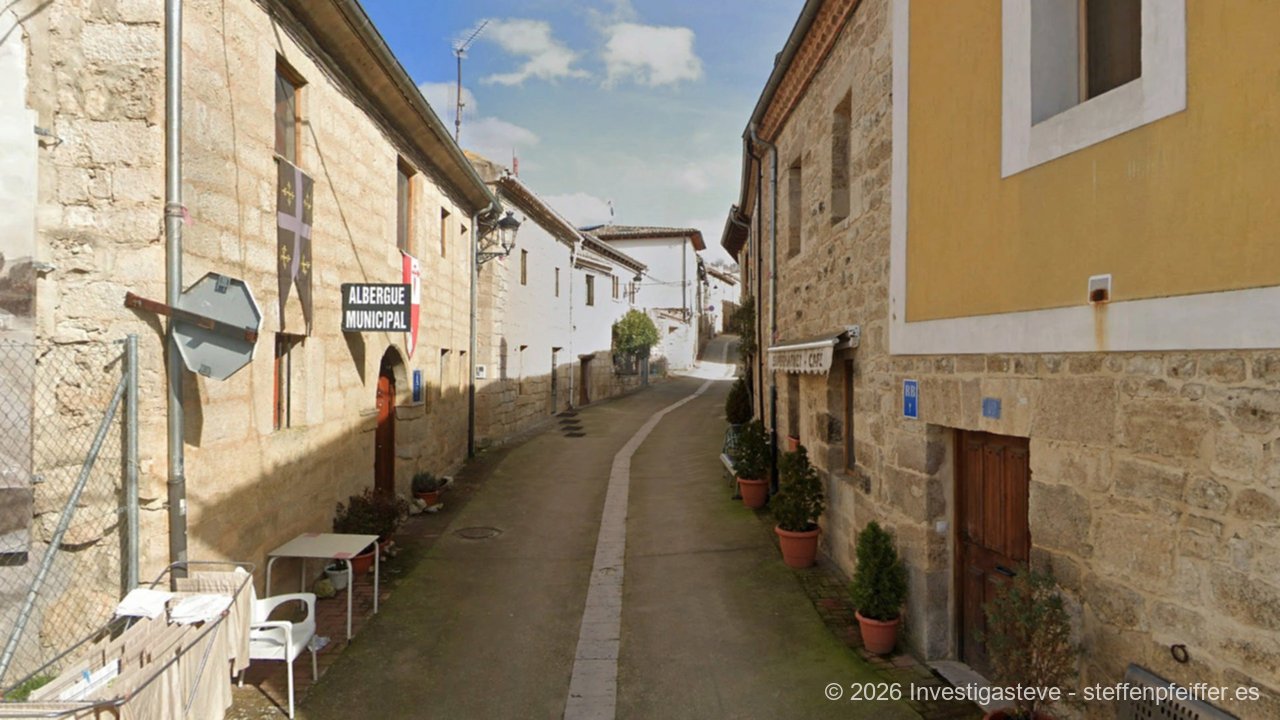
In this moment, the acoustics of your journey change radically. The monotonous whistling of the wind, sweeping unhindered over the fields on the plateau above, falls almost silent the moment you venture the first step into the descent. Instead, you hear a sound that acts like a promise in the dryness of the Meseta: the soft, rhythmic splashing of water. Hontanas, whose name derives from the Latin “fontanas” – the springs – is a place defined acoustically by its fountains. You feel the tactile contrast of the temperature change; the cool, more humid air of the hollow settles like a balm on your sun-heated skin. The ground beneath your boots changes from the hard, cracked earth of the plateau to the solid, centuries-old cobblestones of the village street, leading you deeper into the lap of this stone oasis.
The olfactory signature of Hontanas is a mixture of the freshness of damp rock, the scent of burning poplar wood in the chimneys, and the heavy, inviting aroma of homemade stew wafting from the open doors of the hostels. Psychologically, arriving in Hontanas is a moment of profound relief. You feel sheltered, almost as if returning to a secret hiding place that the outside world has forgotten. The narrowness of the alleys, in contrast to the vastness you have just left, creates a feeling of intimacy and security. Here, in the “village of springs,” you suddenly become aware of why this place has been such an important resting point since the Middle Ages: it is the physical manifestation of rescue and refreshment amidst a relentless landscape.
What This Place Tells
The history of Hontanas is a narrative of strategic concealment and the life-giving power of water. As early as the 13th century, the importance of this place was so great that the Bishop of Burgos, in 1208, spared no expense and acquired the village for the then-enormous sum of 500 maravedíes. You must imagine the historical causality: in a region where water is rarer than gold, a village with bubbling springs was an invaluable asset. The place developed along the Camino, not as a defensive fortress on a hill, but as an inviting Hospital in the valley. Hontanas was the place where the exhausted pilgrim of the Middle Ages, after the dangerous stages through the lonely plateau, finally encountered civilization and care again.
The architectural centerpiece, the Iglesia de la Inmaculada Concepción, tells of this wealth and deep piety. Originally built in the 14th century in the Gothic style and later remodeled in the Baroque, it appears almost disproportionately large compared to the low houses. Its massive tower served not only for the glory of God but was often the first and only point of orientation for pilgrims on the plateau. The historic walls of the church have survived the steps of millions of pilgrims; they have witnessed plagues, wars, and the slow depopulation of the region. Yet Hontanas always endured, firmly rooted at its springs, which never ran dry.
Particularly moving is the story of the former Hospital San Juan, whose ruins still speak of the mercy of times past. Here, pilgrims were not only fed but also given medical care. The Antonine monks, who worked nearby, brought their knowledge of medicinal herbs and the care of “Saint Anthony’s Fire” to Hontanas. As you walk through the streets today, you feel the psychological weight of this history – a place that has alleviated pain and given hope. The continuity of hospitality is almost physically tangible here; it is carved into the stone and carried on by the present-day inhabitants with a pride that shows that Hontanas has never lost sight of its identity. It is a place that teaches that true significance often lies hidden.
Addresses & tips in Hontanas
Camino Distances
🗺️ After the lonely crossing of the plateau from Hornillos del Camino, Hontanas appears like a saving island in the hollow, before the path continues to the ruins of San Antón and on to Castrojeriz.
| Previous Place | Distance (km) | Next Place | Distance (km) |
|---|---|---|---|
| Hornillos del Camino | ca. 10.5 km | San Antón (ruins) | ca. 7.5 km |
Sleeping & Arriving
Arriving in Hontanas is, for many pilgrims, the epitome of “Camino magic.” It is the physical transformation from exhausted hiker to welcome guest. As the village is so compact, social life is concentrated almost exclusively on the few alleys leading to the church. When you take off your boots in front of one of the hostels like “El Puntido” or “Santa Brígida,” the tactile feeling of the cold stone floor beneath your socks is an almost religious experience. The creaking of the old wooden staircases in the renovated stone houses is the soundtrack of your arrival. You feel history in every beam and every uneven floor covering that has stored the steps of generations before you.
The atmosphere in the accommodations of Hontanas is marked by a special intimacy. Since the village cannot be seen from above, pilgrims often feel here like part of an exclusive community sharing a secret. In the inner courtyards of the albergues, the distant murmur of the village fountains mingles with the murmur of conversations in a dozen languages. It is a place of emotional metamorphosis: the tension of the Meseta stage falls away, and a deep, pleasant tiredness spreads. The tactile experience of a warm shower within the thick walls of a house that has defied heat and cold for centuries is pure luxury.
At night, Hontanas transforms into a sea of absolute silence. As the village lies deep in the hollow, no sounds from the outside world penetrate. You hear only the occasional striking of the church clock and the constant flow of water. Sleeping here is deep and regenerative, as if the earth itself were holding you in its protective fold. When you wander through the still dark, cool alleys the next morning, while mist often still hangs in the hollow, you feel a tactile freshness that strengthens you for the ascent back to the plateau. Leaving Hontanas always feels a little like saying goodbye to a protective home you only found a few hours ago.
Eating & Drinking
The cuisine in Hontanas is an honest homage to the Castilian pantry. Here, the food tastes of the earth you have walked over all day. The absolute classic is the “Sopa de Ajo,” the garlic soup often served in large earthenware pots in the hostels. The scent of toasted bread, sweet paprika powder, and robust garlic fills the dining rooms and awakens even the weariest spirits. It is a tactile pleasure to dip the crusty country bread into the hot broth and feel the comforting warmth spreading from the stomach throughout the body.
Another highlight is the water of Hontanas. You should not just drink it; you should celebrate it. The water from the village fountains is so cool and pure that, after the dusty Meseta, it tastes like an elixir. It has a metallic clarity that quenches thirst in a way no bottled water ever could. In the village’s small bars, it is often served with local cheese and spicy chorizo. The taste is intense, salty, and fatty – exactly what the body craves after a day full of deprivation. The heavy red wine of the region, served in simple glasses, rounds off the culinary experience and provides the necessary heaviness to sink into a deep sleep.
The communal dinner in places like Hontanas is a psychological anchor point. You share not only bread but also blister plasters and the stories of the day. The wooden tables, often marked by generations of pilgrims’ knives, offer a tactile connection to the long tradition of sharing. Here, in the depths of the hollow, the food tastes of community and of victory over the distance. Those who experience Hontanas culinarily understand that enjoyment on the Camino does not lie in complexity but in the quality of the simplest ingredients: water, bread, oil, and company.
Supplies & Logistics
Logistically speaking, Hontanas is a small miracle of efficiency. Despite its small population, the village is perfectly adapted to the needs of pilgrims. It functions as a vital supply post between Hornillos and Castrojeriz. In the small shops, often directly attached to the hostels, you find everything you need for the next stage: from fresh fruit to hiking maps to the indispensable energy bars. You sense a logistical professionalism here born from centuries of experience. Every movement by the locals is practiced, every piece of advice well-founded.
Shopping: There are small sales points in the hostels (e.g., El Puntido) that stock food, drinks, and pilgrim supplies. The selection is focused on essentials but of good quality.
Gastronomy: Several restaurants and bars offer pilgrim menus, breakfast, and bocadillos. The cuisine is down-to-earth and tailored to the needs of long-distance hikers.
Accommodation: The bed capacity is surprisingly high for the size of the village. Nevertheless, a reservation is advisable in high season, as Hontanas, due to its unique location, is a very popular overnight stop.
Public Facilities: There are public fountains with drinking water quality and simple sanitary facilities in the accommodations. An ATM or a larger health center, however, is only found again in Castrojeriz.
In summary, Hontanas is logistically a safe bet. You should definitely fill up your water supplies here, as the path to Castrojeriz over the ruins of San Antón is beautiful but often very exposed. The psychological security that Hontanas offers stems from the knowledge that here, the body is taken care of so that the mind can focus entirely on the path again. The village is a perfectly oiled machine of hospitality that has nevertheless never lost its rustic charm.
Don’t Miss
– The “Aha moment” during the descent: Pause briefly before you take the path down into the village. This visual shock – the sudden appearance of an entire settlement in an empty landscape – is one of the most iconic moments of the entire Camino.
– Iglesia de la Inmaculada Concepción: Enter the nave and pay attention to the Baroque altars. The cool silence inside offers a perfect space for a short meditation away from the hustle and bustle.
– The village fountain on the square: It is the beating heart of Hontanas. The tactile experience of holding your forearms under the ice-cold water is the best therapy against the heat of the Meseta.
– The ruins of Hospital San Juan: Search at the western edge of the village for the remains of the medieval Hospital. They are a silent monument to centuries of pilgrim care and a place of deep historical reflection.
– Evening atmosphere on the Calle Real: When the sun is low and the shadows of the houses dance across the cobblestones, Hontanas unfolds an almost unreal beauty. The acoustics of the village evening are balm for the soul.
Insider Tips & Hidden Places
A true insider tip in Hontanas is the search for the tiny, often overlooked stonemason marks on the bases of the church walls. When you run your fingertips over these centuries-old indentations, you touch the personal signature of a craftsman who built this tower stone by stone. It is a tactile connection to the human labor behind the monumental architecture. These small details tell more about the endurance and faith of the people in Castile than any history book.
Another hidden place is the small path that runs along above the hollow when you briefly leave the village. From there, you have a view of the roofs of Hontanas while simultaneously feeling the infinite expanse of the plateau at your back. It is a place of absolute psychological balance between protection and freedom. In the evening hours, when the first lights come on in the village and the smoke from the chimneys rises vertically into the still sky, Hontanas from up here looks like a glowing nest in the dark earth.
Pay attention to the small niches in some house walls where lights were once placed to guide pilgrims at night. These “lights of hope” are mostly empty today, but the psychological causality of their existence is still palpable. They testify to a time when arriving in Hontanas could decide between life and death. The olfactory experience in the narrow side alleys, where it smells of damp earth, mint, and old stone, is a journey back to a time when the world still breathed to the rhythm of footsteps.
Finally, there is a small viewpoint west of the village where you can watch the sunrise while the village still sleeps in the shadow of the hollow. The light first touches the peaks of the distant hills and then creeps down like a golden carpet into the barranco. This visual process is a metaphor for the awakening of hope. Whoever experiences this moment in silence takes a strength on the way to Castrojeriz that goes far beyond physical endurance. It is the moment when the Meseta shows its friendly face.
Moment of Reflection
Do you stand in Hontanas to hide, or to finally be found? The village in the hollow is a powerful metaphor for our own inner world. Often we run over the smooth surfaces of our daily lives, always keeping the horizon in sight, and overlook the deep folds of our soul where the true springs bubble. Hontanas teaches us that sometimes we must descend, slow down the pace, and venture into the depths to find refreshment and healing.
Ask yourself: What is my personal “Llanura,” that barren plateau where I often feel lost? And where within me lies this “Hontanas,” this protective space where I can take off my masks and simply be a guest? The silence of the hollow challenges you to leave the noise of your ambitions outside and listen to the soft splashing of your inner springs. Perhaps you will recognize here that the greatest treasures do not lie on the peaks, but where they are least expected – in the hidden, in the deep, in the still. Are you ready to venture the descent?
Camino of the Stars
This place lies on the Camino Francés, on the stage from Hontanas to Frómista. The sequence of places is:
Hornillos del Camino → San Bol → Fuentes Sidres Albergue → Hontanas → San Antón → Castrojeriz → Alto de Mostelares → Itero del Castillo → Puente Fitero → Itero de la Vega → Boadilla del Camino → Frómista
Did you also experience the moment when Hontanas suddenly appeared before your feet out of nowhere? Did the cool water of the fountains refresh you just as deeply after the heat of the Meseta? Share your experiences, your photos of the “sunken village,” and your very personal thoughts with us via the contact form. We look forward to your story, in whatever language of the way you tell it to us!
About the Author