A First Glance – Introduction & Atmosphere
When you leave the sleeping walls of Castrojeriz behind you early in the morning, you already sense that the path will demand a different sacrifice from you today. Ahead of you, the Alto de Mostelares rises – not as a gentle hill, but as a massive, almost vertical wall of limestone and clay that cuts across the horizon like an insurmountable obstacle. The ascent, respectfully called “La Cuesta” by the locals, begins abruptly. Immediately, you feel the muscles of your calves tensing, your tendons protesting, and your breathing falling into a jerky, hard rhythm. The sound of your own lungs, gasping greedily for the cool, still-moist morning air, becomes the dominant soundtrack of this moment. It is an auditory proof of your existence, a rhythmic panting that mingles with the sharp clack of your hiking poles on the stony ground. Each strike of the poles sends a vibration through your arms up to your shoulders, a tactile feedback of the unyielding hardness of this mountain.
The air smells different up here than in the valley. The heavy scent of the damp earth of Castrojeriz gives way to a tart, almost metallic aroma of dry stone and wild, dusty thyme, which fights for survival in the barren crevices of the ascent. As you worm your way up meter by meter, you feel the sweat welling up under your backpack, a burning contrast to the sudden, cool gust of wind that catches you as soon as you reach the first edge of the plateau. Psychologically, this ascent is a purification. All that is unimportant falls away from you, reduced to the next step, the next breath. You do not look up, so as not to be discouraged, but stare at the texture of the path beneath your feet – at the cracked earth, the small, sharp-edged pebbles, and the dried stalks of the previous year, trembling like skeletons in the wind.
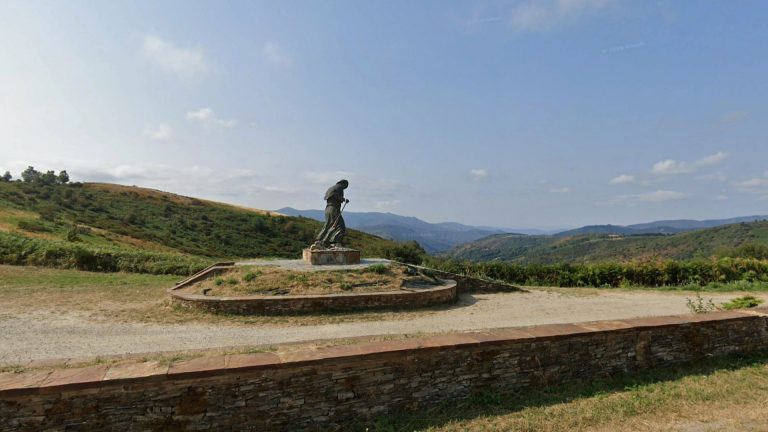
Once at the top, on the edge of the actual Páramo, the metamorphosis happens. Your view expands with a force that almost hurts. Behind you lies Castrojeriz, nestled at the foot of its own castle hill, tiny as a toy village in a sea of ochre and green fields. Before you, however, spreads what pilgrims have both feared and loved for centuries: the absolute infinity of the Tierra de Campos. It is an ocean of grain waves, stretching to the horizon, interrupted only by the shadows of clouds drifting like dark islands over the land. The silence up here is so dense that it almost roars in your ears. It is not an absence of sounds, but a presence of space. You feel the immense dimension of the Meseta not just with your eyes, but with every fiber of your being. The Alto de Mostelares is the gate to another world, where time and space take on new meanings.
What This Place Tells
The Alto de Mostelares is far more than a geological elevation; it is a stone witness to the strategic causality that shaped Castile. Geologically speaking, it is a “Páramo,” a limestone plateau that towers over the valley of the Río Odra as a relic of a long-distant erosion history. During the time of the Reconquista, when the Christian kingdoms pushed south against Moorish dominance, this elevation was of inestimable military value. Whoever controlled the Mostelares controlled access to the Pisuerga basin. The ruins visible in the distance on the castle hill of Castrojeriz correspond directly to the barren expanse of the Mostelares. You can imagine the scouts standing up here in the lashing wind, squinting against the blinding sun, scanning the horizon for dust clouds that would announce approaching troops.
Historically, this point marks the transition from the hilly landscape of the province of Burgos into the flat, almost hypnotic Tierra de Campos, the “land of fields.” This region was once considered the breadbasket of the Roman Empire and later of the Castilian kings. The Alto de Mostelares tells the story of hard labor, harvest cycles, and deprivation. The pilgrim path here leads over trails once trodden by mule carts and sheep herds into the hard limestone. It is a story of movement. As you walk across the plateau, you step in the footsteps of millions. The psychological weight of this place stems from the fact that it offers no hiding places. It forces confrontation with one’s own exhaustion and one’s own insignificance before nature.
In local folklore, the Mostelares is often described as a place of trial. It is said that the mountain reads the intentions of the walker. Those who ascend with pride are bent by the wind; those who come with humility are granted the view into infinity by the mountain. This narrative expansion finds its counterpart in the physical reality of the plateau. There are no trees here to provide shade, no streams to quench thirst. Only the bare, honest contact between sky and earth. The Alto de Mostelares is a monument of constancy. While cities grew and perished down in the valley, the plateau remained what it always was: a silent, majestic stage for the drama of the crossing. It tells that every progress on the Camino – and in life – must first be earned through a hard ascent before the vastness of possibilities becomes visible.
Addresses & tips in Alto de Mostelares
Camino Distances
🗺️ After leaving Castrojeriz, the Alto de Mostelares represents the first and only significant incline of this stage before the path descends into the wide plain of the Tierra de Campos.
| Previous Place | Distance (km) | Next Place | Distance (km) |
|---|---|---|---|
| Castrojeriz | ca. 3.4 km | Itero del Castillo | ca. 7.1 km |
Sleeping & Arriving
Arriving on the Alto de Mostelares does not mean finding a bed, but reaching a state of inner peace. There are no hostels here, no walls to protect you, except the sky above you. “Arriving” happens at the moment when your legs stop burning and your heartbeat calms as you stand at the edge of the plateau. It is a psychological arrival in the Meseta. Many pilgrims choose this place for a first, extended rest after the murderous ascent. When you sit down in the dry grass, you feel the stalks tickling your bare calves and the coolness of the ground slowly seeping through your clothing. It is a tactile moment of grounding after the exertion.
The atmosphere up here is marked by a camaraderie of the exhausted. People nod to each other in silence, share a sip of water, or simply the breathtaking view. It is a place of collective metamorphosis: from the walkers who down in Castrojeriz were still anxiously eyeing the steep slope, they have become conquerors of their own doubts up here. The psychological relief is almost tangible. You feel closer to the clouds than to people, and this feeling of sublimity is the true reward for the sweat of the last half hour. The rustling of windbreakers and the distant whistling of the wind in the telephone wires crossing the plateau form a lonely but comforting backdrop.
If you decide to linger here for a while, you witness a light show unlike any other. The sun shines up here unfiltered, almost aggressive, and yet the light has a clarity that outlines every contour on the horizon with razor-sharp precision. You can see the church towers of villages still hours or days away. This visual promise of the future is the psychological anchor you need for the coming, often monotonous kilometers through the fields. In Itero del Castillo, the next village, you will find a bed, but the memory of “arriving” on the summit of the Mostelares will stay with you deep into the night. It is the arrival at yourself, in the absolute silence of a landscape that tolerates no lies.
Eating & Drinking
Eating and drinking on the Alto de Mostelares is a sacred act of necessity. After the ascent, a simple apple tastes like the most delicious delicacy in the world. The texture of the fruit, the crack of the skin, and the sweet-sour juice moistening the dry mouth become a sensory revelation. You feel the sugar shooting directly into your bloodstream, soothing the trembling muscles. Water up here is no longer just a drink; it is liquid life. The metallic taste of the aluminum flask, the gurgling of the liquid, and the cool freshness in your throat form a tactile contrast to the heat of your body.
Often, pilgrims unpack their supplies from Castrojeriz up here: a piece of hard, crusty bread, a slice of salty ham, or a bar of dark chocolate. The smell of the ham mingles with the aroma of the dusty wind to form an olfactory signature of the Camino. You eat slowly, almost reverently. Each bite is chewed consciously while your gaze sweeps over the endless fields. There is no hurry here, because the Mostelares forces a pause. The rhythmic chewing and swallowing are the only sounds in the vast silence, an intimate moment of self-care amidst a barren nature.
Those who rest up here often share their supplies. A handful of nuts passing from hand to hand, a piece of fruit being shared – these small gestures of generosity taste of community. The psychological effect of a shared meal in such an exposed place is immense. It connects pilgrims across language barriers. In the simplicity of the food lies the true strength for the path. You learn up here that you don’t need much to be happy. A shady spot in the lee of a rock, a water bottle, and the vastness of the horizon suffice to satiate the soul. The culinary experience of the Mostelares is one of reduction to essentials, a taste of freedom and achieved distance.
Supplies & Logistics
The logistics of the Alto de Mostelares are a lesson in self-reliance. There are no kiosks up here, no water taps, and no shelters. Those who dare the ascent must carry their entire survival kit on their backs. The weight of the backpack, which you feel in every fiber of your back during the ascent, is the physical manifestation of your preparation. Supply begins in Castrojeriz, where you must absolutely refill your water reserves. The mountain forgives no carelessness. When you arrive at the top and find your bottle empty, the psychological strain of the Meseta begins earlier than planned.
Shopping: In Castrojeriz, you should stock up on sufficient water (at least 2 liters per person in heat) and energy-rich snacks. On the plateau itself, there are no shopping options whatsoever.
Gastronomy: There is no catering. The Mostelares is pure nature. The next opportunity for refreshment is only in Itero del Castillo or at the Hospital de San Antón (if staffed).
Accommodation: Wild camping is strictly prohibited and, due to the winds, also uncomfortable. The next official beds are in Itero del Castillo or back in Castrojeriz.
Public Facilities: No toilets, no shelter. In case of approaching thunderstorms, the plateau must be left immediately due to the risk of lightning.
In summary, the Alto de Mostelares is logistically a “zero point.” It demands forward-looking planning from the pilgrim. You must learn to manage your resources – both water and your own strength. The descent after crossing the plateau is often as steep and rocky as the ascent, putting a strong tactile strain on the knee joints. Those who have their logistics under control can enjoy the spiritual expanse of the place without being distracted by physical needs. The Mostelares is a school of self-sufficiency, a place where you learn that you are your own most important provider.
Don’t Miss
– The view back at Castrojeriz: Turn around several times during the ascent and at the top edge. The perspectival shrinking of the village is a visual measure of your physical achievement. The castle ruins on the neighboring hill appear almost at eye level.
– The compass rose plaque: At the top of the plateau, there are often small markers or cairns. Search for the point where you feel you are standing exactly in the middle between heaven and earth.
– The silence of the fields: Sit down for five minutes and close your eyes. Listen to the whistling of the wind and the distant rustling that sounds almost like the sea – it is the grain stalks of the Tierra de Campos.
– The boundary stone of the districts: Pay attention to the stone markers along the path. They are tactile evidence of the historical division of this barren land.
– The flora of the Páramo: Look at the tiny, hardy plants. They smell intensely of essential oils after rain or in the blazing sun. An olfactory wonder of barren nature.
Insider Tips & Hidden Places
A true insider tip on the Alto de Mostelares is the search for the “fossils of silence.” If you move just a few meters off the main path into the scree, you often find fossilized shells or imprints from a time when this plateau was still the floor of a sea. This tactile connection to millions of years of earth history immediately relativizes your own worries and foot blisters. It is a moment of deep historical causality – the knowledge that you are walking over an ancient seabed that now lies dried out in the wind.
Another hidden place is the lee behind the large stone blocks on the western edge of the plateau, just before the steep descent begins. Here, butterflies and small lizards often gather, using the warmth of the limestone. If you linger there, you can observe the bustling activity of nature on a small scale, hidden from the fleeting pilgrim’s eye. It is an auditory pleasure to listen to the fine scratching of lizard paws on the stone while vultures circle soundlessly above you.
The psychological depth of the place also reveals itself in the “stone messages” that pilgrims have left here. They are not large monuments, but often tiny arrangements of pebbles that form names, dates, or wishes. When you run your hand over these stones, you feel the energy of hope deposited up here. It is an invisible altar of desires, making the Mostelares a place of emotional metamorphosis.
Those who have time should inhale the scent of the plateau after the first rain. It is an olfactory event you will never forget. The mixture of wet limestone, reawakening thyme, and the freshness of the Meseta air is like a perfume of freedom. This moment of freshness after the heat is the most valuable insider tip that the Mostelares holds for the patient hiker. It is the smell of victory over one’s own inertia.
Moment of Reflection
Do you stand on the Alto de Mostelares because you have to, or because you finally want to see how far your horizon truly reaches? The mountain is a metaphor for every hurdle in your life. It does not ask about your fitness, but about your will. When you stand at the top and the wind lashes your clothes, do you feel the cold of loneliness or the freedom of independence? The Mostelares takes your breath away to give you a new perspective.
Perhaps you realize up here that the path behind you was just as important as the infinity before you. The castle of Castrojeriz, now appearing so small, symbolizes your past – solid, safe, but abandoned. The Tierra de Campos before you is your future – vast, confusing, but full of light. Which part of your old self did you leave on the stones during the ascent? And what are you willing to take with you into the infinite expanse of the next stages? The silence of the plateau gives you the answer if you are brave enough to listen to it.
Camino of the Stars
This place lies on the Camino Francés, on the stage from Hontanas to Frómista. The sequence of places is:
Hontanas → San Antón → Castrojeriz → Alto de Mostelares → Itero del Castillo → Puente Fitero → Itero de la Vega → Boadilla del Camino → Frómista
Did the “Wall of Mostelares” also push you to your limits, or was it the moment of absolute freedom on the plateau that changed you forever? Perhaps you found a fossil or had a special encounter in the wind of the Páramo? Write us your story about this threshold place of the Camino – we look forward to your experiences via the contact form, in every language of the way!
About the Author