A First Glance – Between Heaven and Earth
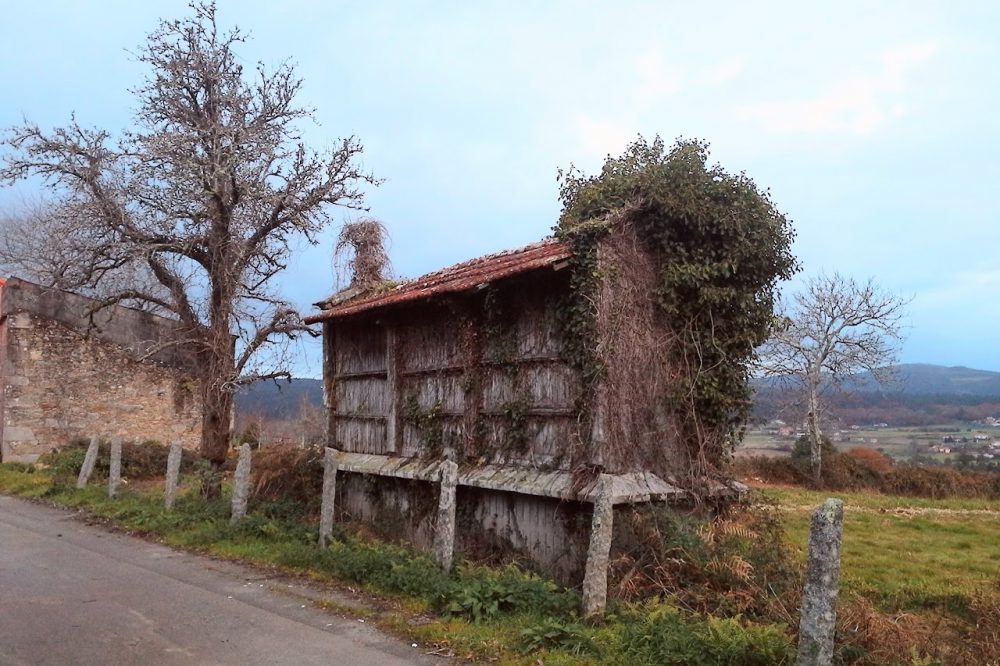
Anyone walking through Galicia will see them sooner or later: small houses on legs, light, almost floating – the hórreos. Between the gray of the granite walls, the green of the meadows, and the blue shimmer of the Atlantic, they appear like silent observers of life.
These granaries, whose name comes from the Latin horreum (“storehouse”), accompany pilgrims along the Camino de Santiago, especially on the routes through A Coruña, Pontevedra, Lugo, and Ourense.
They stand at the edges of fields, behind churches, sometimes in the middle of village squares, and tell of a culture that united the practical with the spiritual.
What These Constructions Tell Us
The hórreos arose from a simple necessity: the protection of the harvest. In a region where rain is not a visitor but a constant companion, grain, corn, and chestnuts had to be stored dry and safe.
They are documented since the 13th century, though probably older. Some archaeologists point to Roman storage forms, others to Celtic drying platforms. What is certain is that the hórreo became a symbol of the Galician way of life – and an architectural heritage represented today by more than 30,000 examples across Galicia.
Their structure follows an ingenious logic: a rectangular body of stone or wood rests on pillars topped with vira-ratos – flat granite slabs. These barriers prevent rats and mice from reaching the harvest.
Through fine ventilation slits – usually cut into wooden boards – air circulates to keep the interior dry. The roofs are covered with stone slabs or tiles, and the gables often bear crosses or obelisks. These symbols are not merely decorative but part of popular belief: they protect the stores from envy, witchcraft, and storms.


Construction and Purpose
Three main types can be distinguished:
- Stone hórreos, found most frequently in coastal regions such as Fisterra or Carnota;
- Wooden hórreos, common in the inland areas, built from chestnut or oak wood;
- Combined versions, where the base is made of stone and the body of wood.
Depending on the region, hórreos change their shape, almost as if adapting to the landscape. In the province of Pontevedra, they are narrow, tall, and elegant – built to breathe in the humid coastal winds. Further inland, in Lugo or Ourense, they become broader and more compact, often with four to six pillars on each side. There, they defy cold rather than sea spray.
An average hórreo measures between six and ten meters, yet some exceed all standards: the famous granary of Carnota reaches an impressive thirty-five meters in length and rests on twenty-two pillars – eleven on each side.
In earlier times, nearly every family owned its own hórreo. Wealthier farmers built several, visible symbols of abundance and prosperity. In smaller villages, people shared what they had: so-called hórreos comunales – communal granaries, built, used, and maintained together.
Today, most of them no longer serve for storage. Their value has transformed – from practical to symbolic. They have become quiet emblems of Galicia, memories carved in stone and wood. Many have been restored, some protected as historic monuments, others integrated into the cultural heritage of the Xunta de Galicia. They still stand – no longer full of grain, but full of history.
Famous Sites and Masterpieces
Some places have turned their hórreos into landmarks:
- Carnota (A Coruña): The most famous hórreo of Galicia, built in 1768, flanked by the Church of Santa Columba. Thirty-five meters long, twenty-two pillars – a national monument.
- Combarro (Pontevedra): The “open-air museum of hórreos,” with more than 60 granaries right by the Ría de Pontevedra. At high tide they are reflected in the water; at low tide, their ancient stone bases emerge.
- A Merca (Ourense): The largest ensemble, with 34 hórreos on one square – each differing in height, shape, and roof.
- San Andrés de Teixido: A pilgrimage site on the Costa da Morte, where the hórreos are part of the sacred landscape. Legend says that every person must visit San Andrés de Teixido at least once in life – those who fail to do so return as souls in the form of insects or animals. The village itself lies dramatically on the cliffs of the Costa da Morte, where the wind plays with the stories of pilgrims and sea and sky blend into one.
- Araño (Rianxo) & Poio: Famous for their unusual width and intricate roof designs.
- Piornedo (Lugo): Home to the oldest wooden hórreos, some standing beside Celtic roundhouses, the pallozas.
These places form a quiet architectural Camino of their own – a path of stone, wood, and memory.
Legends and Symbolism
Countless stories surround the hórreos. In earlier times, people believed that a good spirit lived in each granary, protecting it only as long as the owner treated the stored food with gratitude. The crosses on the gables were meant not only to secure divine blessing but also to keep away the meigas – witches and sorceresses. In some villages, people would place bread or chestnuts at the base at harvest time, as an offering to the spirit of the house.
Others said that the hórreos spoke to the stars: their narrow shape served not only for ventilation but for the “breath of heaven” that flowed through them. The symbolism remains clear – earth, nourishment, protection, and faith, all united in one structure spanning the space between field and sky.
Curiosities and Special Facts
- In Galician law, hórreos are sometimes classified as movable property: they can be inherited, relocated, or sold, provided they are not protected monuments.
- Estimates mention about 30,000 hórreos in Galicia and 18,000 in Asturias.
- Some, especially in Piornedo and A Merca, have been converted into small eco-museums displaying agricultural tools and sacks of grain.
- Modern replicas made of concrete or sheet metal are considered expressions of feísmo – the alienation from traditional architecture.
- In some regions, hórreos are used as holiday cottages or art galleries, always with the condition that their original structure remains untouched.
Despite modernization and depopulation, they remain symbols of rural Galicia – resilient, quiet, profoundly authentic.
Don’t Miss
Anyone following the Camino will encounter hórreos at every step: in the valleys of O Cebreiro, on the hills of Negreira, by the sea near Fisterra. Particularly worthwhile are the ensembles in Combarro and Carnota, where history, landscape, and popular faith merge into a single image that lingers in memory.
A Moment of Reflection
Perhaps hórreos are more than harvest chambers. They are small parables: stable, practical, open to wind and light – and yet firmly rooted. Like the pilgrim who carries his journey step by step, they carry the memory of work, community, and faith. Do you stop when you see one, or do you walk on – knowing that it, too, has been doing the same for centuries?
Camino of the Stars
The hórreos accompany many routes: the Camino Francés, the Camino Primitivo, the Camino del Norte, and especially the Camino de Fisterra-Muxía, where they often stand right beside the pilgrim paths.
The best known follow this sequence:
O Cebreiro → Portomarín → Arzúa → Santiago → Negreira → Dumbría → Fisterra → Muxía … and everywhere – between eucalyptus and sea – they appear again, witnesses of the Galician soul.
By the way: if you’ve mapped and photographed a beautiful hórreo (or several) with its coordinates, feel free to send me the photo, location, and your name, and after verification, I’ll add you to the map.
About the Author