First Glance – Introduction & Atmosphere
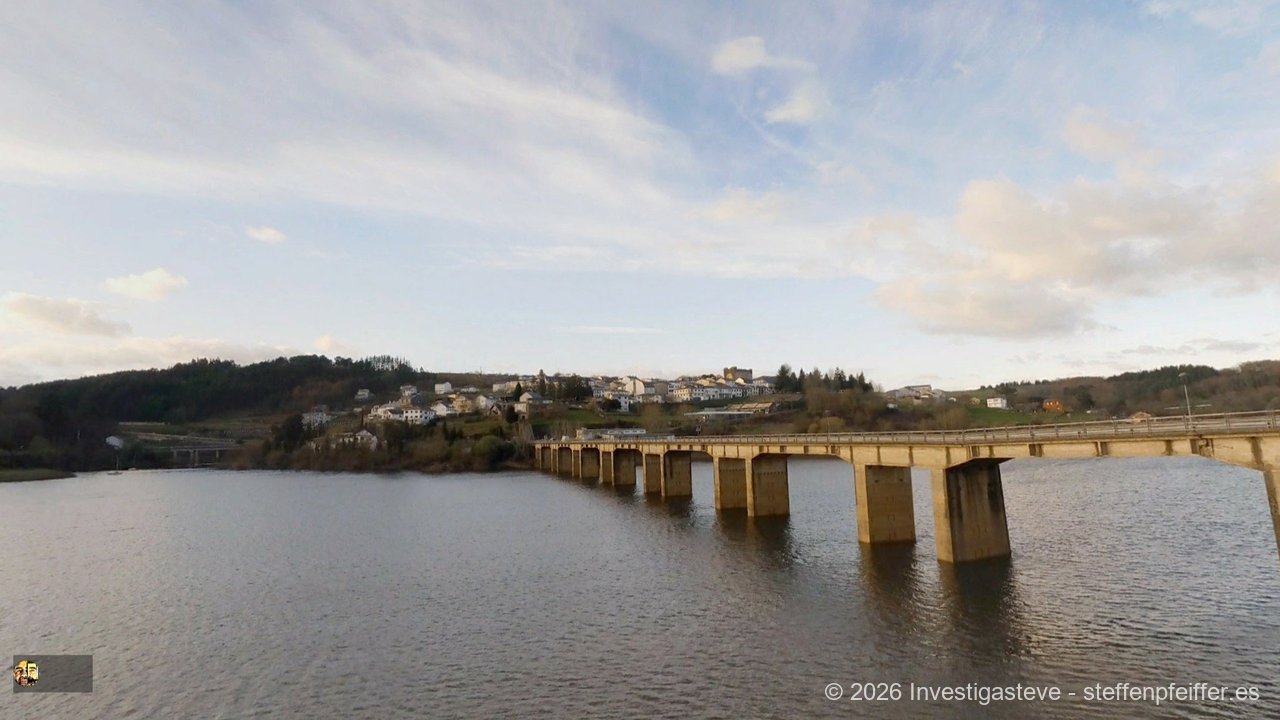
When you have worked your way through the dense oak forests and over the gentle hills of Galicia after setting off from Sarria, Portomarín does not simply announce itself – it demands your full attention. From afar, when the path emerges from the shady trails, a panorama opens up that seems almost surreal in its dramatic vastness. Deep down in the valley, the blue ribbon of the Miño glitters, widening here into the Belesar reservoir. The air at this point is often filled with a fine, silvery haze that lies like a soft-focus lens over the landscape, while the wind, steadily rising from the water, carries the tart aroma of ferns and the cool freshness of the river. Your gaze inevitably falls on the imposing, modern bridge that stretches like a grey concrete finger over the water, and on the monumental staircase that, on the other bank, leads into the town like a stone ladder to heaven.
Arriving in Portomarín is an experience of physical and emotional overwhelm. You feel the rhythmic click of your pilgrim staffs on the asphalt of the bridge, a sound that merges with the monotonous rustle of the wind and the distant gurgle of the water into a meditative backdrop. Your hand on the railing feels the cool smoothness of the metal, while beneath you the depth of the valley suggests an almost dizzying freedom. When you finally reach the foot of the staircase, formed from the arches of the old, sunken bridge, an act of ritual ascent begins. Step by step, you push yourself upwards, feeling the burning tension in your thighs and the rough texture of the granite beneath your soles. Once at the top, the place welcomes you with an atmosphere that is a strange mixture of triumphant arrival and melancholic silence. It smells here of roasted coffee from the little bars on the square and of the damp heaviness of the centuries-old church walls. In Portomarín, you are no longer just a walker; you become part of a narrative of loss, rebirth, and the unshakeable constancy of the human spirit.
What This Place Tells
Portomarín is a town of two faces, a place that literally rose from the floods. Its history is one of the most radical transformations along the entire Camino de Santiago. Until the 1960s, old Portomarín lay deep in the valley, directly on the banks of the Miño. It was a flourishing medieval centre, characterised by a significant bridge and powerful fortified churches guarded by the medieval military orders – the Templars and later the Knights Hospitaller. But the construction of the Belesar reservoir sealed the fate of the old town. The village was to sink beneath the waters. In an unprecedented feat of strength worldwide, the residents and monument conservationists decided not to abandon the most important structures. Stone by stone, the monumental church of San Nicolás (also called San Juan) and the church of San Pedro were dismantled, numbered, and rebuilt exactly as they had stood in the valley for centuries, up on the hill, Monte do Cristo.
The historical causality of this place is visible today in every joint. When you stand before the fortress church of San Nicolás, you notice the small, white numbers on the dark granite ashlars – silent witnesses to a logistical masterpiece of the 1960s. This church is no ordinary house of God; it is a fortress of God. With its high walls, battlements, and crenellations, it looks like a stone guardian that once defended the Miño crossing against invaders. Historical immersion becomes a physical experience here: the coolness emanating from the interior of the thick walls carries the smell of beeswax and incense that has settled in the pores of the stone over generations. You can almost feel the presence of the knights of the order who once channelled and protected the streams of pilgrims here.
But Portomarín also tells the story of the “Galician Atlantis”. When the water level of the reservoir drops in dry summers, the Miño reveals the ruins of the old village once more. Then the stone skeletons of the houses, the pillars of the medieval bridge, and the outlines of the old cemetery emerge like ghosts from the past. This psychological layer of the town – the knowledge of the sunken beneath the visible – gives Portomarín a depth that goes far beyond the architectural. It is a parable for the Camino itself: we leave old things behind, sink ballast in the depths of our memory, only to rise again to new heights. The historical constancy of the town is thus not a static monument but a dynamic process of renewal, finding its firm anchor in the 1200-year tradition of the pilgrims to Santiago.
Addresses & tips in Portomarín
Camino Distances
Portomarín is a classic stage destination at the end of the route from Sarria and forms the spectacular start for the onward path towards Palas de Rei.
Sleeping & Arriving
Arriving in Portomarín is like entering a fortress of hospitality. After the sweat-inducing climb up the monumental staircase, the village opens up as a highly efficient yet welcoming pilgrim centre. The selection of accommodation is immense and reflects the importance of the place as one of the central hubs of the last 100 kilometres. The public Xunta hostel is prominently located at the entrance of the town and offers that classic, almost monastic framework that many pilgrims seek. Here, the atmosphere is characterised by the polyphonic babble of languages in the corridors and the rhythmic clatter of lockers. You feel the collective relief of an entire community that has successfully completed the day.
For those seeking a slightly more intimate or modern experience, Portomarín offers a variety of private hostels and guesthouses, such as Albergue Ultreia or Aqua Portomarín. The tactile experience at check-in is often associated with the coolness of stone floors and the scent of freshly washed linen drifting through the open windows of the dormitories. The psychological component of “treating yourself” plays a big role here; many pilgrims opt for a private room to mobilise their reserves for the demanding next section after the first days of the journey. The sanitary facilities are generally of an excellent standard, and the feeling of hot water on tired muscles is often perceived in Portomarín as the true luxury of the day.
Particularly noteworthy are the communal areas and terraces of the hostels, which often offer a breathtaking view over the Miño Valley. Sitting here while the sun slowly sinks behind the western hills, dipping the sky in a deep violet, is a form of mental regeneration that has a lasting effect. The acoustic backdrop of the evening consists of the distant ringing of the church bells of San Nicolás and the soft murmuring of conversations on the squares. Stories about the path are shared, blisters are treated, and plans are made for the next morning. Staying overnight in Portomarín means becoming part of a pulsating organism that comes to rest at night only to awaken with new energy at daybreak.
The logistical professionalism of arriving in Portomarín is remarkable. From efficient check-in to the provision of laundries to luggage transport, everything is designed to relieve the walker. It is a place of preparation. The smell of detergent mixes with the aroma of the evening meal being prepared in the hostels’ kitchens. Those who come to rest here feel the security of a town that specialises in catching tired people and sending them back out into the world strengthened. It is a healing stay that regenerates the body and sharpens the mind for the coming challenges.
Eating & Drinking
The gastronomic stage of Portomarín is a homage to the treasures of water and soil. As you walk through the cobbled streets to the central square, you are inevitably drawn by the tempting aroma of boiling octopus. Portomarín is known for its excellent pulperías, where the national dish of Galicia – Pulpo á Galega – is perfected. The steam rising from the large copper cauldrons carries the scent of bay leaf and sea water. The octopus is served on traditional wooden plates, generously drizzled with golden olive oil and refined with coarse sea salt and the indispensable pimentón. The texture of the tender meat on the tongue is a reward that feels almost like a religious experience after a long day of walking.
An absolute speciality of the local cuisine is the Miño eel (anguila), offered in various variations in the town’s restaurants – often baked or in a spicy sauce. This is a direct culinary causality of the location on the river. Those who appreciate the taste of the sea will find what they are looking for here. To round off a meal, the famous Tarta de Portomarín should not be missed, an almond cake whose recipe is often kept as a family secret. Its taste is characterised by the fine sweetness of the almonds and a light note of lemon zest, while the bite is firm yet juicy. Traditionally, a sip of Aguardiente, the local pomace brandy, is served with it, for which Portomarín is famous far beyond its borders. Every spring, the Fiesta del Aguardiente is celebrated here – proof of the deep cultural anchoring of this “water of life”.
Drinking a cool Galician beer or a glass of Ribeiro wine from a traditional ceramic bowl, the cunca, is part of the evening ritual. The cool weight of the bowl in your hand and the earthy, fresh taste of the wine form the perfect soundtrack for reflecting on the day. Eating in Portomarín means literally absorbing the power of Galicia. It is an honest, powerful cuisine that does without trendy frills and instead relies on the quality of the basic products. The acoustic panorama in the restaurants – the clatter of cutlery, the laughter in different languages, and the hiss of the taps – creates an atmosphere of community that nourishes and strengthens the pilgrim.
Supplies & Logistics
Logistically, Portomarín is a powerhouse on the Camino Francés. As one of the best-equipped towns in the province of Lugo, it offers everything the pilgrim’s heart desires and what is necessary for a smooth journey. The strategic importance as a stage destination has created an infrastructure that leaves nothing to be desired.
Shopping: Several well-stocked supermarkets (such as Supermercado Miño) cover the daily need for food and hygiene items. There are specialised bakeries offering fresh Galician country bread and the famous tartas. In the pilgrim shops, you will find replacements for worn-out equipment, from walking sticks to rain ponchos.
Gastronomy: The density of restaurants, bars, and cafés is enormous. From a quick tapa at lunchtime to a generous pilgrim’s menu in the evening, food is always available, with opening hours strictly aligned with the rhythm of the walkers.
Sleeping: With a capacity of over 800 beds in various categories (Xunta hostel, private hostels, guesthouses, hotels), Portomarín is prepared for large pilgrim flows. Nevertheless, advance reservation is recommended in high season, especially in private accommodations.
Public Facilities: The town has a health centre (Centro de Saúde) for medical emergencies, two well-stocked pharmacies specialising in pilgrim ailments, as well as several banks with ATMs. The tourist information office offers comprehensive maps and the coveted stamp for the credential.
Particularly noteworthy is the logistical connection for luggage transport. Almost all hostels cooperate with the major services that bring backpacks to the next destination. Mobility for the “footsore” is also ensured by local taxi companies and bus connections to Lugo or Sarria. Safety in Portomarín is exemplary; the town is a pure pilgrim zone where social control by the locals and the constant presence of the Guardia Civil offer a high level of protection. Portomarín is the place where you can replenish your supplies, care for your body, and mentally prepare for the demanding next section to Palas de Rei. Here, logistics become an invisible but reliable companion on your path.
Don’t Miss
- The church of San Nicolás (San Juan): Admire the monumental defensive architecture and look for the small numbers on the stones that tell of the relocation of the town.
- The staircase at the entrance: Climb the monumental steps formed from the arches of the old medieval bridge – a tactile transition into the new town.
- The ruins of old Portomarín: When the reservoir’s water level is low, a walk to the sunken houses and the old bridge is a must for history enthusiasts.
- Church of San Pedro: Visit the second great stone monument of the town, also rescued from the sunken valley, and enjoy its silence.
- Viewpoint in the town park: Treat yourself to a moment on one of the benches in the park above the Miño and let your gaze wander over the vastness of the water.
- An Aguardiente tasting: Try the local spirit in one of the bars on the Plaza Mayor – it is the liquid soul of the region.
- The central square (Plaza Mayor): Linger under the arcades and observe the pulsating life of the Camino, which comes together here as if under a magnifying glass.
Insider Tips & Hidden Places
Away from the marked main path and the busy squares, Portomarín hides corners of almost ethereal silence. One of these is the small path leading from the town park slightly downhill towards the lakeshore. While most pilgrims hurry eagerly to their hostels, this area offers an acoustic oasis. When you sit down under the old chestnut trees, the babble of voices from the village disappears and is replaced by the gentle lapping of the Miño and the rustle of the leaves. It is a place for the tactile experience of nature: run your hands over the moss-covered stones of the shoreline fortification and feel the coolness of the Galician granite. Here it smells intensely of fresh mint and damp earth – an olfactory contrast to the urban bustle.
Another hidden place is the small chapel near the cemetery on the edge of town. Almost no tourist strays here, yet the building preserves an intimacy often lost in the large San Nicolás church. In the evening hours, when the light falls flat over the hills, silhouettes are created here that look like old legends. It is the perfect spot for the flow of your own thoughts, a space without distraction where the history of Galicia whispers in every crack of the masonry. If you look closely, you will often find inscriptions on the walls of the cemetery that go far beyond the religious and tell of the deep connection of the people to their sunken land. This melancholy of displacement from the valley is still palpable in the air up here.
Did you know that there is a narrow passage in Portomarín, hidden behind the church of San Pedro, that leads directly to a small hill from which you have the best view of the sunken pillars of the old Roman bridge? This place is an insider tip for photographers and dreamers. When you stand there at dusk, the boundary between the water world below and the stone world above seems to blur. It is a moment of historical immersion in which you realise that time does not run linearly but lies in layers on top of each other. Such discoveries reveal themselves only to those willing to adapt the pace of their journey to the speed of their soul.
Finally, it is worth seeking out the small side streets leading away from the central arcades in the late evening hours. There you will often find tiny craft businesses or private wine cellars that open their doors to initiates. The smell of old wood, tanned leather, and homemade wine is ubiquitous here. It is the “real” Portomarín that exists beyond the pilgrim industry – a place of work, tradition, and an unshakeable joy of life despite all historical ruptures. Those who take the time to perceive these nuances discover a town that is far more than just a stopover; it is a living testament to the power of human community.
Moment of Reflection
In Portomarín, you stand at a place of maximum transformation. The town itself is a metaphor for the Camino: everything important was saved, carried to a new place, and there recharged with new meaning. In the silence before the fortress church of San Nicolás, ask yourself: “What from my life is worth preserving and taking with me when I change?” The psychological metamorphosis that Portomarín triggers in the pilgrim is the shift from physical achievement to awareness of continuity. The stone gives you the necessary grounding, while the sunken village in the Miño teaches you that farewells are necessary to build something new.
The historical causality of your being here connects you with the knights of the order and the millions of people for whom this place was a spiritual lifeline. Do you feel the responsibility to carry forward this heritage of protection and renewal? In Portomarín, you become aware that the Camino is not mere walking, but an archaeological dig in your own soul. The tactile reality of the rough granite under your hands reminds you of your own resilience. Use this moment of reflection to clear your mind for the coming stages. When you leave Portomarín tomorrow and climb the heights towards Toxibó, take the “light of resurrection” of this town with you. It will be your anchor when the path demands more of you again. Here, in the silence of the stones, you have found the strength to continue your journey with a new, indestructible dignity.
Camino of the Stars
This place lies on the Camino Francés, on the stage from Sarria to Palas de Rei. The sequence of places is:
Sarria → Barbadelo → Rente → Mercado da Serra → Brea → Ferreiros → Mirallos → A Pena → Mercadoiro → Vilachá → Portomarín → Toxibó → Gonzar → Castromaior → Hospital da Cruz → Ventas de Narón → Ligonde → Airexe → Portos → Lestedo → A Calzada → Palas de Rei
Did you also feel that moment of triumph when climbing the monumental staircase of Portomarín, or search for the shadows of the sunken village on the banks of the Miño? Perhaps you were impressed by the defensive character of the church of San Nicolás, or did the almond cake with a glass of Aguardiente give you new strength? Share your personal impressions, your photos of the numbered stones, or your insider tips from the alleys with us. Your story inspires other pilgrims to see more than just a logistical stopover in Portomarín – we look forward to your tale!
About the Author