First Glance – Introduction & Atmosphere
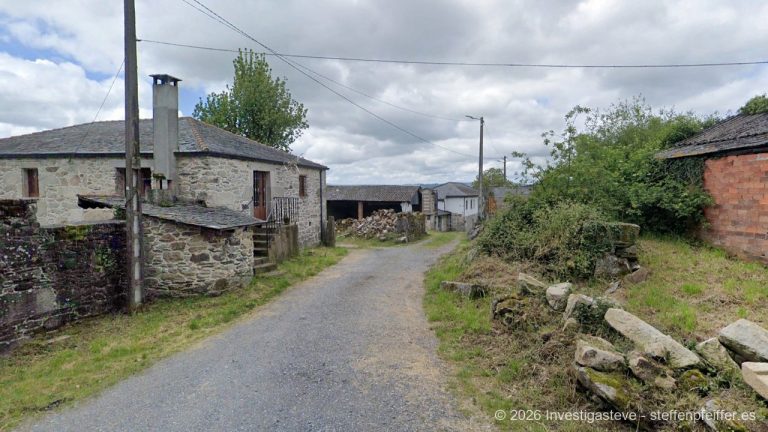
When you cross the gentle high plains of the Comarca Ulloa and leave the shadows of the eucalyptus groves behind you, you reach Portos, a place that almost shyly evades the fleeting gaze. It is not a village in the conventional sense with a market square and town hall, but an archaic hamlet, a cluster of a few, weather-beaten stone houses scattered as if tossed in the green campiña. The air here has an almost crystalline purity, often saturated with the fine, almost invisible Galician drizzle, the orballo, which settles on your skin like a cool veil. You hear the rhythmic, almost meditative click of your pilgrim staff on the uneven ground, a sound that finds a soft echo in the wide, open landscape. It mingles with the distant, melancholic ringing of cowbells and the deep, soothing rustle of the wind in the treetops, which carries stories from the nearby mountains.
In Portos, you feel the tactile reality of Galicia in its most unadulterated form. The rough, lichen-covered granite walls of the traditional farmsteads feel cool and unyielding beneath your fingers – a testament to centuries of constancy against the elements. The smell of freshly mown hay and the tart, earthy scent of damp fern form an olfactory backdrop that instantly decelerates you. Psychologically, Portos marks a decisive threshold for many pilgrims: it is the moment when the exhaustion of the preceding kilometres from Portomarín gives way to a sudden, reverent curiosity. The visual panorama of wide pastures and scattered hórreos, the typical granaries on stone stilts, conveys a feeling of archaic security. Here, you are no longer just a walker on a map; you become part of a timeless continuum, a passage that prepares you physically and mentally for what waits hidden away from the main path.
What This Place Tells
The narrative of Portos is inseparable from its geographical role as a “Porta” – a Latin legacy that marks the place as a gate or transition point. Historical causality leads us back to the 12th century, when the Camino Francés experienced its first great flowering. Portos lies at the highest point of this stage, a high-plain passage that acts strategically between the regions of Portomarín and Palas de Rei. Yet the true, deeper story of this hamlet only reveals itself when you turn your gaze eastward. In the Middle Ages, Portos was far more than just a transit point; it was the functional anteroom to the Monasterio de Vilar de Donas, one of the most significant religious centres of Galicia. Here, at this unassuming crossroads, pilgrims were once received, or at least assured of the protection, by the Caballeros de Santiago, the legendary knights of Saint James.
The connection to the Monasterio de San Salvador de Vilar de Donas gives Portos a spiritual gravity that far exceeds its modest size. The foundation of Vilar de Donas by women of the Arias de Monterroso family – the name-giving Donas or ladies – tells a fascinating story of female power and piety in an otherwise male-dominated era. When the monastery was donated to the Order of Santiago in 1148, it transformed into a mausoleum for the deceased knights of the order. Within this structure, Portos likely functioned as a kind of filter, a place of first rest before entering the consecrated ground of the pantheon. As you walk through the hamlet today, you feel the historical immersion in the weight of the stones; it is as if the walls still preserve the echoes of the armoured steps and quiet prayers of the knights who guaranteed the safety of pilgrims for centuries.
But the history of Portos is also a narrative of silence and constancy. While the great centres of the Camino experienced wars, secularisations, and modern mass tourism, this small hamlet remained a silent witness to rural tradition. The way of life here is characterised by morriña, that deep Galician longing reflected in the melancholy of the decaying stone houses and the vastness of the landscape. The historical causality of the place lies in its inconspicuousness: it preserved authentic Galician village life precisely because it was never the object of great ambitions. Only the modern Camino boom has brought Portos back into the world’s consciousness – not as a spectacular sight, but as a place where you can touch the soul of the Way in its simplest, most honest form. A visit here is like opening a secret chamber in the great book of the Camino de Santiago.
Addresses & tips in Portos
Camino Distances
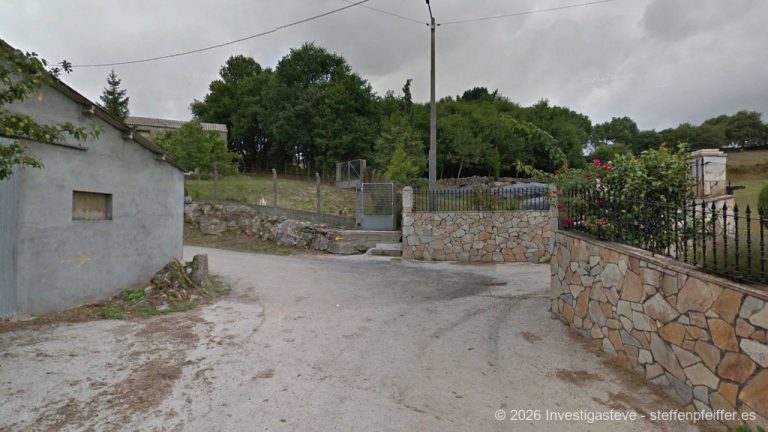
After about 1.5 kilometres through gentle rolling hills and open meadows, the gate to the hamlet of Portos opens here.
Sleeping & Arriving
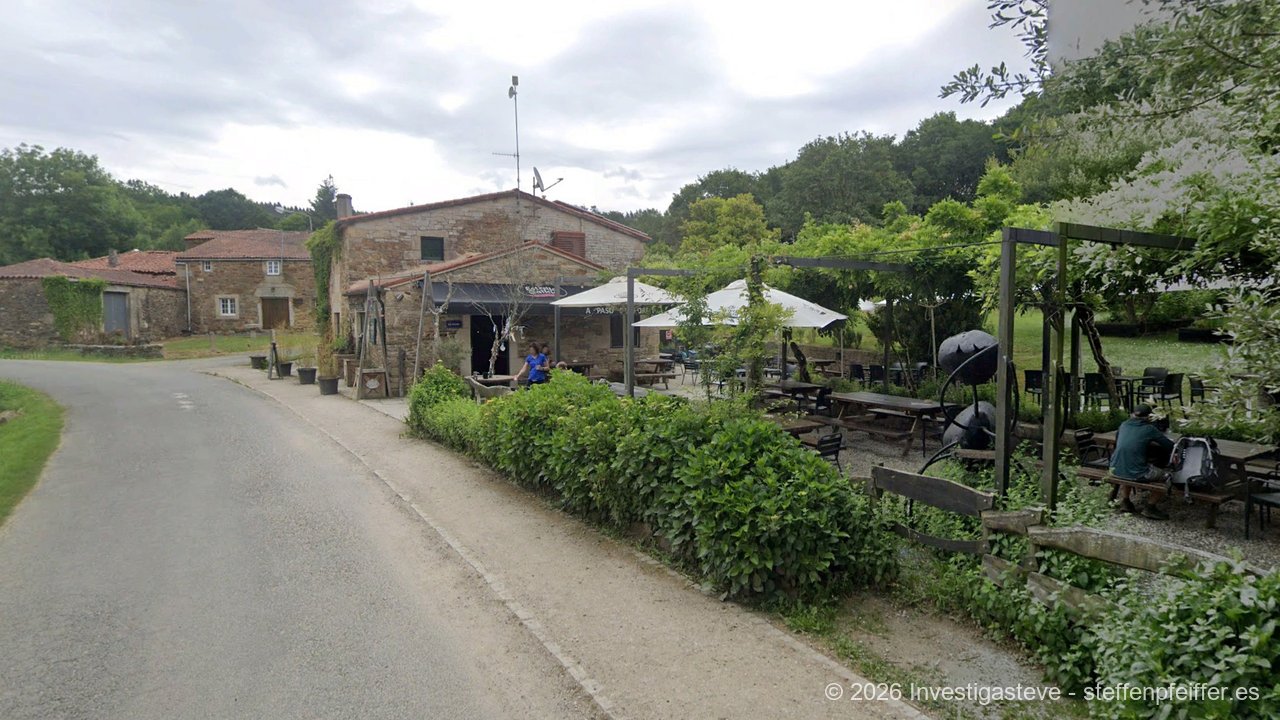
Arriving in Portos is an experience of radical deceleration. When you cover the last metres of the path from Os Lameiros and the first stone houses of the hamlet appear, a feeling of deep, almost shock-like relief often sets in. There is no urban noise here, no honking, no hustle. The heart of the accommodation is the private albergue-pension “A Paso de Formiga”. The name – literally “At the Ant’s Pace” – is a promise and at the same time a wonderful psychological metaphor for the entire Camino. Arriving at this house, which has been run by an experienced family since 2012, feels like returning to a private home. You feel the tactile warmth of the wood inside and smell the aroma of freshly brewed coffee wafting through the rooms, immediately welcoming you.
The atmosphere in this accommodation is characterised by an ironic, fine humour and a deep humanity. While large stage towns often have an almost industrial processing, Portos offers the intimacy of a small community. The tactile experience of taking off your heavy hiking boots after a long day and feeling the cool floor under your feet is intensified here by the absolute acoustic silence of the surroundings. You only hear the soft rustle of the bed linen and the muffled whispers of other pilgrims. An absolute special feature that makes Portos a strategically important point is the existing stables. For pilgrims on horseback, this is one of the few places on the entire Camino Francés that offers adequate care for horse and rider. This tactile element – the snorting of the horses, the smell of fresh straw and leather – gives arriving an almost medieval authenticity.
Psychologically, Portos offers a refuge for those pilgrims who want to escape the masses. Only those who have accepted the “ant’s pace” as their personal philosophy usually find their way here. Arriving here becomes a ritual act of self-care: you wash your clothes in the old troughs, let your gaze wander over the wide meadows, and feel the tension of the 20 kilometres from Portomarín slowly fall away from you. The communal areas, often outdoors on the terrace, encourage conversations that go deeper than the usual “Where are you from?” In the face of the vastness of the Ulloa high plain, arriving becomes an inner contemplation. You smell the scent of freedom and the cool evening breeze that promises you that here, at this unassuming place, you are exactly right to gather strength for the final sprint to Santiago.
The rooms in Portos are simple, but of a cleanliness and brightness that opens the heart. It is a tactile feast to snuggle into the cool sheets while the moon rises over the Galician hills outside. The acoustic backdrop of the night consists only of the distant call of a little owl or the gentle neigh of a horse in the stables. Those who sleep here wake up the next morning with a clarity often sought in vain in noisy stage towns. Arriving in Portos is thus far more than just finding a bed; it is arriving at a primitive form of pilgrimage, where reduction to the essentials becomes the highest quality. Here, the “ant’s pace” teaches you that every metre counts and that the true reward is often hidden in the silence of the small places.
Eating & Drinking
The culinary world of Portos is completely concentrated on the bar-cafeteria of the albergue and offers that honest, powerful home cooking that is so appreciated in Galicia. The smell wafting through the farmstead in the late afternoon is an olfactory revelation: it smells of freshly fried tortilla, the scent of eggs, potatoes and olive oil immediately luring you into the kitchen. The tactile warmth of a plate of steaming empanada, the traditional filled pie, is the first step of physical regeneration. Every bite of these artisanally perfect dishes tastes of the soil of the Ulloa region – down-to-earth, nourishing and without any artificial extravagance. It is a culinary immersion that shows that true satiety on the Camino grows from the quality of local ingredients.
An absolute must and the gastronomic insider tip of Portos are the Filloas. These traditional Galician pancakes are often homemade here according to old family recipes. Their tactile delicacy and fine sweetness, combined with a slight note of anise or honey, are a sensory experience that lingers long in the memory. The clatter of pans and the sizzling of the batter in the kitchen form an acoustic promise that culminates in the family atmosphere of the bar. To drink, one traditionally has a cool beer or a heavy Galician country wine, whose earthiness perfectly matches the hearty raciones of cheese and ham. The tactile contact with the cool ceramic bowl of wine and the strong aroma of the regional cheese form a taste duo that awakens the spirits.
Eating in Portos also means perceiving time as an ingredient. As there is no urban hustle, you perceive every bite more consciously. The psychological component of eating is closely linked here to gratitude: you sit on the terrace, feel the last rays of sun on your skin, and enjoy a meal prepared with love and decades of experience. It smells of freedom and simplicity. Even a simple bocadillo, a filled sandwich, becomes a tactile delight here thanks to the crusty country bread. Those who dine in Portos experience a form of hospitality that is not based on profit but on the genuine care of the tired walker. It is the “food of the ant’s pace” – slowly enjoyed, deeply effective, and essential for the onward path.
Supplies & Logistics
Logistically, Portos is a place of radical reduction. Those who come here must be aware that this hamlet is not a supply centre in the modern sense. The strategic causality of its location makes it an ideal stopping point, but requires a certain degree of forward planning from the pilgrim. There are no supermarkets, no pharmacies, and no ATMs here. This may seem like a limitation at first, but psychologically, this absence of consumer pressure often feels liberating. You are forced to rely on what you carry in your backpack or what the only albergue on the spot offers.
Shopping: There are no shops in the place itself. If you need special hiking provisions or hygiene items, you must have already bought them in Portomarín or wait for Palas de Rei, about 6 kilometres away. A tiny tienda in the albergue only offers snacks and drinks for immediate needs.
Gastronomy: Catering is excellently covered by the bar-cafeteria “A Paso de Formiga”. Here you find hot and cold meals, homemade specialities, and drinks tailored specifically to the needs of pilgrims.
Sleeping: Only one private accommodation is available. As capacity is limited to about 20 beds, advance reservation – especially in high season – is strongly recommended for psychological security.
Public Facilities: There are no medical infrastructure or public offices in Portos. The nearest health centre and all other urban services are in Palas de Rei, which logistically is unproblematic due to the short distance of about an hour’s walk.
Safety in Portos is exceptionally high due to the seclusion and the small population of about 25 to 35 people. Everyone knows everyone, and social control works in a very positive, caring way. The mobile network can occasionally fluctuate in this hollow of the high plain, which further emphasises the acoustic silence and invites the pilgrim to put away the smartphone and focus on the here and now. Logistically, Portos acts as a “safety valve” of the stage: those who realise that their strength is no longer sufficient for the final sprint to Palas de Rei find a safe haven here. The existing stables for horses also make the place a logistically unique hub for horse pilgrims, who find rare special infrastructure here.
Don’t Miss
- Monasterio de Vilar de Donas: Make the 2.3-kilometre detour – the Romanesque church and the knights’ tombs are a spiritual highlight of the entire Way.
- The albergue “A Paso de Formiga”: Admire the creative design and the humour of the hosts – a place with soul.
- The homemade Filloas: Try these Galician pancakes; their taste is the culinary essence of the Ulloa region.
- The stables: Look at this rare facility – the smell of straw and the snorting of the animals bring you very close to medieval pilgrimage.
- The Ant’s Pace garden: Sit on the terrace, close your eyes, and just listen to nature – an auditory meditation of the highest order.
- The stonemason marks: Look for the secret signs of the medieval builders on the old buildings.
Insider Tips & Hidden Places
Away from the marked pilgrim path, when you dare the arduous detour to the Monasterio de Vilar de Donas, you enter a zone of absolute historical immersion. The monastery lies in a hidden forest valley, and the moment the massive Romanesque church suddenly emerges from the greenery of the trees is of a dramatic, visual force. It is as if you are entering a room where time has stood still since the 12th century. Inside the church of San Salvador, you should look for the local guide – often a resident of the neighbouring house who keeps the heavy keys. When the heavy oak door opens with a deep, plaintive squeak, you immediately smell the scent of cold stone, old wood, and the history of the Order of Santiago.
A real insider tip in Vilar de Donas is the contemplation of the Gothic wall paintings in the main chapel. While most visitors only glance briefly at the sarcophagi, these 14th-century frescoes reveal a theological-political pictorial language that fuses grace and worldly power in a fascinating way. Pay particular attention to the depiction of the Donas, the foundresses in their splendid medieval costumes. It is a psychological encounter with the feminine root of this place. The acoustics inside the church are of such density that every whisper sounds like an echo from the past. When you run your fingers over the cool, smooth-polished tombstones of the Caballeros, you feel the tactile connection to an era when faith and combat were inextricably interwoven.
Another hidden treasure are the Celtic and Irish symbols that can be discovered on some capitals and friezes of the church. Triskeles and triquetras point to a deeper, pre-Christian layer of settlement and make the place an archaeological mystery. Here, in the silence of the forest valley, the air is often noticeably cooler than in Portos, and the smell of moss-covered stone and distant watercourses creates an atmosphere of melancholy. It is a place for the flow of your own thoughts, a space without distraction where the history of Galicia whispers in every crack of the granite. This detour is not a mere diversion; it is a pilgrimage within the pilgrimage that gives you access to the “world of the dead” of the knightly order.
Finally, it is worth looking for the old fountain in Portos itself, which lies a little away from the houses under a mighty oak. The water there is ice-cold and of a clarity rarely found today. The acoustic splashing acts like a natural sedative for the mind. Whoever washes their hands here feels the tactile freshness of the Galician subsoil. At dusk, when the mist rises from the valleys, Portos transforms into an almost unreal scene. The silhouettes of the hórreos appear as stone guardians of time. These small, unassuming places are what give Portos its deeper meaning – as a place of small wonders that only reveal themselves to the seeker who is ready to truly walk the “ant’s pace”.
Moment of Reflection
In Portos, you stand at a point of maximum deceleration. The name of the albergue – “At the Ant’s Pace” – challenges you to question your own speed on this path. Are you driven by the urge to devour kilometres, or do you have the courage to become slow in order to perceive the details along the way? The psychological metamorphosis that takes place in Portos is the acceptance of your own limitations and the discovery of beauty in the small things. In the silence of the hamlet, you become aware that the Camino is not a race, but a sequence of moments of presence. The stone of the houses and the pantheon of knights in Vilar de Donas give you the necessary historical grounding for this reflection.
In the silence of this place, ask yourself: “What do I learn about myself through slow walking?” Portos offers you the space for this psychological inventory. The tactile reality of the rough granite under your hands reminds you of your own resilience, while the wide horizon of the Ulloa high plain opens your soul. Use this moment of calm to recalibrate your inner compass. When you leave Portos tomorrow, take the principle of the ant’s pace with you into your heart. It will carry you safely to Santiago – step by step, steadily, and with open senses. Here, in the silence of the stones, you have found the strength to understand your journey not only as a physical achievement, but as spiritual unfolding.
Camino of the Stars
This place lies on the Camino Francés, on the stage from Portomarín to Arzúa. The sequence of places is:
Portomarín → Gonzar → Castromaior → Hospital da Cruz → Ventas de Narón → Ligonde → Eirexe → Portos → Lestedo → A Calzada → Palas de Rei
Did you also feel the fascinating philosophy of the “ant’s pace” in Portos, or were you deeply moved by the mystical detour to the knight’s pantheon in Vilar de Donas? Perhaps you had a special encounter on the terrace of the albergue or tried the best filloas of your life? Share your personal impressions, your photos of the tombs of the Caballeros, or your thoughts on the silence of this hamlet with us. Your story inspires other pilgrims to see more than just a transit point in Portos – we look forward to your tale!
About the Author