A First Glance – Introduction & Atmosphere
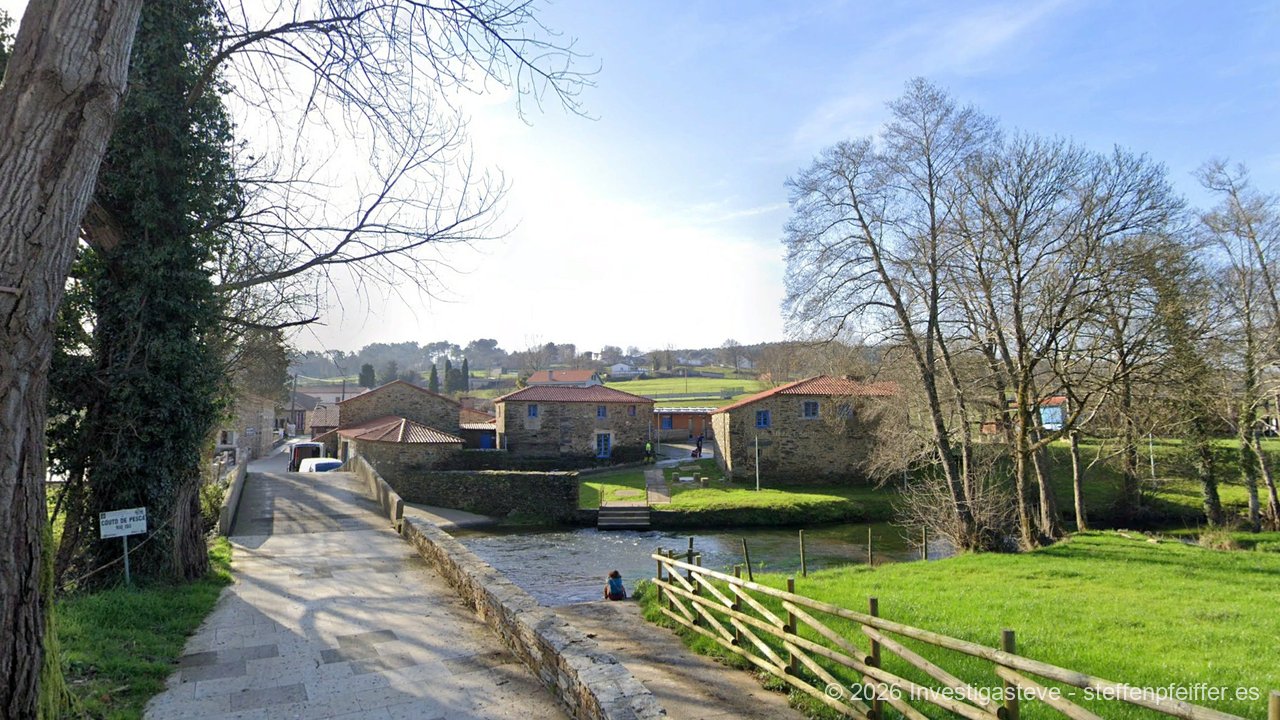
When the Camino Francés, after the long, dusty descent from the heights behind Castañeda, gradually sinks down into the deep green valley of the Río Iso, a scene opens up before the pilgrim that looks like an oil painting come to life from the Middle Ages. Ribadiso de Baixo is not a place you simply walk through; it is a place that captures the walker with an almost physical gentleness. The first thing your senses perceive is the auditory panorama of the flowing water. The steady, soothing gurgle and babble of the Río Iso forms the orchestral foundation of this place. It is a sound that immediately makes you forget the heat of the previous ascent and the effort of the kilometres. Beneath your soles, you feel the transition from the hard asphalt of the country road to the centuries-old, uneven paving of the Gothic bridge. The granite, smoothed by millions of steps yet still of an archaic roughness, practically vibrates under the weight of history.
The atmosphere in Ribadiso is saturated with a deep, earthy calm. In the air lies an intoxicating mixture of scents: the cool, almost metallic aroma of the fresh river water mixes with the tart smell of damp moss and the sweetish scent of the surrounding eucalyptus groves. When you breathe deeply, you feel the purity of the Galician province, preserved here in the valley like in a natural cauldron. Haptically, the place is an experience of relief. The cool breeze that constantly blows over the river lies like a soothing balm on your heated skin. The light refracts in the emerald-green leaves of the weeping willows that hang their branches deep into the water, bathing the entire ensemble in a diffuse, emerald-green glow. It is a place of psychological metamorphosis; here, the urge to cover miles gives way to a deep longing to linger. Ribadiso is the promise of an intact world, a refuge where time does not pass but circles in the deep eddies of the river.
What This Place Tells
The history of Ribadiso de Baixo is inseparably woven with the sacred duty of hospitality that has shaped the Camino de Santiago for over a millennium. The heart of the hamlet is the former Hospital de San Antón de Ribadiso de Baixo, whose origins date back to the 13th or 14th century. These massive granite buildings, which now house the public pilgrim hostel, tell of a time when pilgrimage was a life-threatening undertaking. In the cool, dark rooms of the Hospital, the sick and exhausted found shelter from the wolves of the Galician forests and the inclemencies of the weather. When you place your hand on the rough ashlars, you feel the historical causality of every chisel stroke. These walls are silent witnesses to an era in which faith was the only currency that counted. The Hospital was run by the brothers of the Order of San Antón, who dedicated themselves especially to the care of those suffering from “Saint Anthony’s Fire” – a then-widespread ergot poisoning.
The architecture of Ribadiso is a lesson in Galician constancy. The Gothic bridge, which spans the Río Iso in an elegant arch, is far more than a functional structure; it is a spiritual portal. Historically, this bridge often marked the moment when pilgrims washed their clothes in the river – a ritual act of purification before entering the “cheese town” of Arzúa and finally Santiago. The causality of the place’s foundation lies precisely here: at the crossing over the river. For centuries, Ribadiso was a self-sufficient microcosm, where the mill on the river ground the grain of the surrounding fields and the stone houses offered shelter to the few families. It is a documented place of constancy that has preserved its archaic identity despite the modern pilgrim boom.
Psychologically, Ribadiso functions as a filter of emotions. Here, just under 40 kilometres from the destination in Santiago de Compostela, the pilgrim realises the finiteness of their journey. The historical depth of the buildings, which have no windows for pride, only slits for protection, grounds the modern walker. You feel the presence of the millions of people who have stood exactly at this spot before you, perhaps with the same pain in their calves and the same hope in their hearts. Ribadiso tells no stories of glamorous kings, but of the anonymous mass of seekers. The stones store the humidity of Galician winters and the warmth of summers, and in their massiveness, they convey a feeling of unshakeable security. Those who linger in Ribadiso hear the whisper of the centuries in the cracks of the granite and realise that they are only a short link in an infinite chain.
Addresses & tips in Ribadiso
Camino Distances
In Ribadiso, the geographical final phase of the journey becomes tangible. The distances are manageable, yet the topography demands a conscious allocation of energy before the final ascent to Arzúa.
Sleeping & Arriving
Arriving in Ribadiso is a haptic experience of absolute deceleration. When you cross the bridge and step onto the grounds of the Albergue Xunta (the old Hospital), you immediately feel the stress of the stage fall away from you. Setting down your backpack on the grassy forecourt is a ritual act of liberation. Your feet, often marked by blisters and the heat of the day, long for the river. The first haptic highlight is immersing your legs in the ice-cold water of the Río Iso. The water is so clear that you can see every pebble on the bottom, and the cold shoots through your body like an electrifying impulse, constricting the blood vessels and relieving swelling. It is a moment of pure, unadulterated regeneration that no spa in the world can replace.
The Albergue de Peregrinos de Ribadiso de Baixo is one of the most legendary accommodations on the entire Camino Francés. Anyone who checks in here sleeps within the walls of the 14th century. The atmosphere inside is characterised by a sacred stillness. Light falls only sparsely through the small openings in the granite, and the smell of old stone and cool moisture has a calming effect on the nervous system. There are no modern dormitory complexes here, but a simple, almost ascetic facility that focuses entirely on rest. Psychologically, Ribadiso offers an alternative to the often bustling and noisy Arzúa. Those who stay here choose nature and history. The social component takes place on the riverbank; pilgrims sit on the grass, share a bottle of wine or an orange, and dangle their legs in the water. It is a community of the exhausted that finds a new form of energy here.
Those seeking a bit more privacy find an equally warm welcome in the private Albergue Milpés. Here too, arriving is defined by the proximity to the river and the family atmosphere. The rustling of the willow leaves and the distant ringing of a church bell form the soundscape for the evening. Arriving in Ribadiso means pushing civilisation far away once more for a night. You feel the haptic warmth of the setting sun on the dark granite stones of the houses while the coolness rises from the river valley. It is an arrival in the here and now, far from stage plans and odometers. Those who sleep here dream the dreams of medieval pilgrims, protected by walls that have seen everything.
Eating & Drinking
Culinarily, Ribadiso is a place of honest, down-to-earth strength. The gastronomic centre is the Mesón Ribadiso, a rustic inn right by the wayside, just a few steps from the bridge. When you enter the dining room, you are greeted by an olfactory panorama that immediately stimulates salivation: the scent of freshly prepared Caldo Gallego – that nourishing Galician soup of cabbage, potatoes, and beans – mixes with the aroma of roasting meat and homemade empanada. Here, eating is celebrated as an act of restoration. The haptic experience begins with breaking the hearty country bread, whose rough crust cracks under your fingers and whose soft core is ideal for soaking up the last remnants of the spicy sauces.
The “Menú del Peregrino” in Ribadiso is famous for its generosity. You often sit at heavy wooden tables, marked by years and countless meals. A glass of cool regional wine, served in the traditional white ceramic bowls (Cuncas), cools heated spirits. Drinking from the ceramic is a haptic pleasure; the rough surface sits well in the hand, and the wine tastes more intense, more earthy in this archaic environment. Particularly recommended are the dishes with “Ternera Gallega,” the high-quality Galician beef, often cooked directly over a wood fire here. The smoky note of the meat corresponds perfectly with the cool forest air of the valley.
Psychologically, the meal in Ribadiso fulfills an important function of social cohesion. While one often remains in silence by the river outside, inside the mesón, there is laughter, discussion, and sharing. The auditory backdrop of clattering cutlery, the hiss of the coffee machine, and the multilingual murmur creates a feeling of home for a while. Here, you refuel not only carbohydrates but also joy of life. Those who eat in Ribadiso taste the causality between hard work in the field and the reward on the plate. It is honest food for honest people. To finish, a strong Café Solo or a small Orujo de Hierbas, and behind the granite walls of Ribadiso, the world looks perfectly peaceful again.
Supplies & Logistics
Logistically, Ribadiso is a place of reduction. There are no supermarkets, no pharmacies, and no banks here. This conscious absence of commercial infrastructure is the charm of the place but requires a certain amount of advance planning. Anyone wishing to stay overnight in Ribadiso should have already replenished their supplies in Melide or Castañeda.
Shopping: There are no shopping opportunities in Ribadiso. The next supermarket is in Arzúa, about 3 km away. Pilgrims should already bring snacks and water for the evening.
Gastronomy: The Mesón Ribadiso offers excellent food from early to late. It is the only culinary anchor point and covers all the needs of pilgrims with breakfast, lunch, and dinner.
Accommodation: Two main options are available: the legendary public Albergue Xunta de Galicia in the historic Hospital and the private Albergue Milpés. Both offer high quality, with the public hostel standing out for its location directly by the river.
Public Facilities: There is no post office or medical care directly on site. In an emergency, you must rely on the infrastructure of Arzúa. A bus stop is only found on the main road above the hamlet.
The logistical reality of Ribadiso is that of a “transit stop.” Since Arzúa is so close, many pilgrims use Ribadiso only for an extended lunch break by the river. Haptically, logistics here means: short distances. Everything is concentrated within a radius of 200 metres around the bridge. If you find here that your hiking boots are failing or your backpack is pinching, it is not far to the civilisation of Arzúa. The connection to the national road N-547 exists but is not noticeable in the hamlet itself. Backpack transport services reliably serve both hostels. Ribadiso is a logistical calm point that proves that with a bed, a river, and a good soup, you have everything you need to be happy.
Don’t Miss
- A bath in the Río Iso: Right next to the Gothic bridge – a must for the regeneration of your feet; feel the healing power of the ice-cold water.
- The Gothic bridge: Linger in the middle of the arch and look downstream; here, nature and architecture merge into a perfect unity.
- The Hospital de San Antón: Visit the walls of the public hostel, even if you are not sleeping there; the historical energy of the 700-year-old stones is palpable.
- The Mesón Ribadiso at sunset: When the warm light falls on the granite facades and the scent of Caldo Gallego drifts through the valley, the Camino magic is strongest.
- The weeping willows by the river: Find a spot under the hanging branches for a meditative pause; the play of shadow and light on the water is hypnotic.
Insider Tips and Hidden Places
Beyond the marked path, which usually only briefly touches Ribadiso, there are small, almost forgotten corners that reveal themselves only to the attentive eye. If you follow the course of the Río Iso about two hundred metres upstream, you reach a small bend where the bank is particularly flat. Here, far from the conversations of other pilgrims, you find a deep, almost mystical silence. The ground is covered with a dense carpet of ferns and moss, making every step soundless. It is an ideal spot for a short meditation; the air here is even cooler and purer due to the evaporation of the water. You can watch the water striders dancing on the surface and hear the soft cracking of branches in the old trees. It is a place of absolute connection with nature, where you can sense the historical causality of the region as untouched wilderness.
Another insider tip is the small alley that leads slightly uphill behind the Albergue Milpés. From up there, you have a view over the roofs of Ribadiso that reveals the architectural cohesion of the hamlet. You see how the slate roofs nestle tightly against the granite walls, almost as if they want to protect each other from the Galician rain. In the early morning hours, when the fog still hangs in the river bends, Ribadiso looks from up here like a mysterious village from a long-forgotten legend. If you look closely, you often find small, hand-laid stone figures or scallop shells on the walls of the older houses, placed there by the inhabitants as a sign of their connection to the Way. Discovering these micro-worlds requires a patient eye and a willingness to slow down. Ribadiso rewards the seeker with moments of absolute authenticity that are not in any official stage plan.
Moment of Reflection
Ribadiso invites you to confront the transience and, at the same time, the constancy of your life. In the silence of the old Hospital, while the water of the Río Iso flows incessantly under the bridge, the existential question arises: What of all that I have experienced on this journey will remain? The place is a psychological filter. The ice-cold water of the river washes away not only the dust of the Way but also, symbolically, the unnecessary worries you have carried with you for hundreds of kilometres. Here, you feel the haptic reality of your own transformation – your legs are stronger, your breath calmer, and your gaze sharpened for the essential things of being.
You reflect on the historical causality of your own steps: Why am I here? What led me to this point? The 1,200-year history of the Camino de Santiago becomes a deeply personal experience in Ribadiso. You are part of an infinite chain of seekers, and in the silence of this valley, you realise that although the goal of Santiago is physically close, the actual place of realisation can lie right here – in a moment of pause on a riverbank. The smell of the damp stone, the crack of the bread, the coolness of the water: all these are haptic anchors that remind you that life consists of moments, not destinations. You breathe deeply, feel the cool air in your lungs, and recognise that you already have everything you need. Ribadiso gives you the spiritual strength for the final kilometres to Santiago by leading you back entirely to yourself.
Camino of the Stars
This place lies on the Camino Francés, on the stage from Palas de Rei to Arzúa. The sequence of locations is:
Palas de Rei → Casanova → Leboreiro → Furelos → Melide → Boente → Castañeda → Ribadiso → Arzúa
Did you regenerate your feet in the ice-cold water of the Río Iso or feel the silence of centuries within the historic walls of the Hospital de San Antón? Which scents of Galician cuisine particularly stand out in your memory at Mesón Ribadiso, and did you find your own personal moment of reflection on the Gothic bridge? Share your experiences and insider tips from this magical place with us – every story keeps the Camino alive for everyone!
About the Author