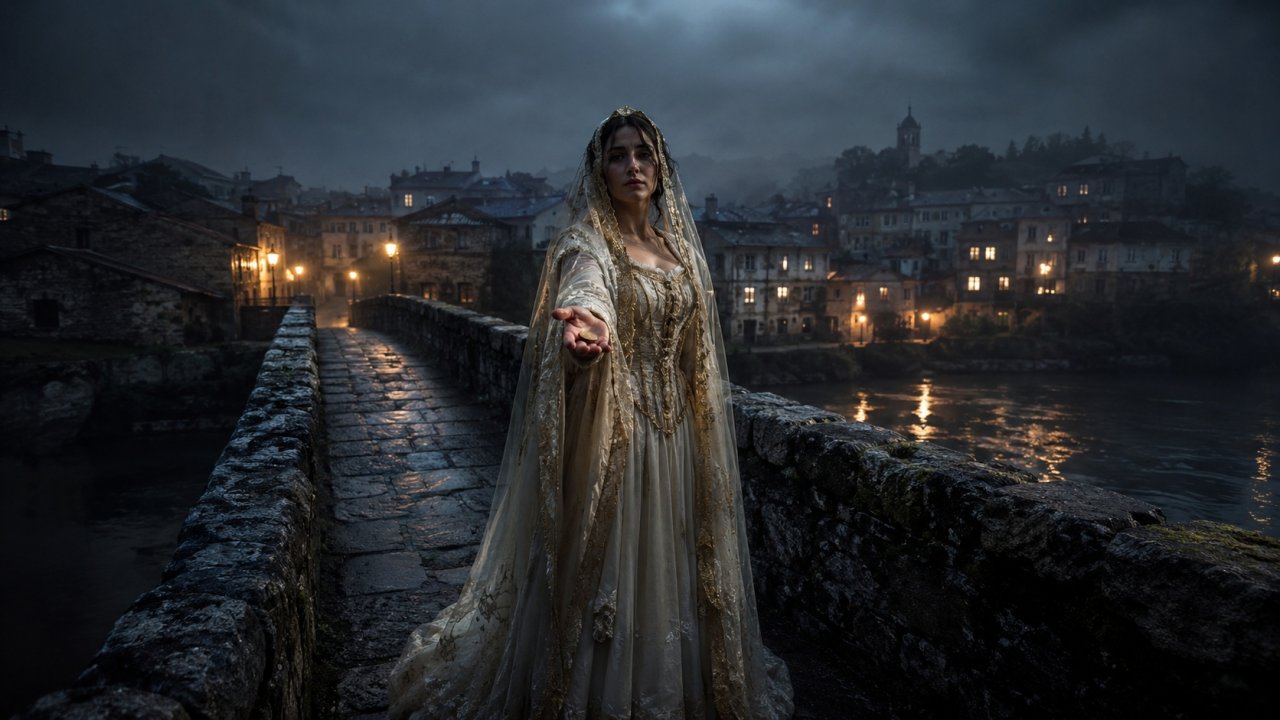
Interpretation by Steffen A. Pfeiffer – Investigasteve
They say the River Mandeo does not merely meander through the old stone walls and the damp, hidden gardens of Betanzos. No, the river is said to whisper the years to itself. The Puente Viejo, that grey stone bridge that not only connects two banks but serves as a gateway to one of those stories told in taverns over the third glass of Mencía, when the mist creeps across the cobblestones outside, has stood there for an eternity.
Children are warned by the elders (at least it was that way in the pre-influencer era) to stay away from the middle of the bridge at dusk. For there, it is said, the Dama del Puente Viejo waits. This apparition is a figure in silk and gold. And she is as intertwined with the city’s fate as salt is with the Atlantic.
The Story of Elvira and Rodrigo
Let us begin the story in the year 1467. For Betanzos, that year was a fat one. It was a year full of merchants’ goods, noble lords, and pilgrims with tired feet walking from Ferrol to Santiago de Compostela. In the midst of this flourishing, the graceful Doña Elvira de Andrade lived. She was the daughter of the Lord of Pontedeume. Her kindness was praised, yet people gossiped just as much about her allegedly stubborn heart. For instead of belonging to the noble count to whom she had been promised, her tender heart beat for Rodrigo.
Rodrigo was a clever miller from the riverbank, who smelled of flour, hard work, and, as one might expect, river water. Their love was pure but impractical, separated as it was by class boundaries and the stubborn logic of her family.
On a cool autumn afternoon, the River Mandeo swelled without warning. A brown, gurgling flood broke loose and threatened to sweep away the town along with its wooden oriels. While the terrified inhabitants gathered their belongings in a panic, Elvira stepped onto the middle of the bridge, facing the water. Once she had taken her position, she began to sing an old Galician song in a steady voice.
Legend claims that her song shamed and tamed the river. Whether it was a beautiful song or more of a croak is not mentioned further in the legend. But the water obediently receded like a scolded yard dog. And Betanzos was saved.
Yet the miracle demanded its price: the current reached for Elvira, and the depths of the Mandeo swallowed her once and for all. That was probably also a kind of Galician retranca of fate, which silenced the song of a fair maiden – possibly possessing the vocal talent of a magpie – for all time.
The Apparition on the Bridge
Since that night, however, the spirit of the once-graceful Doña Elvira de Andrade returns whenever a flood threatens. She stands on the Puente Viejo in her white and gold wedding dress, which she was never allowed to wear. This shimmering figure, visible in the damp twilight of evening, is said to hold out her hand with a gold coin in it.
Her words always sound like an ancient contract: “Give me your coin, traveller, and I shall grant you a wish.”
Whoever refuses or haggles is enveloped in an impenetrable fog; they wander silently until morning, with no memory of the way. In today’s terms, one might call it a ghostly blackout, like the kind otherwise only permitted by the enjoyment of various Orujo Blanco chupitos. But whoever offers even a small copper coin will have a wish fulfilled – healing, love returned, the flourishing of the harvest. Yet the clauses of the spirit world are strict: the wish must be sincere and free of selfishness. Whoever wishes selfishly is left standing by the Lady – and the Mandeo rages that same night with double fury and force.
The Trial of Lucas
Decades later, a descendant of the miller Rodrigo, named Lucas, stepped onto the bridge. With a heavy bag full of coins, he challenged the Lady – not out of humility, but out of cold, calculating calculation. His “sincere” wish? Well, since he apparently confused the Lady with a djinn from the Orient, he demanded immeasurable wealth for himself.
The Lady merely looked at him sadly and told him plainly that the true treasure did not lie in the bank or in the moneybag, but in that love which had once saved the village. And so a dense veil enveloped him. When Lucas awoke on the riverbank the following morning, there was no chest of gold beside him, but a small wooden box. Inside it was an old love letter from Elvira to Rodrigo, Lucas’s ancestor, and with it lay a coin inscribed: “Love is stronger than the river.” Lucas understood immediately, let go of all greed, and changed his life.
The Legend Lives On
To this day, the people of Betanzos tell each other on St. John’s Eve that Elvira’s song drifts over the stones. For some, she is the faithful guardian of the city; for others, her spirit merely waits for that one act of true, selfless love that will redeem her. Yet the coins sometimes found on the pillars of the Puente Viejo are not offerings of fear, but quiet receipts of gratitude. And when the Mandeo rises again, the elders murmur: “Doña Elvira, we remember you.” And the water seems, now and then, to even obey.
About the Author