A First Glance – Introduction & Atmosphere
When you leave the gentle hills of the Esteríbar Valley behind and the dense veil of forest thins, Pamplona, or in Basque Iruña, appears not merely as a city on the horizon. It rises like a monumental promise of stone and history. The moment you cross the medieval Magdalena Bridge over the Arga marks a profound caesura in your pilgrimage journey. Here, down by the river, the air is still humid and carries the earthy smell of willows and cool water. Yet already during the ascent through the mighty fortifications, you feel the psychological metamorphosis: the meditative solitude of the Navarrese mountains gives way to the pulsating energy of a millennia-old metropolis.
The auditory experience upon entering the city through the Portal de Francia is overwhelming. The rhythmic clicking of your walking sticks, which has accompanied you for days through the silence, now rebounds off the massive stone walls and mingles with the distant ringing of the bells of the Cathedral of Santa María la Real. It is an orchestral swelling of civilisation – the babble of voices in the narrow alleys, the clatter of dishes in the bodegas, and the distant roar of the city. You feel the tactility of the place under your feet: the uneven cobblestones of the old town, polished smooth by millions of pilgrim steps over a millennium, demand your full attention and connect you physically with history.
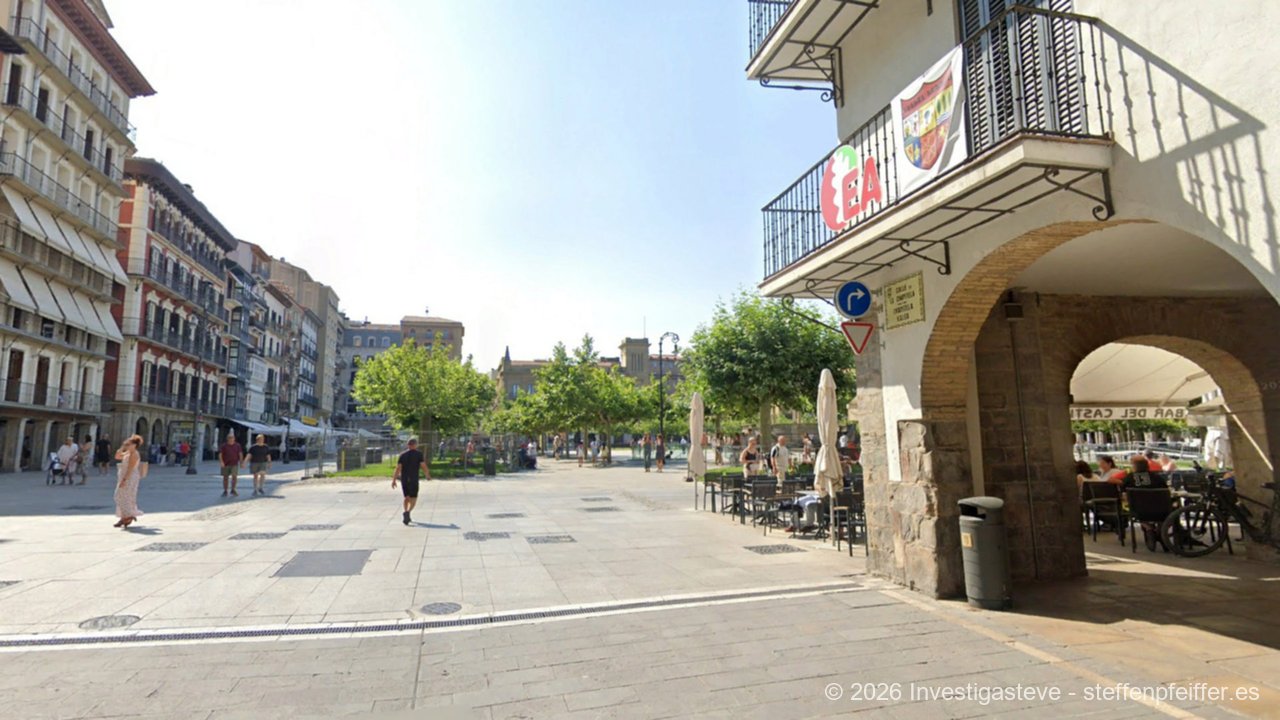
Pamplona greets you with an olfactory complexity that exists only here. It smells of freshly baked tortillas, of the sweetish aroma of ripe wine, and – especially in the morning hours – of the damp stone of the old walls that have stored the night’s coolness. When you reach the Plaza del Castillo, that sprawling “living room” of the city, you experience a moment of emotional expanse. Here, the dust of the path has settled in your clothes, yet the sublimity of the architecture and the joy of life of the inhabitants push exhaustion into the background. You are no longer just a walker in the forest; you are a guest in the first great capital of your path, an actor in a living drama that has been performed uninterrupted since Roman times.
What This Place Tells
Pamplona is an epic made of stone, whose chapters were written by Roman legionaries, Visigothic kings, and courageous Navarrese. The historical causality begins in 75 BC, when the Roman general Pompey founded the camp “Pompaelo” on a plateau above the Arga. Yet the true spirit of the city, which you can feel in every crevice of the wall today, was forged in the Middle Ages. For centuries, the city was a highly explosive construct of three rival settlements: the original Navarrería, the Burgundian San Cernin, and the San Nicolás quarter. These districts were separated by walls and moats, and bloody feuds were part of everyday life.
It was only in 1423 that King Carlos III el Noble put an end to this fraternal war with the “Privilegio de la Unión,” uniting the districts into a single city. When you stand today on the Plaza Consistorial in front of the Baroque town hall, you stand exactly at that symbolic point where the walls fell. The town hall itself, with its magnificent façade, tells of this victory of unity over discord. The architecture here is a psychological mirror: the narrowness of the alleys in San Cernin contrasts with the expanse of the later laid-out squares, a tactile testament to the urban metamorphosis from a defensive fortress to an open royal city.
The Cathedral of Santa María la Real, in turn, tells a story of inner wealth and architectural depth. While its Neoclassical façade appears almost severe, it conceals within one of the most significant Gothic ensembles in Europe. The cloister is a place of absolute auditory silence, where only the distant dripping of rainwater or the fluttering of a dove can be heard. Here lie the kings of Navarre buried, their stone effigies silently applauding every pilgrim who passes through the heavy portal. The historical presence of Ernest Hemingway, who made Pamplona world-famous through his novel “The Sun Also Rises,” adds a modern, almost mythical layer to the city. He sought here the “truth” in bullfighting and in community – a search that many pilgrims today continue in their own way. Pamplona is not just a city; it is the emotional and cultural backbone of Navarre, a place that masterfully straddles the archaic violence of the Encierro and the refined art of the cathedral with enviable ease.
Addresses & tips in Pamplona
| Accommodation | 61 |
| Restaurants | 73 |
| Bars & Cafés | 73 |
| Shopping | 4 |
| Services | 2 |
Show all 213
Show all 61
Show all 73
Show all 73
Camino Distances
Pamplona is for many pilgrims the first major milestone and often the place where the first injuries are treated and equipment is optimised. The paths now lead out of the city basin towards the Sierra del Perdón.
| Previous Place | Distance (km) | Next Place | Distance (km) |
|---|---|---|---|
| Zubiri | ca. 21.2 km | Cizur Menor | ca. 5.0 km |
Sleeping & Arriving
Arriving in Pamplona is a process of sensory overwhelm and simultaneous liberation. Navigating the narrow alleys of the old town, you often instinctively seek out the “Albergue de Peregrinos Jesús y María”. This hostel is an architectural manifesto: housed in a former church, it offers a space that seems almost infinite upwards. The tactile experience of sleeping in a nave is unique. The coolness of the massive columns and the smell of centuries-old wood and incense create a sacred calm that psychologically grounds you immediately. Here you hear the whispering of pilgrims in dozens of languages, an auditory mosaic of the world community that echoes like a prayer under the high dome.
Yet Pamplona offers the right accommodation for every emotional state. Those wishing to exchange the solitude of the path for the comfort of history will find in the “Grand Hotel La Perla” on the Plaza del Castillo that place where Hemingway himself once stayed. The feeling of cool silk on the skin and the view from the balcony onto the bustling activity of the city are a tactile luxury that completes the emotional metamorphosis from walker to cosmopolitan. Arriving in Pamplona also means celebrating the ritual of arrival: collecting the stamp in the cathedral, setting down the backpack, and experiencing the first real shower in days as a baptism.
In the smaller guesthouses on Calle Mayor or around the San Nicolás church, you feel the family heart of the city. It smells here of floor polish and fresh laundry, and the hosts often treat you like a lost son finally returning home. The logistics of arriving here are perfectly thought out. There are rooms for walking sticks, laundries that smell of soap and warmth, and communal areas where maps are studied and stories are shared. Arriving in Pamplona is not merely a logistical stop; it is an immersion into a social infrastructure that, since the Middle Ages, has been geared not only to accommodate the stranger but to strengthen them – physically and mentally.
Eating & Drinking
The gastronomy in Pamplona is a declaration of love to the fertile earth of Navarre and the culinary mastery of its inhabitants. Here, eating is not merely an act of satiation, but a five-dimensional immersion into regional identity. Strolling through Calle Estafeta or Calle San Nicolás, you are greeted by a cloud of aromas of garlic, olive oil, and roasted peppers. The “Pintxo” ritual is the auditory and social heart of the city: the laughter of the people, the clinking of glasses, and the rhythmic tapping of wine bottles on the counter form the backdrop for a flavour explosion. Each pintxo is a small work of art – the tactility of a crusty baguette meets the creaminess of local sheep’s cheese or the tenderness of oxtail braised in red wine.
An absolute must is the “Menestra de Verduras”, a vegetable stew that brings the essence of Navarrese gardens to the plate. Asparagus, artichokes, peas, and broad beans merge into a symphony of textures that tastes as fresh as if it came straight from the neighbouring field. Psychologically, this food acts like a remedy; it returns to the body the minerals it left on the path. Served with it is a robust red wine from the Olite region or a sparkling Rosado that glows in the glass like liquid rubies. The first sip, cool on the lips, is a reward for every kilometre covered in the dust.
In the traditional asadores of the city, it smells of beechwood fire and grilled meat. The “Chuletón”, a massive beef rib steak, is served here with a tactile honesty that reconnects the pilgrim with their archaic instincts. For dessert, the “Pacharán” must not be missed, that sloe liqueur that smells of aniseed and berries and gently aids digestion. Eating in Pamplona means tasting the causality between climate and culture. The hardness of the mountains and the mildness of the valleys are reflected in the contrasts of spicy chorizo and sweet pastries. Those who sit at the table here experience the emotional metamorphosis through enjoyment – the path becomes a feast of life here for a few hours.
Supplies & Logistics
Pamplona is the logistical epicentre for every pilgrim to Santiago in northern Spain. Here you will find everything you need for the coming hundreds of kilometres, in a density that is unparalleled.
Shopping: The old town offers numerous specialised outdoor shops like “Caminoteca”, where you can optimise your shoes, socks, or backpack. There is also the traditional market “Mercado de Santo Domingo”, where you can buy fresh fruit, nuts, and local cheese for the path.
Gastronomy: From Michelin-starred cuisine to the cheap pilgrim bar, everything is available. Supermarkets like Carrefour or Eroski near the old town are particularly ideal for budget shopping.
Accommodation: Besides the large hostels, there is a wealth of hostals, hotels, and private apartments. Capacity is large; nevertheless, a reservation during the San Fermín week (July) or in the absolute high season is essential.
Public Facilities: Pamplona has excellent hospitals (Clinica Universidad de Navarra), numerous pharmacies, and post offices to send excess luggage ahead. The bus station and railway station offer connections to all parts of Spain.
The logistical causality of the city is impressive: everything is within walking distance, which supports the regeneration of joints. The psychological security that such perfect infrastructure offers allows the pilgrim to clear their mind for the coming, more solitary stages. Pamplona is often used to correct the “equipment sins” of the first days. A new supply of blister plasters, a lighter rain jacket, or simply the knowledge that one can get any medical help here in an emergency strengthens confidence in the onward path. The city functions as a lock – it receives you as an exhausted walker and releases you as a well-prepared pilgrim.
Don’t Miss
Pamplona is not to be merely walked through, but experienced with all the senses. These points are the tactile and visual milestones of your stay:
– Cathedral of Santa María la Real: The Gothic portal and the cloister are places of absolute sublimity. Pay attention to the fine stonework, telling stories of sin and redemption.
– City Wall and Portal de Francia: Walk along the rampart. The tactility of the rough stone and the view down to the Arga let you relive the city’s strategic importance.
– Plaza del Castillo: Sit in the “Café Iruña” and enjoy the Hemingway flair. The scent of coffee and the marble tables create an atmosphere of timeless elegance.
– Town Hall Square (Plaza Consistorial): Stand where the Chupinazo opens the San Fermín festivities every year. Feel the psychological energy of this historic site.
– Museum of Navarre: Housed in a former Hospital, it offers insights into the Roman mosaics and medieval art of the region.
Insider Tips & Hidden Places
Beyond the tourist main arteries, Pamplona conceals corners that radiate an almost eerie silence and beauty. One of these places is the “Rincón de Caballo Blanco” on the edge of the city wall. Here, away from the bustle, you look over the Pamplona basin to the distant mountains. The auditory experience here is shaped by the wind sweeping through the old battlements and the distant roar of the river. It smells of moss and old stone, a perfect place for a silent meditation. The psychological effect of this expanse after the narrowness of the alleys is enormous and prepares you for the vastness of the coming meseta.
Another insider tip is the park “La Taconera”. While most pilgrims only see the old town, this park in the style of French gardens offers a tactile oasis. You wander through avenues of ancient trees, whose bark feels rough and enduring under your fingers. In the moats of the old fortress live deer, peacocks, and swans – an almost surreal image in the middle of the city. The scent of blooming roses in spring mingles with the cool shade of the walls. It is a place of mental regeneration, where time seems to stand still.
Those who keep their eyes open will find small, hidden art galleries and antiquarian bookshops on Calle Dormitalería. The smell of old paper and oil paints in these cool ground-floor rooms is an olfactory journey through time. Here you can discover handcrafted leather goods or small silverwork pieces that testify to the craft causality of the region. These hidden places are the footnotes in the great narrative of Pamplona – they complete the city and offer those individual discoveries found in no guidebook. A small passage, a hidden courtyard with a gurgling fountain – these are the tactile gifts that Pamplona gives to the attentive pilgrim.
Moment of Reflection
When you sit late in the evening on one of the benches on the Paseo de Redín and watch the city lights slowly come on while the distant Pyrenean peaks fade in the twilight, this is the moment for a deep reflection. Pamplona is the place of great contrasts. You have left the first week of your path behind, the mountains of the Pyrenees are now a memory, and the plain of Navarre lies before you. Psychologically, you stand at a threshold: behind you lies the physical torment of the ascent, before you the psychological challenge of endurance.
In this silence, ask yourself: How does the return to civilisation feel? What has the silence of the forests done to you, and what does the noise of the city now do to your inner self? The permanence of the walls of Pamplona, which have endured for 2000 years, gives you the confidence that your own inner foundations are stronger than you thought. The historical causality of the city, which created unity from discord, is a metaphor for your own path: perhaps you too are seeking the unity of your contradictory parts. In Pamplona, you become aware that the Camino is not merely an escape from everyday life, but a journey right into the heart of human culture. When you leave the city tomorrow through the portal of San Nicolás, take the strength of the stones and the warmth of the community with you. You are no longer a beginner; you are a pilgrim who has learned that true strength lies in the connection of tradition and the courageous step forward.
Camino of the Stars
This place lies on the Camino Francés, on the stage from Zubiri to Puente la Reina. The sequence of places is:
Zubiri → Larrasoaña → Akerreta → Zuriáin → Zabaldika → Arre → Villava → Burlada → Pamplona → Cizur Menor → Zariquiegui → Alto del Perdón → Uterga → Muruzábal → Obanos → Puente la Reina
Did you also feel that moment of absolute connection in the narrow alleys of Pamplona when the bells of the cathedral announced your arrival? Which pintxo on Calle Estafeta was your personal reward, or did you discover your own insider tip on the city wall? Share your story of your stay in the capital of Navarre with us. Your experiences are the light for all who are still at the foot of the Pyrenees!
About the Author