A First Glance – Introduction & Atmosphere
You set foot in the stream valley of San Bol – and immediately feel the oppressive, shadowless heat of the Meseta fall away from you. Behind you lie almost six kilometers of a path that stretches like an ochre ribbon through the barren Llanura of Castile, a landscape where the horizon is your only, unrelenting companion. The air up there is dry, tastes of calcareous dust and the tart note of withered thistles. Yet here, at 860 meters elevation, the terrain suddenly breaks open and reveals a small, green miracle: an oasis in the shadowless desert. It is a place that works both physically and psychologically transformative. You hear the rhythmic click of your hiking poles, which echoed so loudly on the hard marl ground of the plateau, suddenly become softer here, as it is overlaid by the gentle splashing of a stream and the rustling of the few, precious trees.
San Bol is not a living village; it is a “despoblado,” an abandoned settlement that has known no permanent inhabitants since the year 1503. When you approach the ruins, which lie about 250 to 400 meters off the main path, you feel an almost archaic silence, interrupted only by the constant rushing of the spring. It smells here of damp earth, of fresh grass, and the subtle mossy scent of the rock springs – an olfactory shock after the dusty dryness of the preceding hours. The texture of the surroundings changes from the cracked crust of the earth to moss-covered stone remains and the cool, clear wetness of the spring basin. Psychologically, you feel a relief here that goes far beyond physical rest; it is the feeling of entering a protected space that releases you for a moment from the relentless rhythm of the Camino.
In the shimmering afternoon heat, San Bol looks like a mirage that only materializes at the very last moment. The visual enclosure of the valley offers a cozy security after the boundless openness of the Meseta. You see the fragmentary wall remains of the former monastery and the ruins of a hermitage, marked by vegetation and slow decay. It is a place of extremes: minimalist, isolated, and yet charged with a spiritual energy that has drawn pilgrims here for centuries. Here begins a journey inward, supported by the cool power of water that gushes at a constant 10°C from the depths of the Castilian soil.
What This Place Tells
The history of San Bol is a monumental riddle, deeply rooted in the religious and social structure of medieval Spain. The name itself is a “corruption” of the original patron San Baudilio – also known as San Boal or San Boil. Baudilio was a Christian deacon from the 4th century who suffered the cruelest tortures under Emperor Julian the Apostate until he was finally beheaded by an axe. His legend is closely linked to healing powers; he was especially invoked against hernias and rupture diseases. In San Bol, this cult of healing manifested itself as early as 1352 in the founding of a specialized leper station. In the isolated stream valley hollow, lepers were cared for, with the permanent spring used not only for survival but possibly also for rituals of ritual purification.
After 1352, the place was transformed into a monastery of the Antonite Order, the same community that operated the famous San Antón de Castrojeriz. These monks were the experts of the Middle Ages in treating ergotism, the dreaded “Saint Anthony’s Fire.” San Bol was initially under the jurisdiction of Castrojeriz, but later came under the control of powerful Benedictine centers such as the Monastery of San Salvador de Oña and the Monastery of Cardeña. These administrative changes indicate an increasing economic tightening, as such remote posts in the lonely plateau were difficult to maintain. Yet the most dramatic chapter in the local history occurred in 1503: overnight, San Bol was completely abandoned.
The reasons for this sudden flight of the monks and inhabitants remain hidden in the darkness of history to this day. Speculations range from a sudden outbreak of an epidemic such as the plague or a leprosy relapse to economic collapse after the expulsion of the Jews in 1492, which may have interrupted important financial flows. For almost 500 years, the ruins were left to decay, a “ghostly place” that pilgrims tended to avoid. It was not until the early 1990s that the municipality of Iglesias decided to revitalize the dead place. Yet even this rebirth was rocky: initially, squatters and drug addicts occupied the ruins until the site was cleared in 1996 and handed over to a regulated pilgrim infrastructure. Thus, a place of disease and decay once again became a refuge of contemplation.
Addresses & tips in San Bol
| Accommodation | 1 |
Camino Distances
🗺️ After about 5.9 kilometers through the shadowless vastness of the Meseta, the gate to the valley of San Bol opens here.
| Previous Place | Distance (km) | Next Place | Distance (km) |
|---|---|---|---|
| Hornillos del Camino | ca. 5.9 km | Hontanas | ca. 5.0 km |
Sleeping & Arriving
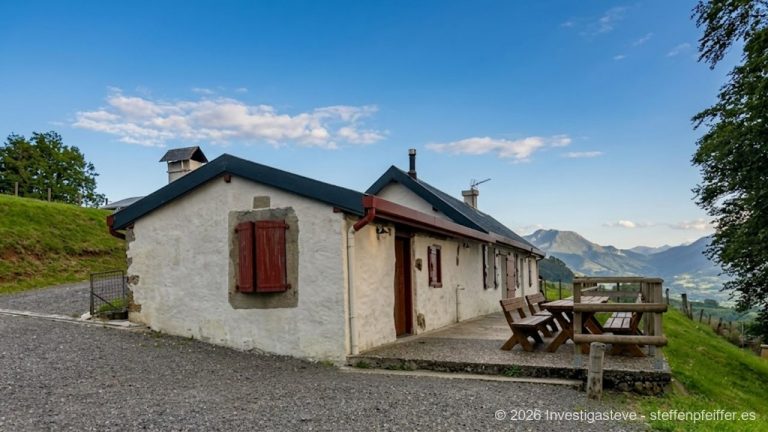
Arriving at the “Albergue de Peregrinos de Arroyo San Bol” is a conscious decision for minimalism and radical reduction. With only 12 sleeping places, distributed across two rooms, the capacity is tiny and a reservation is absolutely essential. When you enter the simple hostel, you leave modern comfort behind: there is no electricity for chargers, no Wi-Fi, and no conventional heating, apart from a pellet stove for cooler days. Arriving here is a tactile process of grounding. You feel the rough texture of the beds and the coolness of the rooms, while outside the garden area invites you to linger under the rare shade-providing trees.
The atmosphere in San Bol is often described as “out of time and place.” It is an experience of extremes: while 71% of pilgrims find the place magical and unforgettable, 21% are overwhelmed by the spartan furnishings and the toilets located in the open field. Yet it is precisely this simplicity that enables an emotional metamorphosis. When the sun sinks behind the edge of the stream valley, a community emerges that is often lost in the more comfortable hostels of the cities. The absence of digital distraction forces you to be present – to perceive your own heartbeat, the conversations with fellow pilgrims, and the overwhelming silence of the night under a starry sky that seems to shine especially brightly here in the dark hollow.
The central ritual of arrival, however, is the walk to the spring. Many pilgrims wash their feet in the 10°C cold water of the basin. The initial pain of the cold shock quickly gives way to deep relief, as the temperature inhibits inflammation and reduces swelling. It is a tactile purification that, after the dust of the Meseta, feels almost like a sacred act. Those who stay overnight here become part of a modern hospitalero tradition that coordinates and manages San Bol and the 5 km away hostel Santa Brígida in Hontanas. Arriving in San Bol means shedding the masks of everyday life and facing the naked reality of the path.
Eating & Drinking
The culinary world of San Bol is as reduced as its architecture, yet precisely that gives it a special intensity. There is no food for purchase, so pilgrims must either bring their snacks and supplies from Hornillos or buy them in Hontanas. Yet the highlight is the communal meal in the evening, for which a paella is often prepared. In the simple bar of the hostel, the scent of the food mingles with the cool evening air. It is a moment of genuine human connection when pilgrims from all over the world sit at the simple tables, share wine, and exchange their stories, while the only light often comes from candles or flashlights.
However, the water of San Bol is the real “drink” of the place. It flows pure and cool all year round and is the only spring in the otherwise water-poor Llanura. For the thirsty wanderer, this clear spring water has a quality that no bottled mineral water could ever achieve. It tastes of the depth of the earth and offers a physiological refreshment that becomes a staple of survival in the heat of the Castilian high summer. Those who rest here appreciate the simplicity: a picnic in the shade of the trees, accompanied by the water of the saint, often remains deeper in memory than any multi-course menu in the city.
Supplies & Logistics
Logistically speaking, San Bol is a challenge that requires forward-looking planning. It is a place of absolute self-sufficiency. Pilgrims should ensure they have sufficient snacks and toilet paper in their backpacks, as the sanitary conditions are very primitive. Since there is no electricity, an external battery for mobile phones is essential, although reception in the valley floor is weak to non-existent anyway. The hostel is usually open from April to October, but the exact times can vary, so a telephone inquiry or an email to the Ayuntamiento of Iglesias is advisable.
Shopping: No shops on site; supplies must be obtained in Hornillos del Camino (about 6 km back) or Hontanas (about 5 km ahead).
Gastronomy: Communal dinner for overnight guests at an extra charge; no public restaurant service for day pilgrims.
Accommodation: 12 places in the Albergue Arroyo San Bol; reservation at +34 638 932 448 or ayuntamiento@iglesias.es is mandatory.
Public Facilities: None; San Bol consists exclusively of the hostel and the monastery ruins; toilets are located outdoors.
The strategic decision to stay overnight in San Bol breaks the usual rhythm of the Hornillos–Castrojeriz stage. While many pilgrims walk the 24 km in one go or stay in Hontanas, San Bol offers the chance for exclusive solitude. One should arrive early, ideally between 2:00 and 3:00 PM, as the few places are quickly taken in high season. Those who accept the logistical simplicity are rewarded with an authenticity that recalls the origins of the Jacobean pilgrimage: a community of necessity in a landscape that leaves no room for vanities.
Don’t Miss
– The spring of San Bol: Dip your tired feet in the 10°C cold water. Feel the initial shock and the subsequent healing warmth in your limbs.
– The monastery ruins: Search for the fragmentary wall remains of the former Antonine convent. Pay attention to the construction style, which still hints at the former expansion of the order despite the decay.
– The literary site: San Bol is the setting for one of the most memorable encounters in Hape Kerkeling’s bestseller “I’m Off Then.” Here he met the Brazilian pilgrim Claudia, who runs like a red thread through his narrative.
– Dinner under the stars: Enjoy the community at dinner. The absence of artificial light makes the view of the Milky Way over the valley an unforgettable visual experience.
– The hermitage remains: Explore the remnants of the small chapel, which are silent witnesses to a 1200-year-old pilgrim history.
Insider Tips & Hidden Places
The archaeological spring of San Bol hides more than meets the eye at first glance. The hydrological peculiarity that the water flows all year round at exactly 10°C indicates a deep groundwater circulation system that functions independently of the seasonal rains of the Meseta. In a region geologically characterized by calcareous marl, this constant flow is a true natural wonder that already determined the choice of this place for a leper station in the Middle Ages. It is fascinating to consider that you are here at a point that was settled not according to economic, but purely hydrological criteria.
A modern myth that seems almost like a medieval legend is the story of the hospitalero “Luis.” In the 1990s, he told English pilgrims – perhaps merely on a whim – about the supernatural healing power of the spring. This narrative spread virally through the then-emerging internet community and became a fixed part of Anglo-Saxon pilgrim folklore. Today, esoterically inclined pilgrims seek “vortex” phenomena and energy centers here. Even though science only confirms clean, cool water, this process of “myth-making” shows how the Camino still gives birth to new legends today.
San Bol is also a paradoxical place of beauty. There is no architectural splendor like in San Antón, no magnificent churches, and no mass traffic. Its charm lies in the subtlety of decay and radical authenticity. For German-speaking pilgrims, the place has a special emotional resonance as a “literary sanctuary” of the encounter between Hape Kerkeling and Claudia. Many seek exactly the spot where the love that was not meant to be began – a postmodern quest for experience that charges the place with a new, secular meaning.
A little-noticed aspect is the hospitalero network. Since San Bol and Hontanas are managed by the same group, there is often a lively exchange of food and laundry between the two places. Those who listen carefully when the supply jeep arrives in the afternoon get an insight into the coordinated management that makes this isolated outpost operational in the first place. It is a small miracle of modern pilgrim logistics that a place that was dead for 500 years today breathes again to the rhythm of footsteps.
Moment of Reflection
Do you stay in San Bol to seek the healing of your blisters – or do you recognize that the true healing lies in the silence that makes your questions loud? San Bol is the counterpoint to the monumentality of the Way of St. James. It is a place that offers nothing but the bare necessities, and precisely that is its power. In the absence of Wi-Fi, electricity, and constant noise, you are thrown back upon yourself. The story of the sudden abandonment in 1503 reminds us how fragile human settlements and securities are.
This place stays in memory because it forces you to be honest. Without the distractions of the modern world, only the cold of the water, the warmth of community, and the vastness of the sky remain. San Bol asks you: What in your life is ballast that you, like the village 500 years ago, could simply leave behind? And what is the “spring” within you that never runs dry, even in the driest Meseta of your everyday life? Those who pass through San Bol not only leave the province of Burgos behind but also enter a piece of new territory in their own soul.
Camino of the Stars
This place lies on the Camino Francés, on the stage from Hornillos del Camino to Castrojeriz. The sequence of places is:
Hornillos del Camino → San Bol → Fuentes Sidres Albergue → Hontanas → San Antón → Castrojeriz
Did you also experience the ice-cold water of the spring of San Bol as a small rebirth, or did the spartan silence of the ruins make you more pensive? Perhaps at this place, which Hape Kerkeling immortalized, you yourself experienced a special encounter or found a quiet corner for meditation? Write to me about your experiences in German, English, Spanish, French, or Galician via the contact form – your story helps us keep the mystical heritage of San Bol alive.
About the Author