First Glance – Introduction & Atmosphere
When you set out early in the morning from the mountain village of Foncebadón, the world often still lies hidden under a dense, milky veil that shrouds the barren peaks of the Montes de León like a shroud. The path to the Cruz de Ferro is no ordinary march; it is a ritual ascent, a physical and psychological concentration of everything you have experienced on the Camino Francés in recent weeks. The air up here, at over 1,500 meters altitude, is thin and cuttingly cold, saturated with the moisture of drifting clouds and the tart, almost metallic scent of damp slate and wild thyme. Every breath burns slightly in your lungs and reminds you that you are on the roof of the Way of St. James. The ground beneath your boots is uneven, a mixture of coarse rubble and compacted earth that makes a dry, almost crunching sound with every step, carrying far in the eerie silence of the mountain world.
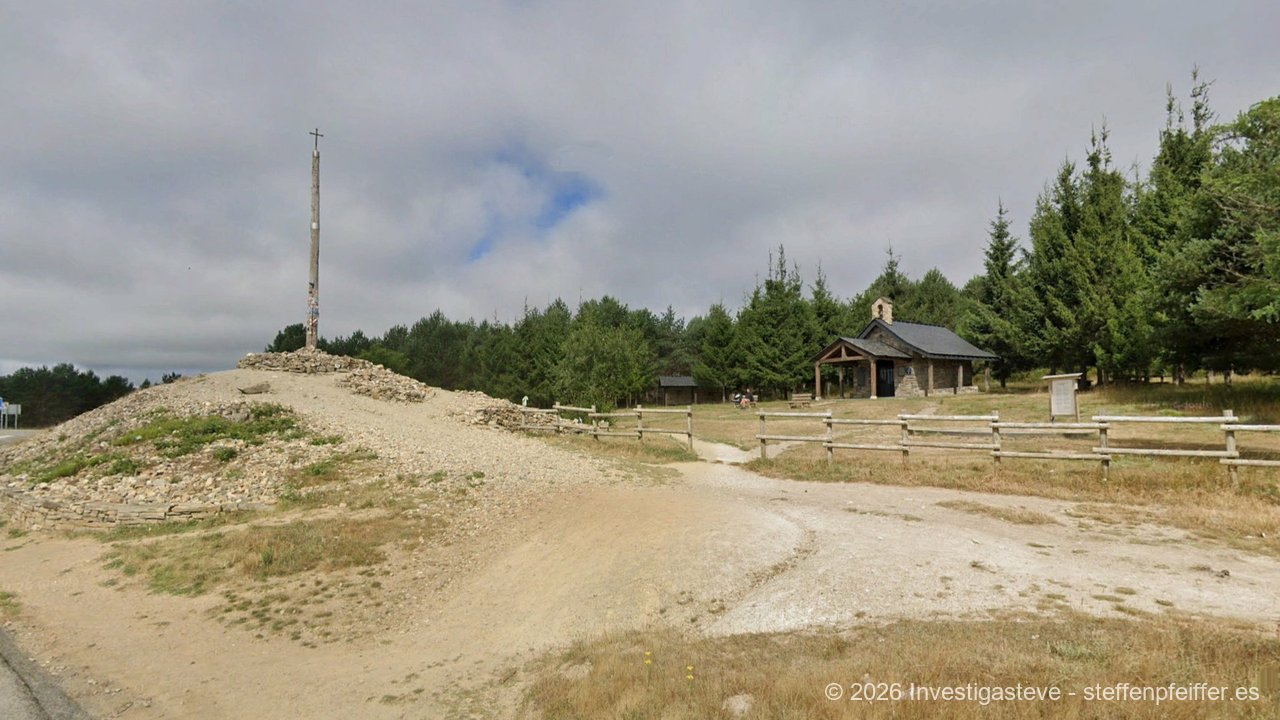
Suddenly, almost out of nowhere, a silhouette emerges from the mist, as simple as it is poignant: a long, weathered oak trunk, atop which sits a delicate iron cross. You have reached the Puerto de Irago. Yet it is not the cross alone that makes you pause. It is the immense mound of stones – the “Montes de Piedad” – that towers at its feet. Thousands, even millions, of pebbles, chunks, and rocks lie here, each one carried by a pilgrim from a distant homeland. It does not smell of incense or opulent cathedrals here; it smells of hard work, of sweat, of the dust of country roads, and of the bare, honest earth. In this moment, you feel the weight in your own pocket or backpack – that stone you may have carried for hundreds of kilometers, a symbol of your worries, your guilt, your losses, or your hopes.
The atmosphere at the Cruz de Ferro is charged with an almost tangible spiritual electricity. It is a place of total discharge. The rhythmic fluttering of small scraps of fabric, prayer flags, and messages attached to the trunk by pilgrims forms the only acoustic backdrop besides the constant howling of the wind sweeping unhindered over the pass. Haptically, this place is a challenge: the wind tugs at your clothing, the cold creeps under your skin, and yet you feel an inner heat, an emotional metamorphosis. Up here, on the border between the barren Maragatería and the promising, green Bierzo, pilgrimage becomes an archaic act. You stand before the cross, your hand clasping the cold, rough stone, and you grasp that this is the moment toward which your entire life has unconsciously been steering. It is not a place to linger in the conventional sense, but a place to let go, a stone confessional under the open sky, where time between yesterday and tomorrow seems to stand still for the blink of an eye.
What This Place Tells
The story of the Cruz de Ferro is as deeply rooted in the layers of time as the oak trunk itself. We look not only at a Christian monument but at a millennia-old chain of human hope and ritual marking. Long before the first Christian pilgrim set foot on this pass, the Puerto de Irago was a strategic and sacred fixed point. The Romans, who intensively mined this region, probably erected an altar here in honor of the god Mercury, the patron of travelers and roads. It was common practice to lay small stones as offerings at dangerous crossings to implore the favor of the gods for the onward descent. This pagan tradition of the “Mercuriales” – cairns at crossroads – formed the foundation upon which today’s monument rests. It is a fascinating historical causality: the form of the ritual remained nearly identical over the ages, while only the name of the deity addressed changed.
In the 11th century, it was Saint Gaucelmo, a hermit and hospitalero, who gave this place its present Christian identity. Gaucelmo dedicated his life to protecting pilgrims in this inhospitable mountain region. He founded a hospice and a chapel nearby and had the first simple iron cross erected on the trunk to provide pilgrims with orientation in the frequent snowstorms and dense fogs. The cross was a beacon of humanity in a wilderness then dominated by wolves and bandits. Those who heard the ringing of the bell from Gaucelmo’s refuge and saw the cross in the pale light knew they would survive. In this era, the custom became established that pilgrims who wanted to help build the cathedral of Santiago brought a stone from their homeland to lay it down here. It was a form of symbolic foundation-laying for the great goal, which over the centuries transformed into the spiritual gesture of unburdening sins.
Psychologically, the Cruz de Ferro is the culmination point of an inner catharsis. The 1,200-year history of the place is stored in every pore of the slate rock. Every time a pilgrim throws his stone onto the pile, he adds another chapter to the collective narrative of the Way of St. James. It is a democratic form of remembrance; here, rank, name, and wealth do not matter. A beggar’s stone lies right next to that of a king; both are equal in their significance. The clack of a stone hitting others – a short, dry sound – is the echo of countless fates. Historically, the Cruz de Ferro is thus one of the most honest monuments in the world, for it was not designed by architects but created by the feet and hearts of those who have sought and found this way for centuries.
Today, the original cross is kept in the Museo de los Caminos in Astorga to protect it from the elements and the ravages of time, while an exact copy watches over the stone sea on the pass. Yet its effect remains unbroken. The place tells us of the constancy of faith and the universal human longing for forgiveness and new beginnings. When you stand there, you are no longer a tourist of the 21st century; you are part of an endless procession stretching through the centuries. The historical depth of the place acts like a psychological anchor, rooting you in the present while the stories of those who wept, prayed, or simply fell silent here before you drift like a soft whisper through the grass of the Montes de León. The Cruz de Ferro is no dead monument of iron and stone; it is a living organism of hope, a memorial to the power of letting go and the indomitability of the human spirit.
Addresses & tips in Cruz de Ferro
Camino Distances
The crossing at the Cruz de Ferro marks the topographic high point of the Camino Francés. The distances between the stations on this mountain ridge are short, but due to the altitude and often extreme weather conditions, they demand full attention.
| Previous Location | Distance (km) | Next Location | Distance (km) |
|---|---|---|---|
| Foncebadón | approx. 2.5 km | Manjarín | approx. 2.0 km |
Sleeping & Arriving
“Arriving” at the Cruz de Ferro is a purely emotional and spiritual process, as there is no settlement at the monument itself and therefore no hostels. It is a place of transition, not of overnight stays. Nevertheless, the feeling of arrival after the arduous ascent from Foncebadón is physically palpable. Your body, challenged by the incline and the thin air, demands a pause, while your mind is already occupied with the ritual of laying down the stone. There is no reception, no check-in; your arrival is acknowledged only by the wind and the vast panorama of the mountains. The haptic quality of this moment is shaped by the rough surface of the stones and the metallic grip of your walking staff, which you might set aside briefly to touch the cross.
For nighttime rest, you must either retreat to nearby Foncebadón or continue the way to Manjarín or to El Acebo, about seven kilometers away. Foncebadón has transformed in recent years from a ghost village into a vibrant pilgrim center, where you can find modern hostels with hot showers and cozy common rooms. Those who want to savor the solitude of the mountains a little longer hike on toward Manjarín. Although overnight stays in the legendary Refugio Templario of Tomás there are hardly possible anymore, arriving in this environment remains an adventure in itself.
Arriving at the Cruz de Ferro is often accompanied by the smell of damp earth and the distant scent of pine forests beginning deep below you in the valleys of the Bierzo. Psychologically, this is the most important “accommodation” of your journey: the lodging of your soul in a moment of absolute honesty. You find a spot on the pile of stones, feel the instability of the ground – a symbol of life’s uncertainty – and find deep security in the community of those who left their stones here. It is a paradoxical arrival: you are in the middle of the wilderness and yet feel more arrived than ever before on this long path to Santiago.
Eating & Drinking
In the immediate vicinity of the cross, there are no fixed gastronomic establishments. Manjarín and the Cruz de Ferro are zones of self-sufficiency. In the high season, however, a mobile food truck or a small stand often sets up near the parking lot, providing pilgrims with the essentials. Here you can get a cup of hot coffee, whose steam mingles with the mountain mist, or a simple bocadillo that tastes like a gourmet meal after the exertion of the ascent. The taste of the coffee up here is often more intense, almost earthy, and the warmth of the cup on your cold fingers is a small luxury in the barren landscape.
The true culinary reward awaits either behind you in Foncebadón, where rustic mountain restaurants serve hearty stews like the Cocido Maragato, or ahead of you in the Bierzo. Since there is no running water at the Cruz de Ferro, you should definitely ensure your drinking bottles are filled. The scent of mountain herbs like rosemary and sage growing by the wayside accompanies you and stimulates the senses, while physical food becomes secondary. It is an ascetic experience: you live off the supplies in your backpack, sit on a stone wall, and look at the cross while eating an apple or a piece of bread. In this simplicity lies deep satisfaction.
Those who begin the descent to El Acebo will soon be rewarded with the delights of the Bierzo – the famous apples, cherries, and of course the robust red wine from the Mencía grape. Yet up here, at the highest point, the water from your bottle tastes clearer and the simple trail provisions more honest than anywhere else. It is a place where you learn that hunger and thirst are part of being a pilgrim and that the best seasoning for any meal is gratitude for the summit reached. The renunciation of sophisticated gastronomy at the monument itself protects its sacred character and forces you to focus on the essentials: the nourishment for your spirit.
Supplies & Logistics
Logistically, the Cruz de Ferro is a place of extremes. Although accessibility is ensured by the nearby country road LE-142, which allows for rapid assistance in an emergency, the weather conditions can change radically within minutes. It is not uncommon to start in bright sunshine in Foncebadón and find yourself at the cross in a heavy thunderstorm or dense snowfall. The supply of digital infrastructure up here is patchy; mobile network coverage fluctuates depending on cloud cover, forcing you to put away the smartphone and perceive the analog reality of the mountain.
There are no sanitary facilities at the monument itself, requiring forward planning. Those walking the Camino up here must be aware of their responsibility to nature – any kind of litter must be strictly avoided in this sensitive high-altitude zone. The logistics of the place are the logistics of your own backpack. Everything you need, you must carry with you. The next comprehensive supply of medications, banks, or post offices is only found again in Ponferrada, which is still a full day’s hike away.
Shopping: No shops available. Last chance in Foncebadón, next in El Acebo or Molinaseca. Gastronomy: Seasonal food truck possible, otherwise no fixed restaurants. Self-sufficiency is mandatory. Accommodation: No hostels at the monument. Retreat to Foncebadón or continue to El Acebo recommended. Public Facilities: No toilets, no trash bins. A small parking lot for buses and cars is nearby.
In summary, the Cruz de Ferro is logistically a “zero place.” It does not serve the satisfaction of material needs but is purely functionally oriented toward the spiritual ritual. Pilgrims should understand this as part of the challenge: the reduction of external supply reflects the inner concentration on letting go. Those who end up here without provisions or rain gear will quickly reach their limits. Those who come well prepared, however, can experience the logistics of the wilderness as a liberating element that shifts focus away from consumption and toward being.
Don’t Miss
– Laying down the stone: This is the heart of your visit. Take your time, approach the mound consciously, and lay down your brought stone. It is not a throw but a placing down – a physical act of relief. Feel the texture of the stone one last time before it becomes part of the mountain. – The Chapel of Saint James: Right next to the stone pile stands a small, modern chapel. It is mostly simple and offers a space for silent prayer or meditation away from the wind. The smell of old stone and the silence inside form a wonderful contrast to the rough outside world. – The view back and forward: The Cruz de Ferro marks the border. Turn around and look back at the barren expanses of the Maragatería you have crossed. Then look west, where the Bierzo awaits deep in the valley. This visual contrast shows you your own progress on the way. – The small messages: Look at (without touching or removing them) the photos, notes, and objects left by other pilgrims on the trunk of the cross. They are silent witnesses of love, grief, and hope, making the global dimension of the Way of St. James tangible.
Insider Tips & Hidden Places
An often overlooked detail at the Cruz de Ferro is the ground beneath the stone pile itself. If you look closely, you can see at the edges of the mound how the grass tries to reclaim its place among the stones. It is a quiet symbol of life growing from the laying down of burdens. A true insider tip is to visit the place at sunrise. When the first rays kiss the mountain ridges and the iron of the cross glows golden for a moment, the spiritual intensity is almost beyond words. Most pilgrim streams arrive later, so at dawn you have the chance for an exclusive, solitary communion with the mountain.
Another hidden aspect is the acoustic quality of the place in strong wind. If you stand directly against the oak trunk and place your ear (carefully) against the wood, you can feel the vibrations transmitted through the cross above into the trunk. It is as if the mountain itself is singing – a deep, sonorous tone that penetrates bone and marrow. It is the physical connection between heaven (the cross) and earth (the trunk and the stone pile).
If you move a few hundred meters away from the monument toward the ruins of Gaucelmo’s old hospice, you often find remnants of walls hidden in the tall grass. Here, away from the main path, you can feel the historical presence of the holy hospitalero. It is a place of absolute peace, where you can imagine the medieval pilgrims seeking shelter. It smells of damp moss and history. These small detours into the surroundings of the cross reward you with a depth that goes far beyond a quick photo of the monument. Sometimes you find small, hand-laid stone labyrinths there – symbols of the winding path of life, created by modern pilgrims in moments of deep reflection.
Moment of Reflection
The Cruz de Ferro is more than a geographic point; it is an altar of honesty. In the moment your stone leaves your hand and hits the mound, something happens inside you. It is the psychological realization that you cannot control everything, cannot make everything right, and above all cannot carry everything with you forever. The burden you lay down here is often invisible – it is the disappointments of life, the bitterness over missed opportunities, or the grief for loved ones.
When you stand there and feel the wind brushing over your skin, you grasp the radical simplicity of existence. The mountain does not ask about your professional achievements or your bank balance. It simply accepts what you give it. This total acceptance by nature and the monument has a healing effect. You feel small in the face of the 1,200-year-old tradition and yet infinitely important as part of this chain. It is the moment when the “I” becomes “we.”
The silence after laying down the stone is not emptiness, but a filled space. You breathe more freely, your shoulders loosen, and the view of the impending descent to Molinaseca and Ponferrada no longer appears as a threat but as an invitation. You have shed your skin up here. The Cruz de Ferro teaches you that forgiveness – especially toward yourself – is the heaviest stone you can carry, and the most beautiful one you can let go. With every step you now take away from the summit, you will become lighter. The spirit of the mountain will accompany you, as a reminder that for every ending there is a new beginning, as long as you are willing to leave the old by the wayside.
Camino of the Stars
This place lies on the Camino Francés, on the stage from Rabanal del Camino to Ponferrada. The sequence of locations is:
Rabanal del Camino → Foncebadón → Cruz de Ferro → Manjarín → El Acebo → Riego de Ambrós → Molinaseca → Campo → Ponferrada
Have you already experienced the moment of letting go at the Cruz de Ferro? Which stone did you carry with you, and what story do you associate with this symbolic act? Perhaps you also took a special photo of the chapel or the cross in the mist? Share your experiences, your emotions, and your tips with us. Every experience at the Iron Cross is as unique as the pilgrim themselves – we look forward to hearing about your transformation!
About the Author