First Glance – Introduction & Atmosphere
You leave the proud walls of Astorga behind, and almost immediately, the texture of your journey changes. While the silhouette of the cathedral and the Gaudí palace slowly grows smaller behind you, the urban asphalt gives way to a path that takes on the color of rusty iron and deep ochre. You enter Murias de Rechivaldo, and the first thing you feel is a remarkable deceleration. The ground beneath your pilgrim boots has a particular haptic quality here – the red earth of the Maragatería is dry and fine as powder, while after a downpour it becomes a sticky, heavy mass that reminds you with every step that you are now becoming one with the barren Meseta high plateau of León. It is a place of threshold experience, barely five kilometers from civilization, yet light-years removed from its hustle. The acoustics of the village are dominated by a deep, rural silence, into which only the distant rustle of poplar leaves on the banks of the Jerga and the occasional, metallic tapping of a pilgrim staff on the cobblestones mix.
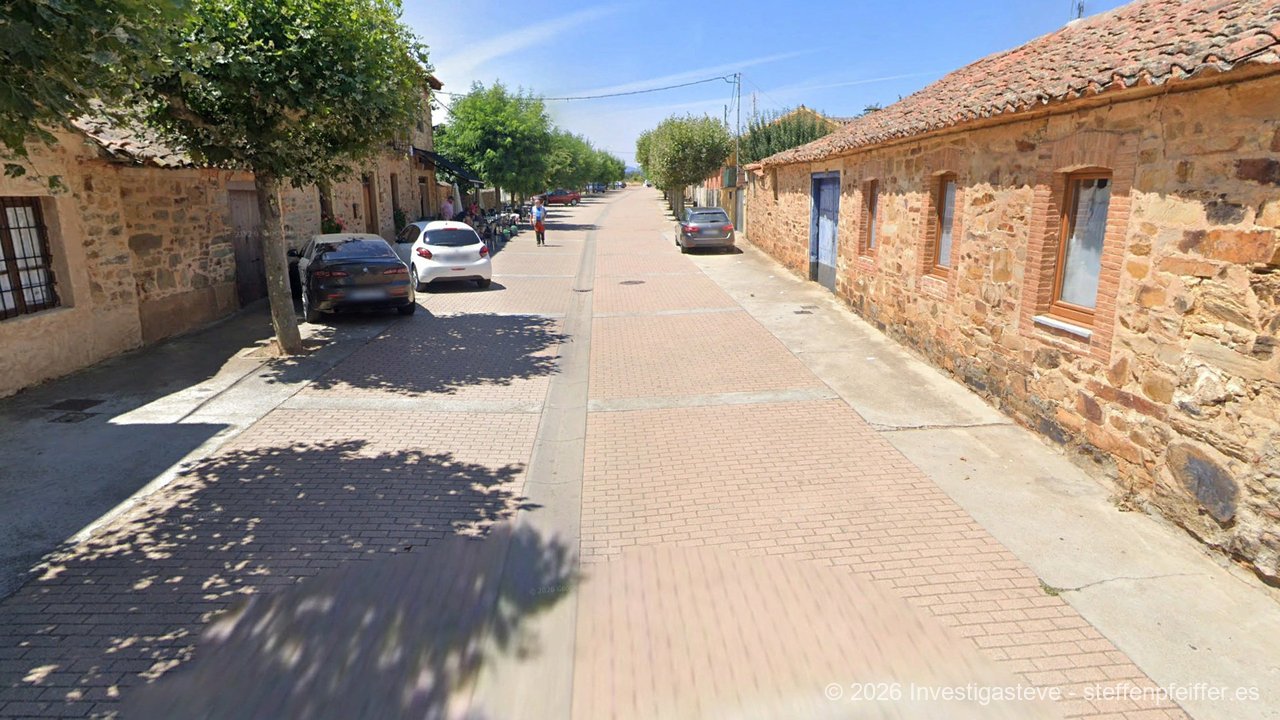
The visual aesthetic of Murias de Rechivaldo is shaped by the massive, squat stone houses of rough granite and quartzite, whose dark facades are often broken by brightly colored window frames and doors in cobalt blue or emerald green. It is a village that huddles together like a protective fortress against the relentless winds of the high plateau. As you stroll along the Calle Real, you perceive the smell of dry grass, thyme, and the distant, smoky aroma of oak wood fires that provide for physical well-being even in summer. Psychologically, Murias marks the moment when the pilgrim sheds the security of the city and faces the solitude of the coming stages. It is a feeling of relief at leaving the masses of Astorga behind, coupled with an awed expectation before the barren beauty that now stretches to the horizon. You feel the warmth of the sun, stored in the dark stones, radiating a cozy warmth as you surrender to the rhythm of the Maragatería.
Being in Murias de Rechivaldo means redefining the dimension of time. Here, time does not flow; it rests in the deep joints of the fieldstone walls. The village appears like a stone memory that has absorbed the exhaustion and hope of millions of pilgrims over centuries. It is a multisensory immersion: you hear the gentle splashing of the Jerga stream, you feel the cool smoothness of the fountain water on your wrists, and you see the wide, almost infinite horizon line that promises you that every step leads you closer to yourself. The atmosphere is charged with an honest, rough poetry that needs no pomp but impresses through its pure existence. Murias is the first real outpost of a world where nature and tradition write the law, and you are the privileged witness of this steadfast calm.
What This Place Tells
The story of Murias de Rechivaldo is inseparable from the saga of the Arrieros Maragatos, those legendary muleteers who formed the economic backbone of the region for centuries. You must realize the historical causality: since the soil up here on the León high plateau was too barren for intensive agriculture, the inhabitants developed a unique survival strategy. They became the freight forwarders of the Spanish empire. In their massive stone houses with the characteristic wide inner courtyards, the patios, they stored goods from all over the world – fish from Galicia, fabrics from Castile, and spices from the south. Murias was a logistical hub, a place of rest and transshipment. When you stand before the huge wooden gates of the houses today, you feel the weight of history haptically; the iron fittings are cold and massive, witnesses to a time when wealth was defined by mobility and reliability. The Arrieros were proud men, and their legacy resonates in the proud, almost aloof architecture of the village to this day.
Archaeologically and historically, however, the significance of the place goes back even further. The Romans left their traces here when they used the region to exploit the gold mines of Las Médulas. The Jerga stream was once a lifeline for these ancient enterprises. In the Middle Ages, Murias consolidated its position as a permanent part of the Way of St. James when the pilgrim streams demanded a new form of hospitality. The church of San Esteban, which dominates the village scene, is a stone witness to this era. Originally completed in its present form in the 18th century, it rests on foundations that are considerably older. When you enter the interior, you are enveloped by a smell of old wax, incense, and cool masonry – an olfactory time travel to an epoch when faith was the only navigation aid. Particularly curious is the depiction of Saint Roch, the patron saint of plague victims, traditionally shown here as a pilgrim with his dog. This underscores the psychological role of Murias as a place of healing and protection.
Culturally, Murias de Rechivaldo is a place of resilience. It is fascinating to observe how the village resists rural exodus by recreating its identity from the pilgrim tradition. The Maragatería is an ethnographic island within Spain, with its own costume, its own music – dominated by flute and drum (Tamboritero) – and a culinary tradition that makes no compromises. History here does not tell of great battles, but of the steady, rhythmic movement of mule caravans and pilgrim staffs. It is a story of endurance. The village has outlived the rise and fall of empires while the red path before its gates remained unchanged. This historical constancy gives the modern wanderer a deep sense of security; you are part of a chain reaching back 1,200 years, and Murias is the stable link that connects you with the past.
Addresses & tips in Murias de Rechivaldo
| Accommodation | 7 |
| Restaurants | 4 |
| Bars & Cafés | 1 |
| Sights | 3 |
| Services | 2 |
Show all 17
Camino Distances
After leaving the urban structure of Astorga, Murias de Rechivaldo is the first notable station that releases you into the rural solitude of the Maragatería. The path gently ascends and leads over the characteristic red earth paths.
| Previous Location | Distance (km) | Next Location | Distance (km) |
|---|---|---|---|
| Astorga | approx. 4.8 km | Santa Catalina de Somoza | approx. 4.2 km |
Sleeping & Arriving
Arriving in Murias de Rechivaldo means exchanging the noise of the world for the whisper of stones. Arriving here has a very own psychological quality: since it is only a short distance from Astorga, it is often those pilgrims who seek peace and want to escape the mass tourism of the city who decide to stay overnight in Murias. When you loosen your hiking boots in front of the door of one of the hostels, you feel the physical relief accompanied by an almost childlike anticipation of the coming peace. The Albergue Las Aguedas is a shining example of modern hospitality in a historical guise. Housed in a carefully restored Maragato house, it offers a haptic experience of the highest order. You feel the rough oak beams and the cool smoothness of the handcrafted tiles beneath your feet. The acoustics are shaped by the muted conversations of the pilgrims in the wide inner courtyard, where they exchange experiences of the day.
The smell in the accommodations of Murias is often characterized by lavender, fresh bread, and the fine aroma of regional wine shared in the communal kitchens. There is no anonymity as in the large hostels of the cities; here, arriving is a personal act of being welcomed into a temporary community of fate. You hear the clatter of dishes and the distant chiming of the church bell, an acoustic signal that structures the day and calms the mind. In houses like the Pension El Llacu or the Casa Rural Las Aguedas, the guest becomes part of a family atmosphere. You sit together at massive wooden tables, hands wrapped around a warm cup of tea, and the psychological barrier between strangers melts away in shared exhaustion and gratitude.
For many pilgrims, arriving in Murias is also a haptic cleansing. Washing clothes in the washhouse or in the basins of the hostels, drying socks in the hot wind of the Meseta, and then applying cream to the stressed feet – all these are ritual acts that take on a meditative quality up here. The visual reward follows in the late afternoon, when the low-hanging sun bathes the red paths before the village in an almost glowing light. Sleeping in Murias means resting in harmony with nature. You hear the crickets in the surrounding fields and the soft hiss of the wind in the roof beams. It is the sleep of the just, deep and restorative, far from the artificial lights and sounds of civilization.
Particularly noteworthy is the aesthetic design of the dormitories in the renovated stone houses. The thick walls provide a natural microclimate – pleasantly cool in summer, a haven of warmth in the fresh mountain nights. You feel protected as in a medieval fortress. Arriving in Murias de Rechivaldo is thus more than just the end of a day’s stage; it is arriving at the essential needs of humans: security, community, and silence. Those who stay overnight here often do so with the knowledge that the next day they will penetrate further into the Maragatería, strengthened by the honest hospitality of a place that has never forgotten its roots.
Finally, arriving in Murias is a lesson in humility. Since the place is small, you quickly learn to concentrate on the essentials. There is no entertainment program, no shopping mile. Only the stone, the water, and the path. This psychological reduction acts like a cure for the overstimulated mind of the 21st century. When you slip into your bed and leave the window a crack open, the smell of damp earth and wild thyme wafts in – the perfume of the Camino, which releases you into dreams of distant peaks.
Eating & Drinking
The culinary world of Murias de Rechivaldo is a powerful homage to the Arrieros and a feast for the senses. Those who stop here should not leave the place without having tried the Cocido Maragato. In eateries like the Mesón El Llacu, this dish is celebrated as a ritual spectacle. The smell emanating from the kitchens is intoxicating: a heavy mix of smoked meat, Pimentón de la Vera, chickpeas, and cabbage. The haptic peculiarity begins with the serving: the plates are heavy and rustic, the cutlery massive. The psychological irritation for the newcomer lies in the reversed order of consumption. First, the meat is eaten – often seven different kinds from chorizo to bacon – then come the chickpeas with the cabbage, and only at the very end the hearty soup. It is a cuisine of endurance, developed for men who were on the road all day in wind and weather.
The taste is intense, salty, and of a deep, honest spiciness. It is accompanied by a robust red wine from the province of León, perhaps a Prieto Picudo, whose aroma tastes of dark forest berries and the earth of the Maragatería. The sound of the pouring, the clinking of the heavy glasses, and the breaking of the crusty, dark bread form the acoustic backdrop of every meal. Here, eating becomes an act of regeneration. You feel the warmth of the stew flooding through your body and revitalizing tired muscles. In Murias, you don’t just eat to get full; you eat to become part of a thousand-year-old tradition. The olfactory quality of the regional cuisine, characterized by the scent of garlic and olive oil, connects you immediately with the Iberian soul.
For a small hunger in between or as trail provisions, the small bars offer bocadillos, here usually filled with Cecina de León. This air-dried beef has a haptic texture almost reminiscent of ham but with a much deeper, smokier taste. It smells of the mountains and the cold of winter nights. A piece of robust cheese from the region alongside, and you have the perfect energy source for the further ascent to Santa Catalina. Those with a sweet tooth should look for the Mantecadas – butter-tender pastries that melt in the mouth and whose scent of vanilla and fresh butter forms a wonderful contrast to the harsh mountain air.
The water in Murias is another culinary element. The clear, ice-cold mountain water from the village fountains is a delight for the dusty pilgrim. You feel the freshness on your lips and the purity in your throat. It is a haptic refreshment that no soft drink in the world can replace. Eating and drinking in Murias de Rechivaldo is thus a multisensory experience of grounding. You taste the land, you smell the history, and you feel the strength of the community gathering around the steaming bowls. It is a gastronomy without frills, as honest and direct as the red path that leads through the village.
Supplies & Logistics
Logistically, Murias de Rechivaldo is a small island of security shortly after leaving Astorga. Although the place is small, it offers everything necessary for immediate survival and progress on the Camino. The supply here is characterized by a likeable simplicity. There are no huge supermarkets, but small shops and hostel counters where you get the essentials: water, plasters, fruit, and perhaps a new stamp pad. The haptic quality of shopping here is decelerated; you wait until the owner passes the goods over the wooden counter, exchanging a few words about the weather forecast. It is a supply based on human contact, not barcodes and self-service checkouts.
The psychological effect of this manageable logistics is liberating. You quickly realize how little you can get by with. Those who forgot to replenish their supplies in Astorga find in Murias the last opportunity for a simple supply before the route to Santa Catalina becomes lonelier. The mobile network in Murias is solid, allowing digital coordination of the coming days, yet the acoustic dominance of the village invites you rather to put the phone aside. The water supply is secured by several public fountains, whose splashing is a constant acoustic companion and gives the pilgrim a feeling of abundance amidst the barren landscape.
Shopping: There are no large supermarkets. Basic supplies (water, snacks, pilgrim supplies) are available through small tiendas and sales points in the hostels such as Las Aguedas or El Llacu.
Gastronomy: Several rustic bars and mesóns offer excellent regional cuisine. The main focus is on the Cocido Maragato and pilgrim menus. A reservation for the Cocido is often advisable.
Accommodation: A good selection of private hostels and rural houses. Particularly Las Aguedas and El Llacu enjoy an excellent reputation. Advance reservation in high season is recommended.
Public Facilities: The Iglesia de San Esteban is the spiritual center. There is a public fountain with drinking water in the village center and well-marked path guidance through the village.
A critical point of logistics is the absence of an ATM and a pharmacy. Pilgrims should ensure they have withdrawn enough cash in Astorga and completed their travel pharmacy. Medical help must be requested in Astorga if needed, which is unproblematic due to the short distance. The logistics of the place are thus perfectly aligned with the rhythm of the hike: Murias offers you the bare necessities for the body and everything necessary for the soul. Those who replenish their supplies here do so with a sense of seriousness, for the Maragatería demands good preparation. It is the logistics of reduction that teaches you to separate the essential from the superfluous.
Don’t Miss
– The Iglesia de San Esteban: A must for architecture enthusiasts. Admire the simple facade and the bell gable (Espadaña). Inside, the statue of Saint Roch as a pilgrim is particularly worth seeing – a mirror of your own journey. – The stamp from Murias: Get the stamp for your Credencial at the Las Aguedas hostel or in the church. It is often lovingly designed and documents your entry into the Maragatería. – The Cocido Maragato: Even if you do not stay overnight in Murias, you should take a break here for this legendary stew. It is a culinary experience that will forever change your idea of soup. – The colorful half-timbering: Pay attention to the brightly painted doors and window frames of the stone houses. The strong blue in particular is typical and offers a wonderful contrast to the ochre-colored dust of the path. – The Ermita del Ecce Homo: A little outside the village lies this chapel. A place of absolute silence and a wonderful spot for a short meditation before the path continues to Santa Catalina. – The banks of the Jerga: Give your feet a break in the cool water of the small stream. The splashing and the cool water are the best natural hydrotherapy for stressed hikers.
Insider Tips & Hidden Places
Beyond the marked path of the Calle Real, Murias de Rechivaldo hides small, almost invisible treasures that only those willing to slow down their pace will find. One such place is the small, hidden square behind the apse of the church of San Esteban. Here, away from the pilgrim stream, you find an old stone bench perfectly placed in the shade of an ancient wall. The acoustics here are isolated; you hear only the muted echo of the church bell and the whisper of the wind in the crevices of the masonry. It smells of damp moss and the dust of centuries. It is the ideal place to write a few lines in your diary or simply admire the visual poetry of the roughly hewn stones. You feel the historical weight of the place particularly intensely here, without being distracted by tourist infrastructure.
Another insider tip is the path that runs parallel to the Jerga stream toward the old fields. There, where the gardens of the locals begin, a completely different olfactory quality reveals itself: the scent of fresh cabbage, tomato plants, and damp earth mixes with the tart aroma of wild herbs. You can often still see the traditional irrigation systems here, small channels that direct the water from the stream to the barren fields – a haptic reminder of the hard work of the farmers. If you take the time to look at the structures of these small gardens, you recognize the deep connection of the people of Murias to their land. It is a place of absolute authenticity, far from the glossy brochures of modern tourism.
A third, almost forgotten place is the small group of stones at the edge of the village in the direction of Santa Catalina, often used by locals as a resting point. Those who look closely will find markings carved into the stones, perhaps from Arrieros or pilgrims of earlier epochs. The haptic quality of this weathered granite is like a braille script of history. It is a place of reflection. When you sit here and let your gaze sweep over the wide plain, you grasp the dimension of the Way of St. James. You see the dust of other wanderers on the horizon and feel the collective energy that has kept this place alive for over a thousand years.
Lastly, one should pay attention to the light plays on the facades of the Maragato houses in the late evening hours. When the warm light of the street lamps falls on the uneven stones, shadow patterns emerge that seem almost like secret messages. At this time, the acoustics also change; the village becomes a stage for nature. You hear the distant barking of a dog and the call of the little owl. It is the time of secrets. Those who step outside their hostel door once more in these moments breathe in the cool, clear night air of the mountains and feel a deep peace that only places like Murias de Rechivaldo can give. It is the discovery of slowness in its purest form.
Moment of Reflection
In Murias de Rechivaldo, your pilgrimage reaches a critical psychological turning point. You have left the security and the bustle of Astorga. Here, on the red earth of the Maragatería, the air begins to be closer to the truth. The ascent is no longer just a topographical indication but a psychological necessity. The massive walls and the colorful doors of the village challenge you to ask yourself: What do you take with you into the mountains, and what have you left on the plain? It is a time of reduction. In the simplicity of a Maragato house, you recognize how little you actually need to be happy and safe. A dry place, a plate of warm stew, and the community of those who share the same goal – nothing more is needed.
The silence of the high plateau and the visual vastness act as a catalyst for your thoughts. You feel that you are no longer the same person who started in Saint-Jean-Pied-de-Port or Burgos. The way has worn you down, just as the wind smooths the edges of the granite blocks in Murias. You learn here to accept effort as part of the reward. When you sit in the inner courtyard in the evening and watch the shadows of the mountains grow longer, you grasp the finiteness of your journey and at the same time the eternity of the Camino. This realization fills you with a pride that has nothing to do with arrogance but with deep humility before your own endurance.
When you leave Murias de Rechivaldo, you do so with a new seriousness. The mountains before you are no longer obstacles but symbols of your own growth. You have learned to listen to your body, to ration your strength, and to focus on the essentials. The village has grounded you and at the same time prepared you for flight. It is the place of the last, deep inspiration before the Maragatería demands everything from you. You take the glow of the red paths as inner light into the coming days. In Murias de Rechivaldo, you grasp: the way leads not only to Santiago; it leads inevitably to yourself. The silence of the night under the bright starry sky of León cleanses your senses and prepares you for the great spiritual discharge. Here you find the answer to the question of why you set out at all.
Camino of the Stars
This place lies on the Camino Francés, on the stage from Astorga to Rabanal del Camino. The sequence of locations is:
Astorga → Valdeviejas → Murias de Rechivaldo → Santa Catalina de Somoza → El Ganso → Rabanal del Camino
Did you also experience the glow of the red paths upon leaving Astorga as a moment of freedom? Which place in Murias de Rechivaldo – perhaps the cool inner courtyard of Las Aguedas or the banks of the Jerga – remains most memorable for you? Was it the robust taste of the Cocido Maragato or the silence of the church of San Esteban that impressed you most? Share your experiences, your photos, and your insider tips from this first jewel of the Maragatería with us. Your story makes this path alive and tangible for other pilgrims!
About the Author