First Glance – Introduction & Atmosphere
When you have left the mystical mist of O Cebreiro behind and the path leads you over the gentle but steady ascent from Liñares further up into the lonely heights of the Sierra de Rañadoiro, you reach Alto de San Roque – a point that sums up the entire essence of the Galician Way of St. James in a single moment. It is not a place of houses and alleys, but a place of the elements. At 1,270 meters above sea level, you stand at an exposed threshold where the world below dissolves into wide, green waves. The air up here is of a crystalline purity, often sharp and cool, carrying the pungent, spicy scent of wild broom and damp slate. You hear the incessant whistling of the wind, which sweeps unhindered over the ridge and mingles with the rhythmic, hard tapping of your pilgrim staffs on the rough ground – an auditory proof of your progress on the roof of Galicia.
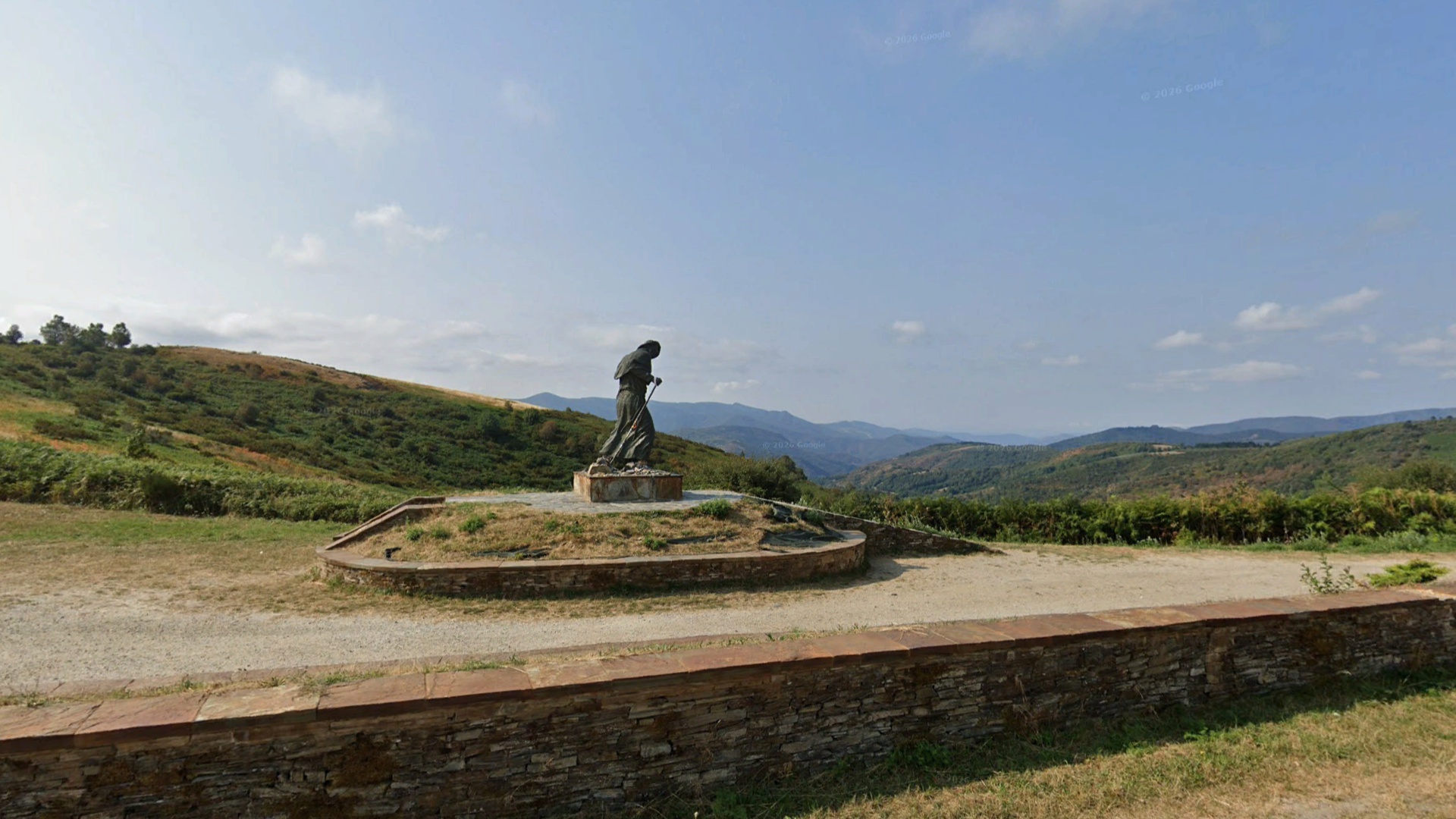
At San Roque, you feel the physical reality of the journey in every pore of your skin. The wind tugs at your poncho, and the coolness of the mountain challenges your body, while your gaze lingers on the iconic bronze statue that rises against the horizon like a frozen moment of effort. Psychologically, this point marks for many pilgrims a moment of deep identification: up here, you become aware that you are not only fighting against the kilometers, but against the inner and outer resistances of your journey. The visual panorama is of an epic grandeur – an endless sea of hills, often bathed in a milky white of clouds, while the distant, melancholic ringing of cowbells from the valleys rises like a greeting from civilization. At San Roque, you are no longer a simple hiker; you are part of the legend, a border-crosser between heaven and earth, inhaling the freedom of the heights with every breath.
What This Place Tells
San Roque is a silent chronicler of human determination and a sacred place of passage. In the historical causality of the Way of St. James, this pass has functioned since the Middle Ages as one of the most critical points of crossing. The name recalls Saint Roch of Montpellier, the patron saint of plague victims and pilgrims, often depicted with his dog and a wound on his leg – a symbol of the fragility and at the same time the resilience of human life. The historical permanence of this place lies in its function as a spiritual guardian: up here, pilgrims prayed for the saint’s protection before undertaking the often dangerous descent into the deeper valleys. You can imagine the historical immersion when you look at the small, simple chapel that rests in the landscape like a petrified anchor point.
The heart of the narrative, however, is the modern monument, the “Monumento al Peregrino,” created by the Galician sculptor José María Acuña. This life-size bronze figure of a medieval pilgrim, holding his hat tight and bracing himself with all his strength against the invisible storm, is far more than just art. It is a manifestation of the collective experience of millions of people over a millennium. When you stand next to it, you feel the historical continuity in the touch of the cool metal. The statue tells of the snowstorms of the 12th century as much as of the personal crises of today’s pilgrims. It is a monument to the triumph of will over the gravity of exhaustion. The historical causality of the landscape has shaped this monument – without the relentless winds of this pass, this figure would have no soul.
But San Roque also tells a quieter story of permanence. The slate slabs that break through the barren earth everywhere here carry the traces of millions of years. At San Roque, history is not presented through opulent architecture, but through the naked reality of the mountain. The smell of wet stone and the whisper of the wind in the low bushes connect you directly with that era in which reaching this pass could decide the fate of a pilgrim’s journey. Every gust that whips over the summit carries the echo of the prayers that have been uttered up here for generations. It is a place of psychological acuity that makes clear to you that true strength often consists of simply taking the next step against the wind.
Addresses & tips in Alto de San Roque
Camino Distances
Alto de San Roque lies as a distinctive pass point on the stage from O Cebreiro to Triacastela, strategically placed between the ascent and the first high plateau.
| Previous Location | Distance (km) | Next Location | Distance (km) |
|---|---|---|---|
| Liñares | approx. 1.0 km | Hospital da Condesa | approx. 2.6 km |
Sleeping & Arriving
Arriving at Alto de San Roque is an experience of radical reduction to the moment. Since there are no hostels, no bunkhouses, and no tourist infrastructure at this exposed point, “arriving” here takes place on a purely mental and spiritual level. When you reach the crest of the pass and the monument appears before you, the tension of the first third of the morning falls away from you. Arriving here is defined by reaching a visual axis: suddenly the view opens into the wide interior of Galicia, and the psychological weight of the mountains seems to dissolve in the infinite expanse. The haptic reality of the place is shaped by the cool heaviness of your backpack and the liberating feeling of pausing for a moment where the sky touches the earth.
The absence of any accommodation means that San Roque remains a place of pure passage, which only intensifies its atmosphere. The acoustic backdrop upon arrival consists only of the roar of the elements and the deep breathing of your fellow pilgrims who also linger up here. It is an arrival in the silence of the mind. Whoever sits here for a while at the foot of the monument experiences a form of regeneration that no dormitory can offer. The auditory isolation from urban noise is so complete here that you perceive the rhythmic beat of your own blood in your temples – a sign of the life pulsing within you. This experience of self-encounter is an essential part of the ritual character of this point.
Particularly appreciated at San Roque is the moment of social metamorphosis under the open sky. Strangers from all over the world meet at the monument, exchange brief, meaningful glances, or help each other take photos. Arriving here becomes a communal act of recognition: you have made it, you are on top. Taking a break at San Roque means using the power of the landscape as fuel for the kilometers ahead. The coolness of the wind on heated skin acts like a natural cleansing. Those who come to rest here awaken inwardly; your focus sharpens on the essentials. It is a healing stay in the open air that orders the mind and opens the heart to the coming beauty of the valley.
For many pilgrims, Alto de San Roque is the place where they first grasp the true majesty of the Galician mountains. You don’t look for a spot in a room, but lean against one of the ancient stone walls, smell the scent of freedom, and watch the clouds drift by below you. Arriving at San Roque means reconciling with the indomitability of your own nature. When you later check into Hospital da Condesa or Fonfría, you will realize that the true highlight of the day was this wind-swept threshold. Arriving at San Roque means letting your soul vibrate to the rhythm of the mountains and finding the certainty that no obstacle is too great if you are ready to face it.
Eating & Drinking
At San Roque, there are no mesóns, no bars, and no food stops. The gastronomic experience up here is that of absolute reduction to your own provisions, lending the consumption of every little item you have brought along an almost sacred significance. The taste of a simple apple or a piece of dark bread becomes a culinary revelation in the pure, cold mountain air. You perceive the texture of your provisions much more intensely when no urban background noise distracts you. Olfactorily, the scent of your brought food mingles with the aroma of damp slate and the spicy hint of broom – a sensory interplay that satisfies hunger in a very primal way.
Many pilgrims use the flat stones near the monument or the steps of the chapel for a short picnic between heaven and earth. The water from your canteen, perhaps still cool from the fountain in O Cebreiro, tastes up here like a life-giving elixir. The coolness of the bottle in your sun-warmed hands and the liberating feeling of shedding your backpack for ten minutes become symbols of true quality of life here. It is the psychological component of sharing that often comes into play here: you offer a handful of nuts or a piece of chocolate to a fellow pilgrim, and in this simple act in the face of the struggling bronze pilgrim, the entire philosophy of the Camino is reflected – a community of frugality amidst a backdrop of timeless permanence.
Whoever “eats” at Alto de San Roque primarily consumes the atmosphere of this historical point. The visual experience of the endless chains of hills fills the mind, while the body makes do with meager reserves. It is a lesson in gratitude that teaches you that true enjoyment does not lie in the variety of a menu, but in the purity of the surroundings and the quality of the moment. The smell of fresh wind and the aroma of freedom are the real ingredients of your meal at San Roque. When you later enjoy a hearty pilgrim’s menu in the valley, you may remember with quiet nostalgia the simple taste of your provisions at the monument – a culinary experience that reminds you how little a person truly needs to be in harmony with oneself.
Supplies & Logistics
Logistically, Alto de San Roque is a zone of absolute self-reliance. Whoever comes here must be aware that this pass is not a supply center; it functions as a strategic orientation marker at one of the highest points of the entire route. The administrative simplicity of the place requires forward planning from the pilgrim, which is easily manageable due to the proximity to Liñares and Hospital da Condesa. Nevertheless, one should not underestimate San Roque logistically: in the sudden weather changes of the highlands, the lack of enclosed shelters or shops quickly becomes a logistical challenge.
Shopping: There are no shops whatsoever at Alto de San Roque. All provisions, water reserves, and necessary hiking utensils must have been replenished in O Cebreiro or Liñares. The next shopping opportunity for food is first offered by Hospital da Condesa, about 2.6 km away, or on a larger scale by Pedrafita do Cebreiro.
Gastronomy: There is no formal gastronomic offering. Pilgrims should plan for a small emergency ration and sufficient fluids for this section, as the exertion of the ascent in heat or cold massively increases energy needs. The bars in neighboring Hospital da Condesa cover the need for hot meals after about another three-quarters of an hour’s walk.
Accommodation: Accommodation is practically non-existent at this pass. The logistics of the day should be planned so that San Roque serves as a place of rest and the night is spent in O Cebreiro or further down in the valley. Camping is strictly forbidden and dangerous due to nature conservation regulations and the exposed location.
Public Facilities: There are no medical facilities, banks, or post offices. In an emergency, access via the nearby LU-633 is available, but mobile phone coverage is often patchy in the deeper hollows. Emergency services are reachable via 112, but medical care is concentrated in Pedrafita or Sarria.
Safety at Alto de San Roque is high due to the clarity of the terrain, but weather exposure carries a real risk of hypothermia or dehydration. Acoustically, the place remains an oasis as long as the wind carries away the noises of the road. Logistically, the pass functions as a “check-in of attention” – here you do not check your luggage weight, but your physical condition for the further course of the stage. San Roque proves that good pilgrim logistics sometimes consist of needing nothing except what you carry in your own heart and backpack. The place teaches you the art of foresight and the beauty of independence at 1,270 meters above sea level.
Don’t Miss
- The Monumento al Peregrino: Examine this masterpiece of bronze art up close – pay attention to the details of the clothing and the expression of resistance in the posture.
- The panoramic view into the heart of Galicia: Pause at the ridge and let your gaze wander over the endless green valleys – a visual panorama of freedom.
- The chapel of San Roque: Visit the tiny sacred building and feel the silence between the ancient slate stones – a place of deep spiritual immersion.
- The wind experience: Stand for two minutes with your eyes closed and feel the power of the elements on your skin – a haptic meditation of the highest order.
- The summit photo: Document your reaching this symbolic threshold in front of the impressive backdrop of the statue – a must for every pilgrim.
- The slate dry-stone walls: Touch the rough stones of the ancient boundaries that have lasted an eternity without mortar – a testament to Galician craftsmanship.
Insider Tips & Hidden Places
Away from the impressive statue and the wide path, Alto de San Roque hides corners that are not in any standard guidebook. One such place is the narrow path remnant behind the small chapel, almost completely overgrown with broom and moss. If you carefully push your way just a few steps through the greenery, you will find a flat stone slab that almost floats like a natural viewpoint throne above the valley. From here, you have a perspective on the pilgrim monument that no tourist photo ever captures: the statue stands isolated against the wide sky, while below it the mist creeps into the valley of Triacastela. It is a place of extreme acoustic isolation, where even the distant roar of the wind at the monument becomes a gentle whisper. The ground here is so soft and covered with lichen, making every step silent and fostering a deep psychological calm that is often missing in the constant pilgrim stream.
Another hidden treasure is a tiny, almost faded stone carving on one of the corner pillars of the chapel, only visible at a very specific angle of light in the early morning. It is a simple cross, framed by a circle, presumably the work of a lonely shepherd or a pilgrim long ago. When you run your fingertips over these cool, rough incisions, you touch the individual history of a person who stood exactly at this spot long before the great bronze monument was erected. This form of silent communication across the centuries makes the historical immersion truly tangible. In the air here often lies an intense scent of wet fern and dry heather, which turns this hidden corner into a place of deep humility.
Did you know that there is a spot below the monument where the echo of your own voice is thrown back from the opposite mountains in a very specific way? When you stand at the right point and speak softly, the wind seems to catch the words and bring them back as a gentle whisper. This auditory phenomenon intensifies the sense of mystical presence that surrounds San Roque. It is as if the landscape itself is communicating with you. Those who take the time to explore these acoustic nuances discover a San Roque that is far more than just a pass along the road – it is a place of subtle vibrations that reveals itself only when you adjust your pace to the speed of the soul.
Finally, at dusk, it is worth looking at the silhouettes of the old slate walls that once served as livestock enclosures. When the last daylight disappears behind the mountains of Lugo, these structures appear almost alive, like stone guardians of a forgotten civilization. The smell of cool stone and the breeze whistling through the cracks create an atmosphere of timeless permanence. It is a space without distraction, where the history of Galicia whispers in every crevice. Those who lose themselves here often find a part of themselves that they had forgotten in the hustle of daily life. San Roque offers the rare opportunity to integrate your own journey once more in absolute silence just before reaching the 100-kilometer mark.
Moment of Reflection
At Alto de San Roque, you stand at a threshold that goes far beyond the geographical. The statue of the struggling pilgrim challenges you to think about your own resistances: What in your life is the “wind” that wants to hold you back, and where do you draw the strength to brace yourself against it? The psychological metamorphosis that takes place up here is the shift from the identity of the seeker to that of the knower. You have conquered the mountains, you have reached the pass, and at this altitude, your everyday worries become small. San Roque challenges you to pause and question your own role in this endless chain of seekers.
The historical causality of your being here connects you with the plague victims of the Middle Ages and the modern hikers of our time. Do you feel the responsibility to carry forward this legacy of pausing and steadfastness? At San Roque, you become aware that the Camino is not a race against time, but a sequence of moments of presence. The coolness of the rough granite under your hands reminds you of your own resilience. Use this moment of reflection to readjust your inner compass. When you begin the descent tomorrow, take a piece of the stone peace and the indestructible dignity of this place with you. It will be your anchor when the hustle of Santiago finally reaches you. Here, in the silence of the mountain, you have found the strength to continue your journey with new, clear sovereignty.
Camino of the Stars
This place lies on the Camino Francés (French Way), on the stage from O Cebreiro to Triacastela. The sequence of locations is:
O Cebreiro → Liñares → Alto de San Roque → Hospital da Condesa → Padornelo → Alto do Poio → Fonfría → Triacastela
Did you also feel that deep moment of grounding at Alto de San Roque, while gazing into the distance next to the bronze pilgrim? Perhaps you were touched by the silence of the small chapel, or did you find your very personal place of strength against the wind on the ridge? Share your personal impressions, your photos of the monument, or your thoughts on the spiritual significance of this pass with us. Every story brings this special threshold point on the Camino to life for the community – we look forward to your contribution!
About the Author