A First Glance – Introduction & Atmosphere
When you leave the hustle and bustle of Zubiri behind, that busy narrowness around the bridge of rabies, the path leads you into a stillness that becomes almost physically tangible. It is that moment on the third stage of the Camino Francés when the world widens and the sounds of civilization – the distant drone of trucks on the N-135 and the clinking of coffee cups in the bars – slowly sink into the dense green of the Esteríbar Valley. You gently ascend, your lungs filling with the cool, spicy air of the Pyrenean foothills, and suddenly it lies before you: Ilarratz. A hamlet so tiny that you could almost mistake it for an optical illusion between the meadows, if it weren’t for that massive, stone presence of the church, looking like an unshakeable guardian over the valley.
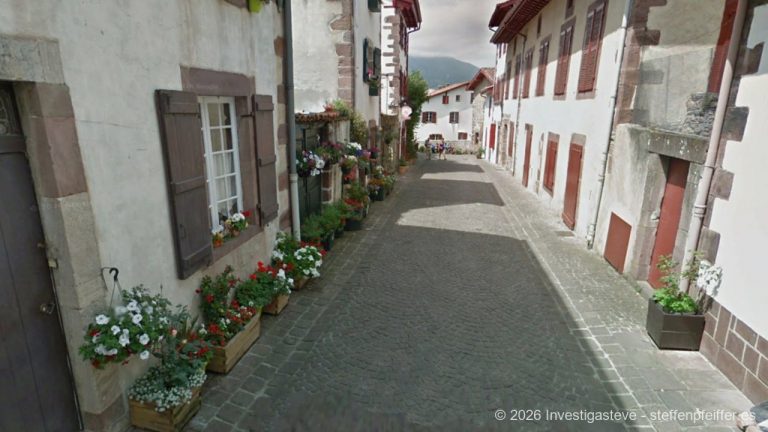
Ilarratz is not a place that greets you with boastful signs or colorful facades. It welcomes you with an archaic seriousness. The ground beneath your feet often changes texture here; the firm asphalt gives way to springy forest floor and cobbled paths, polished smooth by the steps of millennia. It smells here of damp earth, the tart aroma of ferns, and the sweetish scent of wild thyme breaking forth between the stones at the wayside. When the sun hangs low and the light breaks through the treetops at a slanting angle, the mica particles in the local rock of the old houses begin to sparkle, as if someone had scattered stardust over the walls.
In this tiny patch of earth, which today counts barely twenty souls, you feel a very particular density of time. It is a place of pausing, a psychological turning point between the departure in the morning and the longing for distant Pamplona. The atmosphere is characterized by a deep, almost reverent stillness, broken only by the distant rushing of the Río Arga, winding like a silver ribbon through the valley floor. Here you are not a tourist ticking off a sight; you are a walker entering a story that began long before our time, whose echo resonates in the massive walls of Ilarratz to this day.
What This Place Tells
The history of Ilarratz is inextricably linked to the protection of seekers. Whoever looks at the Iglesia de Santa Lucía today sees more than just a house of God; they gaze upon the remains of a former fortress. In the 12th century, when the Way of St. James was still a dangerous terrain full of highwaymen and unpredictable perils, the Templar Order built a castle here. These men of the “Militia Christi” were the first to recognize the strategic value of this terrace above the river. The massive buttresses and reinforced walls of the church are not architectural whimsy, but testimonies of a defensive design intended to offer pilgrims safety behind meter-thick stone.
As the power of the Templars waned, the fate of the place changed. In the 13th century, the fortress was transformed into an abbey, later taken over by monastic orders such as the Benedictines or Augustinians. This transformation from a martial protection station to a place of spiritual retreat and hospitality shapes the identity of Ilarratz to this day. In the archives of the municipality of Esteríbar, the name appears again and again – as an independent settlement with its own mayor, elected in rotation among the few houses. It was a world of self-administration and deep roots in the barren soil of Navarre, before the great rural exodus of the 20th century almost swept the streets bare.
A particularly fascinating chapter of more recent history is being written right now. In 2014, American pilgrims who had fallen in love with the melancholic beauty of the place bought the decaying church from the diocese. Their goal: the restoration of this historical jewel and its conversion into a cultural center and museum. It is an irony of history that people from the other side of the world have come precisely to preserve the Templars’ stones from oblivion. When you stand before the portal today, you feel this spirit of new beginning mixing with the dust of the centuries. It is the tale of the indestructibility of the Camino, which always finds people to make its ruins bloom.
The legends surrounding the patroness Santa Lucía add another, spiritual layer to the place. As the saint of light and sight, she is often invoked by those whose vision is clouded – be it physically or figuratively. It is said that many an exhausted wanderer who rested in the coolness of the nave stepped back out with a new clarity about their onward path in life. Whether it is the miracle of the saint or simply the purifying power of the absolute silence in this valley remains each person’s secret. Yet one thing is certain: Ilarratz tells of the constancy of light, even when the walls around you threaten to crumble.
Addresses & tips in Ilarratz
| Accommodation | 4 |
| Sights | 2 |
Camino Distances
After about 2.9 kilometers of gentle descent and shady forest paths from Zubiri, the landscape opens up here and reveals the first stone houses.
| Previous Place | Distance (km) | Next Place | Distance (km) |
|---|---|---|---|
| Zubiri | approx. 2.9 km | Ezkirotz | approx. 0.8 km |
Sleeping & Arriving
Arriving in Ilarratz is a lesson in humility. Anyone expecting a glittering hotel reception or a buffet here has not yet grasped the spirit of this valley. The accommodation situation in this small hamlet is as changeable as the weather in the Pyrenees. In recent years, there was a private hostel here, the Ezpeleku, known for its familial atmosphere and hearty breakfast. Yet operating small refuges in such an isolated location is a challenge, and so today pilgrims often stand before closed doors, as many of these accommodations have permanently shut their gates. It is a place that shows you that on the Way, nothing is guaranteed except the ground beneath your feet.
Those fortunate enough to find an open door in Ilarratz experience a form of lodging far removed from the industrial processing of the big cities. They are often old stone houses where the rooms smell of wood fire and dried herbs. Here you share the space with history; the thick walls store the coolness of the day and the warmth of past summers. The night in Ilarratz is of a darkness and stillness rarely found in Central Europe. When the flashlight’s light goes out, only the distant murmur of the river remains, and the knowledge that you sleep in a place that already protected tired wanderers eight hundred years ago.
The emotional experience of staying in a place that essentially consists of only a handful of houses is intense. There is no distraction, no Wi-Fi pulling you back into the digital world, and no bar numbing you with music. You are thrown back on yourself. Many pilgrims use the proximity to Zubiri to stay there and pass through Ilarratz only as a fleeting moment of peace. But whoever decides to stay is rewarded with a sunrise that lets the mist veils rise from the Arga Valley like ghosts of the past, while the first coffee in the silence of the dawn is worth more than any luxury breakfast.
Should Ilarratz offer no capacities, the next place, Ezkirotz, is just a stone’s throw away, and the larger Larrasoaña is also within easy reach. This uncertainty is part of the adventure. It teaches you to be flexible and accept what the path offers you. In the community of the few inhabitants, you sense a deep serenity toward the constant stream of strangers. You are greeted, you are noticed, but you are not bothered. It is a form of hospitality based on respect for the other’s journey.
Eating & Drinking
Culinarily, Ilarratz is a place of ascetic contemplation. There are no restaurants here, no cafés, and no corner store supplying you with fresh fruit. Anyone feeling hungry here must trust their own backpack or hope that the hostel parents – if the establishment is open – offer a communal dinner. This absence of commercial gastronomy causes food to become again what it originally was: fuel for the body and a ritual sharing in community. A simple slice of bread with local cheese tastes more intense here on the stone bench in front of the church than a three-course meal in a tourist stronghold.
The sense of smell is particularly sharpened in Ilarratz. Since no kitchen fumes from large restaurants saturate the air, you perceive the fine nuances of nature: the aroma of freshly mown grass, the mineral scent of the nearby water, and occasionally the smoke of a fireplace burning oak wood. Those passing through the village in the early morning hours might smell the scent of freshly brewed coffee from one of the private houses – an olfactory promise of civilization, which only truly begins again in the next towns. It is advisable to stock up on sufficient provisions in Zubiri, for Ilarratz demands the pilgrim’s self-reliance.
Drinking water, on the other hand, is a blessing of this place. The village fountain offers cool, clear water fed directly from the springs of the surrounding mountains. It is a tactile experience to dip burning hands into the ice-cold water and fill bottles for the onward journey. This water is the only “specialty” Ilarratz offers unconditionally to everyone. It is a symbol of the valley’s purity, far from the pollution and noise of the industrial zones one had to pass just after Zubiri. In the simplicity of this enjoyment lies great satisfaction.
Those unable to curb their culinary longing find comfort in anticipation of the coming kilometers. Nearby Ezkirotz and especially Larrasoaña beckon with small bars where the tortilla is juicy and the wine heavy. Ilarratz itself remains the place of inner retreat, where the stomach may growl, but the soul is satiated by the untouched aesthetics of the landscape and the certainty that one can be very happy with very little.
Supplies & Logistics
Logistically, Ilarratz is a blank spot on the map of modern convenience. There are no ATMs, no pharmacy, and no post office. This “supply desert,” however, is not a deficiency but an integral part of the experience in the Esteríbar Valley. Here you quickly learn what you truly need. The nearest ATM is in Zubiri, and anyone who forgot to withdraw cash there must walk as far as Larrasoaña or even further. The pharmacist in Zubiri is the last point of contact for blister plasters or painkillers for a long stretch. Ilarratz teaches you to plan ahead and understand your backpack as your self-sufficient universe.
Infrastructure is limited to the essentials: the path, the water, and a roof over the head for the few who are lucky. There is a bus stop on the nearby main road, served by the Monbus line between Pamplona and Roncesvalles. Yet for the true pilgrim, this is only a theoretical lifeline; one walks this path to feel it, not to observe it in passing. The roads within the village are narrow and unsuitable for through traffic, which helps Ilarratz preserve its museum-like stillness.
Shopping: There are no shops at all. All supplies must be planned in Zubiri (approx. 2.9 km back) or in the upcoming Larrasoaña. In Ilarratz you will find only what you have brought with you.
Gastronomy: You will look in vain for bars or restaurants here. Communal meals are only possible when staying overnight in the private hostel (if active).
Accommodation: The situation is volatile. The only noteworthy hostel is often closed or only available seasonally with advance notice. Most pilgrims use the place only as a rest stop.
Public Facilities: Apart from the village fountain and the church (which is often only viewable from the outside), there are no public services. Ilarratz is the definition of a self-sufficient hamlet.
In summary, Ilarratz is the logistical antithesis to the modern world. Anyone stranded here must rely on the oldest form of logistics: help from person to person or their own equipment. It is a salutary shock for all accustomed to solving every problem via app or credit card. Here, only what you carry in your pockets and in your heart counts.
Don’t Miss
– The massive buttresses of the Iglesia de Santa Lucía: Look closely at the walls – they tell of the fear and the need for protection in the Middle Ages and show the handprint of Templar architecture.
– The view into the valley from the northern edge of the village: Here the panorama widens over the Río Arga and the forested slopes, a moment of perfect geographical orientation in the green heart of Navarre.
– The ancient village fountain: Not just a water source, but a meeting point of stillness, where the cold mountain water awakens the spirits.
– The details of the abandoned Caseríos: Many of the old farmhouses still show the traditional construction of rough stone and heavy timber, a silent monument to Basque-Navarrese rural culture.
Insider Tips and Hidden Places
Beyond the marked yellow arrows, Ilarratz hides small treasures that only catch the eye of those willing to slow down. One of these places is the small stone bench directly in front of the Iglesia de Santa Lucía. It is no official monument, but when you settle there, you feel the coolness of the stone and have the perfect angle to see the hard contours of the church against the often radiantly blue sky of Navarre. It is the ideal spot for meditation away from the pilgrim streams, who usually hurry hastily past the old walls. Here, the wind seems to whisper quiet stories of the knights who once stood guard right here among the surrounding ash and alder trees.
Another hidden spot is the path down to the bank of the Río Arga, about 150 meters south of the village. While the official path remains on the terrace above, a narrow footpath leads through the gallery forest directly to the water. There you find flat places where the water glides crystal clear over the round pebbles. In the summer heat, this is an almost sacred place of refreshment. Dipping tired feet into the flowing water of the Arga has a purifying effect that goes far beyond the physical. It is an encounter with the element that has shaped this valley for eons, far from any tourist development.
Those interested in deeper history should dare the short detour to the “Abadía de Eskirotz e Ilarratz,” which lies only about 800 meters to the southeast. The two places are often perceived as one historical complex. The remains of this complex show even more clearly the transition from a military structure to a monastic center. Here the ruins are often overgrown with moss and ferns, lending the place a melancholy, almost fairy-tale beauty. It is a place for explorers who understand the Camino not merely as a hiking trail but as an archaeological adventure.
A magical moment also reveals itself only at dusk. When the last rays of sunlight touch the mountain ridges in the west, the old oaks cast long, skeletal shadows over the meadows of Ilarratz. In this light, the hamlet appears fallen out of time, a stone relic refusing to yield to modernity. Anyone standing alone on the path at this moment grasps the solitude of the medieval pilgrim in a way no book can convey. It is a tactile experience of isolation that feels profoundly comforting at the same time.
Moment of Reflection
In Ilarratz, the path asks you a quiet question: How much noise do you actually need to feel alive? This place is a mirror of your own inner restlessness. Those who arrive here and immediately impatiently check their watch or look for the next café miss the actual lesson of this hamlet. Ilarratz challenges you to endure emptiness and recognize beauty in the inconspicuous. The massive presence of the church, which has defied storms for eight hundred years, reminds you that true strength often lies in silence and perseverance.
Perhaps you feel here for the first time on your journey a form of “Morriña,” that longing melancholy that usually only appears shortly before Santiago. It is the feeling of being part of an infinite chain of seekers, whose footprints have long been washed away by the rain, but whose energy lives on in the stones of Ilarratz. Will you stay a moment longer to let the echo of the Templars resonate within you, or does the busy security of the next city already pull you away again? In the stillness of this valley lies the answer to the question of why you truly set out.
Camino of the Stars
This place lies on the Camino Francés, on the stage from Zubiri to Pamplona. The sequence of places is:
Zubiri → Ilarratz → Larrasoaña → Akerreta → Zuriáin → Zabaldika → Arre → Villava → Burlada → Pamplona
Did you find a moment of clarity in the stillness of Ilarratz, or did the absence of bars rather drive you to haste? Perhaps you were even lucky enough to glimpse the interior of the church or watch the restorers at work? Share your experiences and impressions of this hidden Templar heritage with us – your story helps other pilgrims discover the hidden details of this little jewel in the Esteríbar Valley.
About the Author