First Glance – Introduction & Atmosphere
When you cross the invisible border into the province of A Coruña, the texture of the path changes. You enter a terrain that was already described in the famous 12th-century Codex Calixtinus as “Campus Leporarius”, the field of hares. Leboreiro does not greet you with triumphal gates or the noise of a busy town, but with an archaic, almost reverent silence, broken only by the rhythmic click of your pilgrim staff on the ancient cobblestones. The air here is cooler, saturated with the moisture of the Galician valleys and the heavy, resinous scent of the nearby eucalyptus forests, which mingles with the note of damp fern and the smoky aroma of distant chimneys. It is a place that forces you to slow your pace, while time itself seems to seep away into the deep joints of the grey granite.
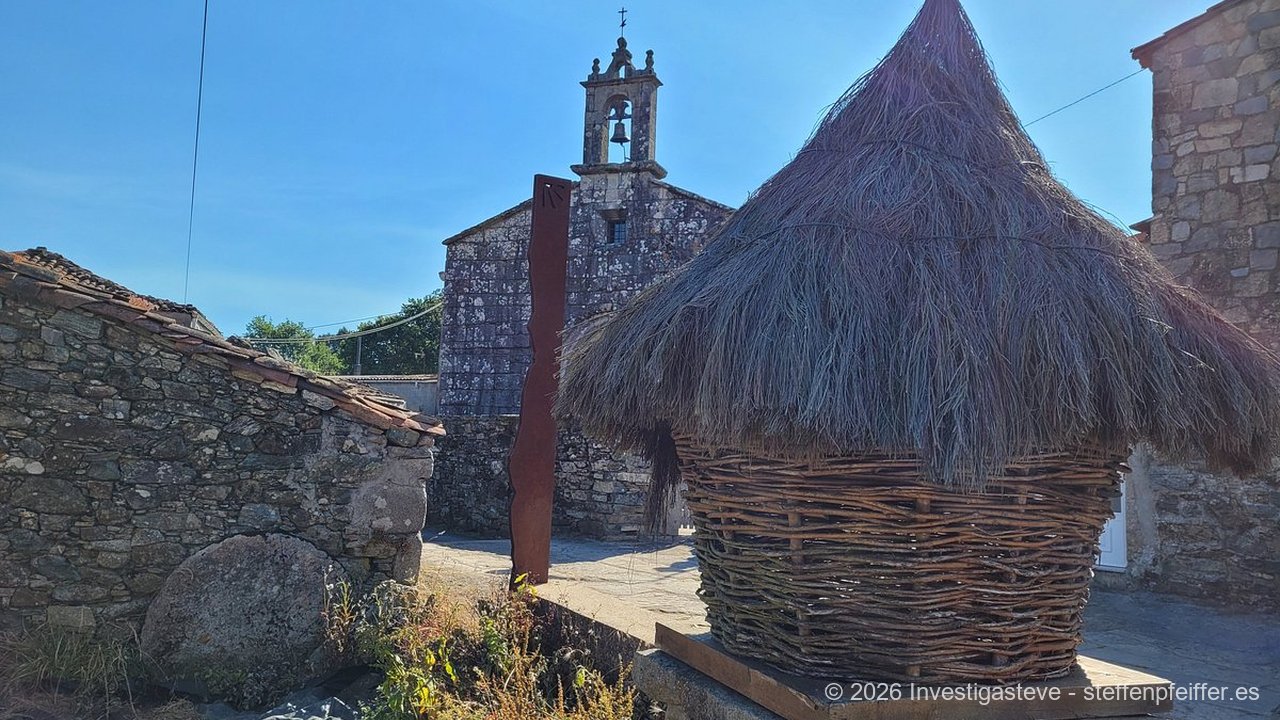
In Leboreiro, you feel the physical weight of history. The tactile roughness of the fieldstone walls lining the path transfers a sense of constancy to your fingertips, a stark contrast to the fleetingness of your own journey. The atmosphere is marked by a deep, psychological calm; you realize that you have crossed a portal. It is the gateway to the last great chapter of the Camino Francés before Santiago. The light often breaks milky in the Galician mist, the “orballo”, bathing the squat stone houses in a scene like a faded oil painting. Here, where the wind whistles softly through the cracks of the “Cabanones” – the traditional wicker storage huts – you feel yourself part of an infinite chain of seekers, all of whom felt the same ground beneath their feet and carried the same hope in their hearts.
What This Place Tells
Leboreiro is a stone witness to medieval hospitalitas. Its history is inseparable from the protection and care of pilgrims, a task that was institutionalized here centuries ago. The heart of this narrative is the Casa da Enfermería, a simple but monumental 12th-century building founded by the noble Ulloa family. It is considered the last medieval pilgrim Hospital still inhabited along the entire Camino de Santiago. When you stand before its walls, you can almost grasp the historical causality: here people not only slept, they were healed, they prayed, and survival was ensured. The smell of herbal ointments and the whisper of prayers still seem to hang in the corners of the masonry, an olfactory and auditory bridge to a time when pilgrimage was a life-threatening venture.
The spiritual gravity of the place concentrates in the Iglesia de Santa María, an architectural jewel from the 14th century that marks the transition from Romanesque to Gothic. Particularly impressive is the tympanum above the portal, showing an enthroned Madonna surrounded by angels. Legend tells of a luminous spring, the “Fonte do Saleta”, where the figure of the Virgin was once found – a classic motif of Galician mysticism, symbolizing the deep connection between nature and the supernatural. Historical immersion becomes a tactile experience here as you step over the worn thresholds of the church, shaped by millions of feet. The murals inside, depicting saints and scenes of redemption, reflect the psychological metamorphosis of the medieval pilgrim, who found comfort and confirmation for his arduous path.
But Leboreiro also tells of the everyday business of survival. The “Cabanones” you see by the wayside are architectural relics of an agrarian culture that has barely changed. These round or oval granaries made of woven willow branches, protected by a thatched roof, were used to store corn and grain. Their sight reminds you that the Camino has always also been a path through rural Galicia. The village, which in the Middle Ages functioned as a strategic control point on the border of the dioceses, has preserved its character as a safe haven. It is a story of resilience against the elements and of an unshakeable hospitality rooted in the tradition of the Ulloa family and anchored in the DNA of the place to this day.
Addresses & tips in Leboreiro
| Shopping | 1 |
| Sights | 7 |
| Services | 1 |
Camino Distances
Leboreiro lies at the start of the 31st stage of the Camino Francés, immediately after entering the province of A Coruña.
| Previous Town | Distance (km) | Next Town | Distance (km) |
|---|---|---|---|
| San Xulián do Camiño | ca. 3.2 km | Furelos | ca. 3.8 km |
Sleeping & Arriving
Arriving in Leboreiro is an act of conscious deceleration. When you step off the asphalt road onto the medieval pavement of the hamlet, the burden of the kilometres falls away from you for a moment. Accommodation options in Leboreiro are limited, which preserves the exclusive calm of the place. The Casa da Enfermería is not only a historic monument but still offers shelter today. The feeling of sleeping in a building that has served as a refuge for 800 years is psychologically deeply moving. You feel the cool solidity of the stone walls and hear the soft creaking of the old timberwork, which acts like a protective canopy over your sleeping bag. It is a tactile grounding that gives you the security you need for the final stage to Santiago.
For those seeking a more family-like atmosphere, the local bar and guesthouse offers a warm welcome. Here, arriving is linked to the senses: the scent of freshly brewed coffee and the warm light falling through the windows onto the rough wooden tables create an immediate feeling of cosiness. The acoustic backdrop is shaped by the hushed conversations of the few pilgrims who have chosen this place instead of moving on to bustling Melide. It is the community of those in the know – those who prefer the silence of Leboreiro to the busyness of the larger towns.
Psychologically, Leboreiro marks a turning point. You are now in the province of A Coruña, the destination is less than 60 kilometres away. Checking into your accommodation here is more than just a logistical necessity; it is a ritual shedding of the walking burden. In the intimacy of this small hamlet, reflection on the path you have travelled becomes almost inevitable. When you sit on the stone walls in the evening and watch the sun sink behind the hills, you feel a deep gratitude for the constancy of this place, which has welcomed so many before you.
The sanitary facilities in the accommodations are functional and clean, with the tactile contrast between modern comfort and the historic surroundings often felt as particularly pleasant. The water in the showers is hot and powerful, a blessing for tired muscles. Sleeping in Leboreiro means becoming part of the living history of the Hospital. It is a privilege to be enjoyed with respect and a certain humility, knowing that you are resting in the same rooms where once knights and beggars sought shelter together.
Eating & Drinking
The gastronomy in Leboreiro is honest, powerful and deeply rooted in the Galician soil. In the village’s only bar, the tradition of the “Menú del Peregrino” is lived with a dedication that goes far beyond mere satiety. The star is often Caldo Gallego, a hearty stew of cabbage, potatoes, beans and a piece of bacon that has simmered for hours on the stove. The smell of this dish is the olfactory definition of home and warmth. When you taste the first spoonful, you feel the energy returning to your body – a tactile warmth that spreads from within.
It is served with typical Galician country bread, whose crust is so hard and crispy that it cracks loudly when broken, while the inside remains soft and airy. The combination of the bread’s texture and the savouriness of the stew is a feast for the senses. To drink, there is often the local Ribeiro wine, served in small white ceramic bowls, the “Cuncas”. The bowl feels cool and heavy in your hand, and the wine tastes earthy and fresh, a mirror of the landscape around you. It is a simple meal that, however, acquires an almost sacred quality through the surroundings of Leboreiro.
For small hunger in between, the hosts often offer homemade empanadas, filled pastries with tuna or meat. The golden, crumbly dough and the juicy filling are ideal provisions. The region’s cheese, Arzúa-Ulloa, should also not be missed. Its creamy, almost runny consistency and mild, buttery taste are a tactile revelation on the tongue. Eating in Leboreiro means focusing on the essentials: quality over quantity, tradition over trend. It is the culinary preparation for the delights of Melide, but with the modesty of a place that knows what the pilgrim truly needs.
Supplies & Logistics
Leboreiro is a place of reduction and concentration. The logistical infrastructure is limited to the essentials, which is precisely what constitutes the charm and spiritual calm of the hamlet. You must be aware that you are staying in a small enclave of history that relies on the proximity of Melide for full modern supplies.
Shopping: There are no supermarkets on site. Small everyday items can be purchased in the local bar. For larger errands or pharmacy visits, you need to go to Melide, about 6 km away.
Gastronomy: Food is provided by the bar and the offerings of the accommodations. Opening hours are closely linked to the flow of pilgrims, so you can always get a hot meal during the day and early evening.
Sleeping: With the Casa da Enfermería and a private guesthouse, only a few places are available, making a reservation highly advisable in high season.
Public Facilities: There are no medical facilities or banks. The nearest major health centre and ATMs are in Melide, which logistically is not a problem as the distance is short.
Safety in Leboreiro is absolutely exemplary. The village is a pure pilgrim zone where everyone knows everyone and social control works in a very positive, caring way. There is hardly any traffic, which increases the acoustic silence and physical safety for walkers. Logistically, Leboreiro acts as a “satellite” of Melide – it offers the tranquillity for the night, while the town provides the services for the day. Whoever understands this duality can enjoy their stay in Leboreiro as one of the most peaceful moments of the entire Way.
Don’t Miss
- The Church of Santa María: Admire the Gothic tympanum and pay attention to the enthroned Madonna – a masterpiece of stonemasonry.
- Casa da Enfermería: Pause before the oldest still-inhabited pilgrim Hospital and feel the breath of centuries.
- The Cabanones: Observe the traditional wicker granaries, which today are rarely found in such a good state of preservation.
- The medieval bridge: Cross the Río Seco on the small stone bridge just before the entrance to the village and listen to the murmur of the water under the old arches.
- The murals: Inside the church, search for the faded but fascinating frescoes that tell stories of sin and redemption.
Insider Tips & Hidden Places
Away from the paved main path, Leboreiro hides little corners that whisper their history only to the attentive pilgrim. One of these places is the area around the “Fonte do Saleta”, the spring associated with the founding legend of the church. If you follow the soft gurgling of the water behind the village, you will find a small, mossy spot where the water emerges from the ground. Here the air is noticeably cooler and smells of fresh mint and wet stone. It is a place for a private tactile refreshment: dip your hands into the ice-cold spring water and feel the tiredness leave your limbs. This place is still considered powerful and healing by the locals, a relic of Celtic water veneration under a Christian cloak.
Another hidden treasure is the small path that runs along the old stone walls towards the eucalyptus forests. Here you often find small symbols carved into the stone – crosses, initials or simple marks – left by pilgrims of past generations. It is a silent, tactile communication across the centuries. When you run your fingers over these notches, you connect with the psychological reality of those who fought the same battle with their blisters and the same triumph over their exhaustion a hundred years ago. It is a place of absolute silence, where only the rustle of the silver eucalyptus leaves in the wind underpins the meditative atmosphere.
Finally, it is worth looking into the backyards of some of the stone houses, where you can still see old stone ovens that were once used for communal bread baking. The tactile sight of the soot-blackened granite and the imagination of the smell of fresh bread that once wafted through the whole village bring to life the history of Leboreiro as a place of sustenance. These small, inconspicuous details are what make the true essence of Leboreiro – a place that pretends nothing, preserving its authenticity in silence and detail. Those who only rush through here miss the soul of the Campus Leporarius.
Moment of Reflection
In Leboreiro, the pilgrim reaches a state of inner consolidation. The name “Campus Leporarius” – the field of hares – may sound curious today, but it reminds us of the fleetingness of time. Like a startled hare, we often rush through our lives and also across this path, always keeping the next goal, the next hostel in sight. Leboreiro, with its centuries-old constancy, challenges you to pause. The massive walls of the old Hospital are a psychological anchor: they tell you that you have arrived, even if Santiago is still a day’s march away. Here it is no longer about “How much further?” but about “Who have I become?”.
The silence of the place acts as a filter for your thoughts. In the cool darkness of the Church of Santa María, you become aware that you are part of a vast human experience. The fears and hopes you have carried in your backpack seem small and manageable in the face of the Hospital’s 800-year history. You feel a psychological relief, a kind of “soul cleansing”, before you plunge into the noisy and bustling Melide. Leboreiro teaches you the art of frugality and the depth of silence. Use this moment of reflection to reconcile with your inner pilgrim. When you leave Leboreiro tomorrow, you will take with you a piece of the stone calm of this place, which will accompany you all the way to the square before the cathedral and far beyond.
Camino of the Stars
This place lies on the Camino Francés, on the stage from Palas de Rei to Melide. The sequence of places is:
Palas de Rei → San Xulián → Ponte Campaña → Casanova → O Coto → O Leboreiro → Furelos → Melide
Have you felt the protective power of the Middle Ages in the Casa da Enfermería, or found a moment of deep connection at the tympanum of the Church of Santa María? Perhaps you have also been inspired by the silence of the Cabanones and the whisper of the eucalyptus trees in Leboreiro? Share your experiences, your photos of the bridge over the Río Seco, or your thoughts about the Campus Leporarius with us. Your story helps others to consciously experience this small but significant oasis of calm on the Camino!
About the Author