A First Glimpse – Entry & Atmosphere
When you have left the last outskirts of Dumbría behind you and the path leads you deeper into the rolling hinterland of the Costa da Morte, the texture of your journey changes in a subtle, almost imperceptible way. You enter the realm of Trasufre, one of those places that elude the fleeting eye because they do not captivate through monumental architecture, but through an archaic, almost shy presence. Trasufre welcomes you with an atmosphere marked by a deep, green melancholy. Here, at about 200 to 250 meters above sea level, the open agricultural landscape gives way to a shady labyrinth of deciduous forests and hidden river valleys. The first thing you notice is the cool, damp embrace of the vegetation. It is that specifically Galician scent of wet ferns, moss-covered granite, and the resinous aroma of the nearby pine groves that lays itself over the hamlet like an invisible veil.
Your footsteps on the ground of Trasufre create a rhythm that corresponds perfectly with the silence of the place. The clicking of trekking poles on the mix of asphalt and packed earth becomes the only artificial sound in an otherwise purely natural orchestra. You hear the rhythmic rustling of the wind in the high treetops, the occasional, distant ringing of a cowbell, and the constant, quiet murmur of the Rego de Vao Salgueiro, which runs through the place like a lifeline. Trasufre feels like an intermediate world – a place of “in-between,” where the dust of the preceding kilometers is washed away before the ascent to the heights of Senande begins. It is a haptic experience: The air feels denser here, almost tangible in its purity, and the coolness rising from the river is like a gentle hand that eases the exertion of walking for a moment. Being here means accepting the radical deceleration. In Trasufre, what counts is not the destination on the horizon, but the quality of the next breath under the dense canopy of leaves.
What This Place Tells
Trasufre is far more than a random cluster of stone houses; it is a stone witness to the “Camino Real,” the historic Royal Way. For centuries, this narrow path was the most important artery for trade and cultural exchange between the interior of Galicia and the rugged coast. When you walk through the hamlet today, you step into the invisible yet deeply engraved footprints of traders, cattle drivers, and royal messengers who rested here since the Middle Ages. The history of Trasufre is the history of a border station. Nestled in the Parroquia San Martiño de Ozón, the place often marked the boundary between the administrative zones of Dumbría and Muxía. This location at the intersection of powers gave the small place a significance that went far beyond its modest size. Here, goods were transshipped, news from Santiago exchanged for tidings from the sea, and the horses watered one last time before heading into the solitude of the forests.
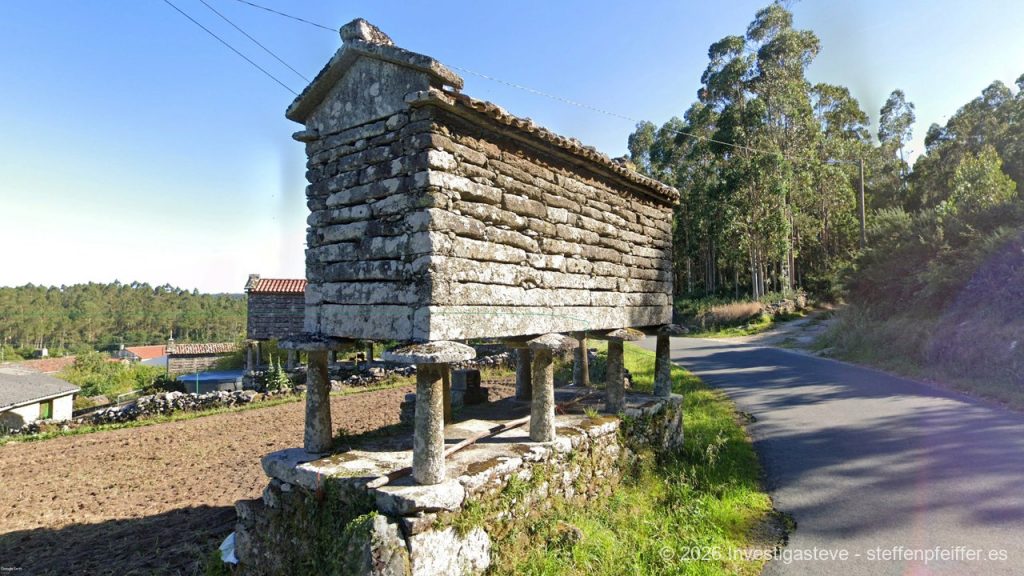
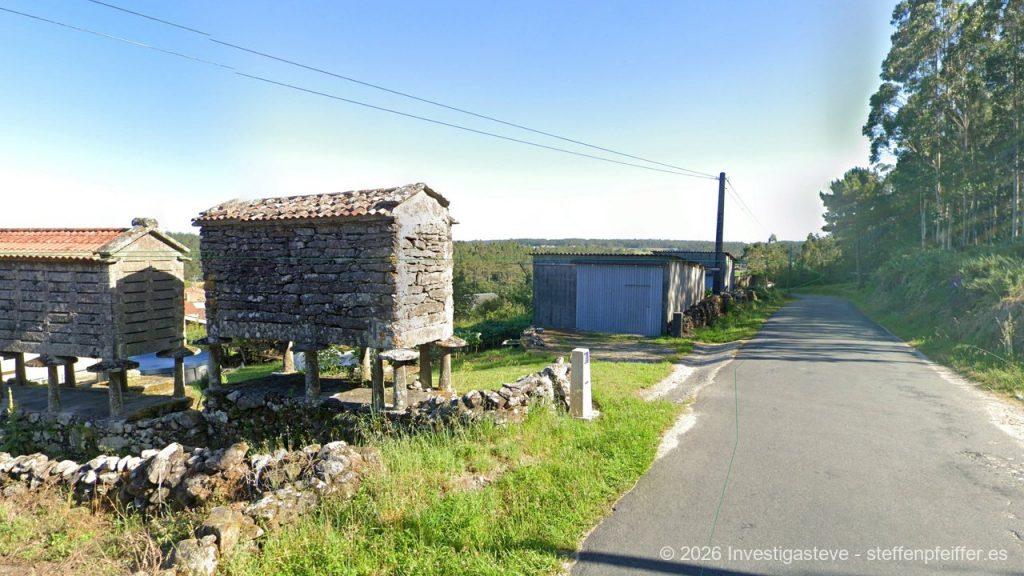
The architecture of the place is an open book of Galician subsistence economy. The “Casas de Pedra,” the rustic stone houses, crowd closely together, as if seeking protection from the unpredictable weather of the Costa da Morte. Everywhere, the Hórreos rise into the sky – those characteristic granaries on stone stilts that look like small, sacred temples of survival. In Trasufre, they tell of a time when the yield of the fields was the only insurance against hunger. The lichens that cover the granite of these granaries glow in an almost unreal yellow and silver, bearing witness to centuries in which the way of life of the people here hardly changed. The 19th century brought secularization and the end of monastic dominance, but Trasufre remained untouched in its rural essence. The rural exodus of the 1960s to 1980s left painful gaps in the social fabric, yet the old walls remained standing – ready to welcome a new kind of traveler.
Today, Trasufre tells a story of rediscovery. With the boom of the Camino de Santiago in the 1990s, the almost forgotten stage point transformed back into an active station. The place has preserved its identity as a “quiet transit point,” but the perspective has shifted. When the locals – today hardly more than twenty permanent residents – greet you with a terse but warm welcome, there resonates the knowledge of a thousand-year-old tradition of hospitality. Trasufre is not a place of great heroic epics, but of heroic everydayness. It is the story of a place that has learned to survive on the edge of the great paths by preserving its untouched nature. The proximity to the legendary Hórreo of San Martiño de Ozón and the spiritual aura of the Ermita da Santiña anchor the hamlet in a network of myths and stones that reminds the pilgrim that he walks here on hallowed ground – on the Royal Way that leads directly into the heart of Galicia.

Camino Distances
Here you will find the distances for the current stage on the Camino Fisterra y Muxía (CFM 3b):
Rest & Arrival
Arriving in Trasufre marks a psychological turning point on the stage. After leaving Dumbría, Trasufre is the first place that conveys the feeling of truly immersing yourself in the “wilderness” of the Costa da Morte. There is no large welcoming committee here and no tourist infrastructure to receive you with open arms. Instead, arriving is an act of self-reflection. You notice that you are there when the forest briefly opens and the few, gray roofs of the hamlet peek out between the trees. It is an arrival for the senses: The coolness of the river valley hits you, and the ground under your feet becomes firm for a moment as you cross the small bridge over the Río Castro. Arriving in Trasufre means leaving civilization behind and fully engaging in your own walking.
You will look in vain for overnight accommodation in the classic sense in Trasufre. The place is so tiny that it has not a single pilgrim hostel or guesthouse. Anyone wishing to linger here depends on the extremely rare private offers or the “Casa Rural Trasufre,” which, however, is often only accessible by prior arrangement and subject to availability. Most pilgrims therefore use Trasufre for what it historically always was: a transit station. Pilgrims who need permanent accommodation must either look back to Dumbría, where the modern Albergue Conco offers a high standard, or continue the way to Senande or Moraime. This absence of bed factories, however, is the place’s greatest treasure. Those who take a break in Trasufre do so in an almost eerie silence, broken only by the breathing of nature.
The feeling of staying overnight – should one be lucky enough to find private lodging – is characterized by a radical reduction. In Trasufre there is no Wi-Fi to connect you with the world, and no bar where you could spend the evening over a cool beer. Instead, the place offers the chance for a night of absolute darkness and deep sleep. When the sun sinks behind the forested hills, the forest takes command. Only the murmur of the river and the rustling of small animals in the undergrowth accompany you. It is an archaic form of shelter that teaches you to be at peace with yourself and your surroundings. Arriving in Trasufre is therefore less a physical reaching of a destination than a mental clicking into a rhythm that is older than the modern world. It is the preparation for the end of the world, which one can only truly grasp in silence.
Food & Drink
Eating and drinking in Trasufre requires the planning of an experienced hiker. Since the place has no bars, cafés, or restaurants, you are entirely dependent on your own backpack here. Yet it is precisely this necessity for self-sufficiency that makes resting in Trasufre a very special experience. He who settles on the banks of the Río Castro to eat his brought-along bread from Dumbría or Senande experiences a quality of enjoyment that cannot be found in any Michelin-starred restaurant. The water of the river splashes at your feet while you bite into a piece of hearty Galician cheese. The taste of the food combines with the cool forest air to form a holistic experience. Dining in Trasufre means perceiving food as what it is: necessary energy for the onward journey.
The olfactory component while eating is particularly strong here. Since no kitchen fumes or exhaust gases cloud the air, you taste every nuance of your provisions. A simple apple here smells of sun and fresh earth, and the water from your bottle feels more alive. It is advisable to stock up on provisions in Dumbría, as the next real supply point awaits you only in Senande at the “Bar A Coxa.” Trasufre teaches you gratitude for the simple. A piece of dark chocolate or a few nuts become a feast here. The only “gastronomic” establishment in the place is nature itself – the moss-covered stones on the riverbank serve as chairs, and the canopy of leaves is your magnificent dining hall.
For the thirsty pilgrim, Trasufre offers a last natural refreshment. Although the river water of the Río Castro should only be enjoyed filtered, the sight of the clear, flowing water has a psychologically immensely invigorating effect. Many pilgrims use the break in Trasufre to cool their faces and forearms, which feels almost like a ritual act of purification. One washes off the dust of the Camino Real and prepares oneself internally for the last third of the way to Muxía. It is a form of sustenance that goes not through the stomach, but through the senses and the soul. Those who leave Trasufre again usually do so with a slight feeling of emptiness in the stomach, but with a full heart and sharpened senses for the coming kilometers.
Supply & Logistics
Logistically speaking, Trasufre is the definition of a “blank spot” on the supply map of the Camino. It is a place of radical absence of commercial services. There is no ATM here, no pharmacy, and no grocery store. Whoever realizes in Trasufre that they have forgotten something must prepare for a march back to Dumbría (approx. 3.8 km) or ahead to Senande (approx. 2.4 km). This logistical vacuum, however, is not a deficiency, but an integral part of the nature experience. Trasufre forces the pilgrim to have perfected their own logistics in advance. It is the test of the hiker’s autonomy.
The paths in and around the hamlet, however, are excellently marked. The yellow arrows guide you safely over the small bridge and through the dense forest passages. The trail surface is a constant change between shady country lanes and short stretches of asphalt, which provides a welcome change for the feet. Anyone needing help here depends on the solidarity of fellow pilgrims or the few locals, as the mobile network can often be patchy in the deep valleys around the Río Castro. There is no Wi-Fi and no public toilets. Trasufre is a place one traverses knowing that one is completely on one’s own for a short time.
Shopping: There are no shops of any kind in Trasufre; the last supply point is in Dumbría, the next in Senande.
Gastronomy: No bars or restaurants available; pilgrims must plan autonomously with their own provisions.
Accommodation: Trasufre has no pilgrim hostels; accommodation can be found in Dumbría (Albergue Conco) or Muxía.
Public Facilities: No formal services such as police or post office; there is a medical center (Centro de Saúde) in Dumbría.
Despite this sparse infrastructure, the logistical importance of Trasufre should not be underestimated. It is the place where you check your supplies of water and patience. The small bridge over the Río Castro is the central logistical fixed point – a technical monument in an otherwise wild landscape. Anyone passing through here should ensure that their GPS device is charged, as the dense forest passages can make orientation difficult in fog or bad weather. Trasufre is a passage of concentration, a place where external logistics recede to make room for inner navigation.
Not to Be Missed
Río Castro Bridge: Cross this iconic point of the Camino CFM 3b; the stone crossing is a symbol of the historic Camino Real.
Ermita da Santiña: A small chapel hidden in the forest just a few hundred meters from the village center; a place of profound spiritual silence.
Historic Camino Real: Pay attention to the texture of the path; in many places you can still see the ancient foundations of this royal trade route.
Hórreos of Trasufre: Observe the variety of these traditional granaries directly along the path; they are masterpieces of peasant craftsmanship.
River Landscape of the Rego de Vao Salgueiro: Use the shady spots by the water for a meditative break and let nature work its magic on you.
Hidden Gems & Secret Spots
Although Trasufre is tiny, it hides small corners that are not described in detail in any official guide. If you take the narrow path downstream shortly before the bridge, you will reach a spot after a few minutes where the Río Castro glides over a cascade of small granite steps. Here, a small pool has formed, the water of which is so clear that you can count every pebble on the bottom. This is a place of absolute absence of humanity. In the early morning hours, when the mist still hangs over the water like cotton wool, this place has something elfish about it. It is the perfect spot to open your diary or simply listen to the whispering of the water without being disturbed by the footsteps of other pilgrims.
Another hidden spot is the old crossing point of the Camino Real at the northern exit of the village. Here, one often still finds remnants of old stone walls that have almost completely sunk into the earth. If you take the time to examine the structures more closely, you can see how the paths were once laid out to give horses and carts a foothold. It is an archaeological search for traces on a small scale. Whoever stops here on the hilltop and lets their gaze wander back towards Dumbría will, in good light, recognize the vast transition zone of the landscape. It is a place of overview, where you grasp how wisely the old road builders used the topography to guide man and beast safely through this hilly terrain.
The immediate surroundings of the Ermita da Santiña are also particularly magical. Many pilgrims walk carelessly past it, but those who dare the small detour into the forest will be rewarded with an atmosphere reminiscent of the first Christian hermits. Near the chapel, one often finds small accumulations of stones that pilgrims have left as votive offerings. It is a silent conversation between the wanderers of the present and the saints of the past. Here, the air smells particularly intensely of old wood and traces of incense, although the chapel is usually locked. It is a “place of power” that does not loudly shout its energy, but preserves it in the silence of the forest. Trasufre is rich in such invisible moments – you just have to be ready to lift your gaze from the ground and engage with the invisible.
Finally, there is a small, almost overgrown spring above the village that formerly served the locals as a drinking water source. The water emerges directly from the rock and has a purity you can taste. It is a place that symbolizes the connection to the earth. Whoever finds this spot feels a deep grounding. It is these tiny details – a spring, a ruined wall, a waterfall – that make Trasufre, in memory, a place far larger than its number of inhabitants suggests. It is a village of quiet discoveries.
A Moment of Reflection
In Trasufre, you stand at a point in your journey that shines neither through comfort nor spectacle, and therein lies its deepest lesson. The hamlet is the epitome of the “nature passage.” The question arises: How often in our lives do we evaluate experiences only by their utility or convenience? Trasufre offers you none of this – there is no bar, no hostel, and no quick solutions. It offers you merely the ground under your feet and the silence of the forest. Here you realize that the Camino is a journey of reduction. Everything you truly need you already carry in your backpack or in your heart. Trasufre is the mirror of your own autonomy.
Walking on the Camino Real, the Royal Way, lends your hike a historical dignity. You are no tourist visiting an attraction; you are part of a centuries-old stream of seekers. In the simplicity of the stone houses of Trasufre, you recognize the constancy of life. While the world outside becomes ever faster and louder, Trasufre remains caught in its rhythm. It teaches you patience. The river flows whether you watch it or not; the stones lie whether you heed them or not. This indifference of nature to your human schedule is deeply healing. It washes away the urge for constant optimization.
When you cross the bridge over the Río Castro, you perform a ritual act of transition. You leave the known behind you and enter the unprotected space of the forest. In this moment of solitude, the question often arises: Who am I when no one is watching? When there is no bar where I can present myself, and no Wi-Fi over which I can share my experiences? Trasufre gives you the answer through the pure presence of the moment. You are the wanderer who breathes, who feels, and who continues on their way. This realization of your own sufficiency is the true treasure of Trasufre. You carry the calm of the river with you into the rest of your day and grasp that the most beautiful stages are often those on which seemingly the least happens – because the true path runs inside you.
Camino of the Stars
This place lies on the Camino Fisterra y Muxía (variant CFM 3b), on the stage from Olveiroa to Muxía. The sequence of places is:
Olveiroa → Hospital → Dumbría → Trasufre → Senande → Quintáns → Moraime → Os Muiños → Muxía
Did you also experience that moment of absolute, almost magical silence on the banks of the Río Castro in Trasufre? Or did you make your very own discovery near the Ermita da Santiña that we are still missing here? Perhaps you have a photo of the historic bridge or would like to share your thoughts about the “Royal Way” with us? Your personal experiences make this guide a living companion for all future pilgrims. Write us a comment and tell us your story from the green heart of Galicia!
About the Author