A First Glance – Introduction & Atmosphere
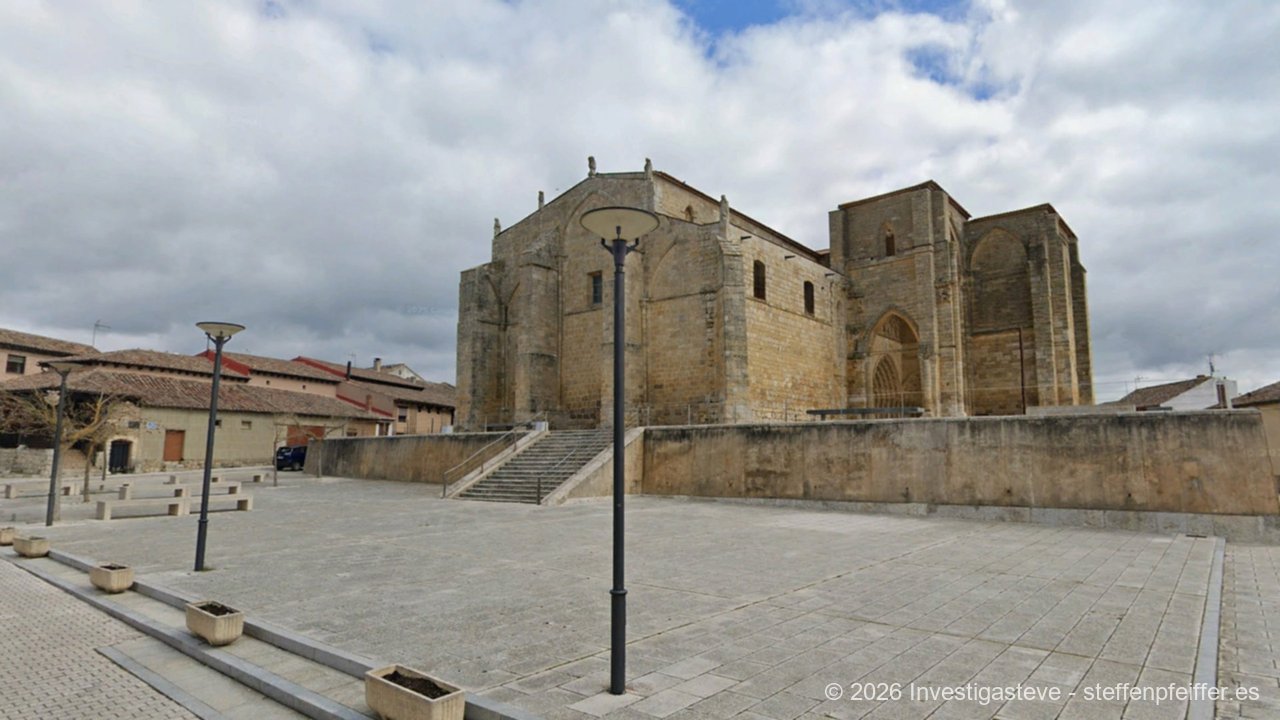
When the pilgrim traverses the almost hypnotic vastness of the Tierra de Campos, that notorious “granary of Spain,” which in summer undulates like a liquid sea of gold and in winter freezes in an ascetic, brown-gray severity, Villalcázar de Sirga does not announce itself through gentle hills or forests. It is a sudden, almost violent eruption of monumental architecture from the flat horizon. Kilometers before you reach the first clay houses of the village, the massive, square outlines of the church of Santa María la Blanca eat into the deep blue of the Castilian sky. It is a sight that makes the walker pause; an optical discrepancy between the modest size of the settlement and the imperial force of this house of God, which resembles more a cathedral in a metropolis than the parish church of a 160-soul village.
The first contact with Villalcázar is characterized by an archaic acoustics. The steady, almost meditative crunch of the calcareous gravel under the soles ceases as soon as you leave the “Sirga,” that historic towpath that gave the place its name, and enter the dusty Calle Real. Here, silence takes command – a dense, almost physically tangible stillness, broken only by the distant, wooden clattering of the storks on the church tower or the soft whistling of the wind sweeping unhindered over the plain. It smells of dry earth, of the spicy sweetness of dried wheat, and – when you approach the famous Mesón – of the hearty, smoky aroma of burning poplar wood and lamb roasted in a wood-fired oven.
Tactilely, arriving in Villalcázar is an experience of textures. The fine, white dust of the Meseta has settled like a second skin on the heated forehead, and the first touch of the rough, sun-warm limestone ashlars of the church feels like a grounding after hours of total exposure. Psychologically, the place offers an immediate transformation. You step out of the existential solitude of the fields into the shadow of a monumental protection. It is the moment when the exhaustion of the day gives way to an awestruck curiosity, while the light of the setting sun bathes the façade in a glowing ochre that underscores the historical causality of this place as an eternal pilgrim station and site of miracles.
What This Place Tells
Villalcázar de Sirga is not merely a village by the wayside; it is a stone archive of the medieval worldview. The name itself carries the DNA of its origin: “Villa” for the village, “Alcázar” – derived from the Arabic “al-qasr” – for the former fortress or castle, and “Sirga” for the path or trail. This etymology reveals the historical layering of a region that was the scene of the Reconquista, of chivalry, and of the deepest veneration of Mary. In the 12th century, this strategically important point was entrusted to the Order of the Knights Templar. The historical causality is tangible here: in a time when the Meseta was a dangerous no-man’s-land, the Templars created a safe haven here, a combination of spiritual center and military bulwark. The church of Santa María la Blanca, built in the transitional style from Romanesque to Gothic, is the architectural legacy of this era – a house of God that is at the same time a fortress.
The walls, however, tell not only of knights but of miracles. King Alfonso X, “the Wise,” was so fascinated by the power of the local image of Mary that he immortalized Villalcázar de Sirga in his famous “Cantigas de Santa María.” He dedicated over a dozen of his songs to this place, in which he told of the lame who learned to walk again here, and of the blind who regained their sight. Psychologically, this literary and musical canonization acted like a magnet on the medieval pilgrim world. Villalcázar became one of the most important pilgrimage sites on the Camino Francés, a place where the hope for divine intervention took physical form. When you stand before the monumental south portal today, you see not only stonemasonry; you see the visualized hope of millions who came here over the centuries seeking healing.
Particularly fascinating is the historical presence of the high nobility. In the Capilla de Santiago rest Infante Don Felipe, the brother of Alfonso X, and his second wife Leonor de Rodríguez de Castro in magnificent sarcophagi. These tombs are tactile masterpieces of polychromy and sculpture. They tell of a time when Carrión and Villalcázar formed the political epicenter of Castile. The fine textures of the stone garments and the details of the facial features make the figures seem almost alive after nearly 800 years. This historical weight lends Villalcázar an aura of sublimity. It is a place that teaches the pilgrim that constancy lies not in the size of the settlement, but in the depth of the stories rooted there. The transition from the splendor of kings to the dust of the fields is palpable here in every corner and challenges the observer to an emotional metamorphosis: one is not merely a tourist here, but a guest in eternity.
Addresses & tips in Villalcázar de Sirga
Camino Distances
Villalcázar de Sirga lies in the central section of the Palencian Meseta. The paths here are characterized by long straight stretches that require high mental endurance.
| Previous Place | Distance (km) | Next Place | Distance (km) |
|---|---|---|---|
| Villarmentero de Campos | approx. 4.1 km | Carrión de los Condes | approx. 6.0 km |
Sleeping & Arriving
Arriving in Villalcázar de Sirga is for many pilgrims associated with a deep psychological relief. After the shade-less march through the wheat fields, the village feels like a protective cocoon. The tactile experience begins at the threshold of the hostels, such as the “Albergue Don Camino” or the municipal hostel. When you take off your sweaty clothes and place your hand on the massive, often cool clay walls of the old buildings, you feel the immediate thermal calming. The smell in the dormitories is a mix of fresh linen, the tart aroma of hiking boots, and that cool earthiness that only centuries-old masonry exudes.
The acoustic backdrop upon check-in is a soft murmuring in various languages, underscored by the rhythmic clicking of backpack buckles and the distant chiming of the church bell. Staying overnight in Villalcázar means surrendering to the intimacy of a small village that nevertheless breathes the heart of an empire. The psychological effect of this environment is profound: you reduce yourself to the essentials – a bed, a shower, a blanket – while at the same time sleeping in the shadow of one of Spain’s greatest architectural wonders. The historical causality of hospitality here has been unbroken since the Templars; you feel in the warmth of the hospitaleros that the care of the pilgrim here is not a business but an ancient duty.
The evenings in the accommodations are characterized by a very special social dynamic. In the inner courtyards, often lined with old agricultural implements that look like sculptures of the past, the walkers gather. The light of the setting sun breaks in the cracked glass windows of the surrounding houses and bathes the scene in a warm amber. You hear the clinking of glasses, the rustling of maps, and the collective sigh of relief. This five-dimensional immersion into communal life creates bonds that often last beyond the Camino. Arrival here is not a purely logistical process, but an emotional docking to the community of seekers. You feel safe in the seclusion, a tiny point in the vastness of Castile that has found a home for one night.
Particularly noteworthy is the stillness of the night in Villalcázar. When the last day tourists have departed and the sun has sunk behind the horizon of the Tierra de Campos, the place reveals its true, mystical quality. The acoustic experience of the night is only underscored by the distant barking of a village dog or the soft rustling of the wind in the cracks of the window shutters. You lie in the cool sheets and feel your own existence with a clarity that only the solitude of the high plateau can bring forth. It is an emotional metamorphosis from the haste of moving forward to the quality of being. Those who wake in Villalcázar do so with a mental freshness that grows from the deep connection with this sacred ground. It is the perfect starting point for the short march to Carrión de los Condes.
Eating & Drinking
The gastronomic landscape of Villalcázar de Sirga is inseparable from one name: the Mesón de los Templarios. This restaurant is known far beyond the borders of the province and functions as the culinary epicenter of the Camino Francés. The first olfactory impression upon entering the dining room is overwhelming – a warm cloud of garlic, olive oil, thyme, and the unmistakable aroma of lamb roasted in a wood-fired oven (“Lechazo”). It is a scent that speaks of tradition and hard field labor, a culinary embrace that dispels the cold of the often windy Meseta evenings. The tactile experience is dominated by the texture of the local bread; the crust is hard and crispy, a contrast to the soft, fragrant crumb inside, perfect for soaking up the delicious juices of the meat.
The psychological experience of a meal in Villalcázar is an act of ritual community. At the long wooden tables of the Mesón, surrounded by medieval decor and the flickering light of the lamps, the boundaries between nations fade. You share the “Sopa de Ajo,” the robust garlic soup with bread and egg, often prepared here with a special intensity. Every spoonful is a five-dimensional experience of warmth and energy. The taste is tart, spicy, and deeply rooted in the soil of Palencia. A robust red wine from the region is drunk with it, whose deep, almost opaque ruby color recalls the blood of the knights who once kept watch here. Drinking this wine from simple glasses that feel cool in the hand is a moment of total presence.
To finish, you must not miss the “Amarguillos de Villalcázar” – small almond cookies whose crumbly consistency melts on the tongue and leaves a fine sweetness. These sweets are the psychological counterweight to the hearty main courses and reflect the gentleness of the place’s veneration of Mary. The acoustics during the meal – the clatter of ceramic plates, the laughter of the pilgrims, and the muted conversation of the locals – form the tapestry on which the fatigue of the day transforms into a deep satisfaction. Those who leave Villalcázar culinarily do so with an inner satiety that goes far beyond physical hunger. You have literally absorbed the ground you walked on, thus establishing a physical connection to the landscape.
Supplies & Logistics
Although Villalcázar de Sirga is a very small place, logistics here function with a pragmatic efficiency almost entirely geared towards the pilgrim stream. You feel the historical causality: without the path, this place would sink into insignificance; through the path, it is a highly functional service point.
Shopping: There is a small village shop covering basic needs. Here you find fresh fruit, water, and typical pilgrim supplies. The selection is limited, but the quality of local products like cheese or honey is often excellent.
Gastronomy: The density of bars and restaurants is enormous for the population. Besides the famous Mesón, there are several bars offering pilgrim menus and bocadillos for the quick hunger.
Accommodation: Capacities range from the simple municipal hostel to private hostels and small guesthouses, often offering very personal and warm care.
Public Facilities: A public fountain with drinking water is centrally located in the square. Full medical care is only available in Carrión de los Condes, about 6 km away.
The psychological security of encountering such reliable infrastructure in this isolated region takes much pressure off daily planning. Acoustically, the logistics are underscored by the occasional passing of a tractor, a constant reminder that you are in a living agricultural region. The emotional relief of replenishing supplies at the fountain is a tactile ritual that initiates departure the next morning. In Villalcázar, logistics work not through anonymous automation but through personal proximity.
Don’t Miss
1. Church of Santa María la Blanca: An absolute must. Admire the spectacular south portal with depictions of the Pantocrator and the apostles – a visual Bible in stone.
2. Royal Tombs: In the Capilla de Santiago, you will find the sarcophagi of Felipe and Leonor. Pay attention to the remains of the original painting, making the historical causality of power tangible.
3. The Madonna of Villalcázar: The figure of the Virgin that inspired Alfonso X’s Cantigas. Her gentle aura is a psychological center of calm.
4. South portal at sunset: When the light falls obliquely, the sculptures emerge plastically. A five-dimensional experience of light, shadow, and history.
5. The Pilgrim Monument: A modern accent on the square, inviting reflection on your own journey and the millions before us.
6. Mesón de los Templarios: Even if you don’t eat there, a look into the historic dining room, which smells of smoke and history, is worthwhile.
Insider Tips & Hidden Places
Villalcázar de Sirga often guards its secrets in the details. One such place is the narrow passage behind the chancel of the church. While most visitors only look at the main nave, you find an acoustic oasis here. The sounds of the outside world fall completely silent, and you hear only your own breathing in the cool, incense-scented space. The floor here is of worn stone slabs, whose smoothness you can feel through your socks – a tactile archive of millions of steps. It is a place of absolute psychological isolation, ideal for a silent meditation on the meaning of the “Sirga,” the path that led us here.
Another insider tip is the small alley on the northern edge of the village that leads directly into the fields. Here, there is a dilapidated adobe barn, on whose walls you can still see the original straw stalks in the dried clay. When you stand there, with your back to the village and your face to the infinity of the Meseta, you feel the historical causality of agriculture most intensely. You hear only the rustling of the ears of grain and the cry of a bird of prey. It smells of dust and freedom. This place is a psychological refuge for all those for whom the bustle on the church square is too much. Here, the reduction to the essentials that the Camino demands becomes physical reality.
Those who keep their eyes open will find small engraved symbols on the outer wall of the church, about two meters above the ground – stonemason’s marks from the 13th century. When you run your fingers over these signs, you establish a tactile connection to the craftsmen who created this wonder from nothing. It is an emotional bridge across the centuries. Each mark is an individual signature, a voice from the past telling of pride and hard work. This discovery is an insider tip for the mindful pilgrim who wants not only to consume history but to touch it.
Finally, a short walk to the village cemetery at dusk is worthwhile. The cemeteries in Castile have their own, dignified aesthetic. Between the cypresses and the simple tombstones of local stone, there is an atmosphere of timeless tranquility. Here you feel the psychological connection to all those who walked this path before us and found their final rest here. It is not a sad place, but one of deep emotional metamorphosis, reminding us that we are all only wanderers between worlds. The light falls particularly softly here through the trees, casting dancing shadows on the ground – a visual poem about becoming and passing away.
Moment of Reflection
Villalcázar de Sirga challenges the pilgrim to an existential stocktaking. In the discrepancy between the monumental church and the tiny village, the human striving for transcendence is reflected. Why did people build such a wonder into the absolute wasteland? The psychological answer lies in the need for protection and orientation. Villalcázar functions as a stone compass for the soul. When looking at the Gothic arches reaching towards the sky, you recognize your own desire for growth and knowledge. The historical causality of the Templars who guarded this house reminds us that we too are guardians of our own values and dreams.
The tactile experience of the rough stones and the cool air in the nave inevitably leads to an emotional metamorphosis. You leave the pride of the conquered kilometers outside in the dust and recognize your own smallness against time. Yet in this humility lies immense power. Villalcázar teaches us that beauty can arise where one least expects it – in the middle of the monotony of the plain. Those who leave this place do so with a new firmness in their step. They have learned that true wonders do not need big metropolises, but only a firm faith and a path that brings people together. The “Sirga” is more than a path; it is the bond that connects us with all those who sought the light in the Tierra de Campos before us.
Camino of the Stars
This place lies on the Camino Francés, on the stage from Frómista to Carrión de los Condes. The sequence of places is:
Frómista → Población de Campos → Revenga de Campos → Villarmentero de Campos → Villalcázar de Sirga → Carrión de los Condes
Did you also feel the monumental awe at the first sight of Santa María la Blanca as a turning point on your path? Perhaps you found a very special stillness in the Capilla de Santiago or had an encounter at the Mesón de los Templarios that warmed your heart? Share your stories, your photos of the royal tombs, or your thoughts on the infinity of the Meseta with us. Every story makes this stone wonder even more alive for all of us!
About the Author