First Glance – Introduction & Atmosphere
When you leave the gentle heights behind Palas de Rei and dive deeper into the labyrinthine greenery of the Comarca Ulloa, you reach Pontecampaña, a place that feels like an organic continuation of the landscape. It is not a village in the conventional sense, but an archaic still life grouped around the Río Pambre. The air here has an almost crystalline purity, saturated with the cool moisture of the flowing water and the heavy, earthy aroma of ferns and moss that covers the centuries-old granite walls like a living carpet. As you approach the settlement, the noise of the modern world falls completely silent. What remains is an orchestral interplay of nature: the steady, soothing gurgle of the Pambre, the rustle of alder leaves in the light west wind, and the distant, metallic ringing of a bell that floats through the valley like a relic from another time.
In Pontecampaña, you feel the tactile power of Galicia in its purest form. The ground beneath your feet changes from firm forest path to uneven, smooth-polished cobblestones that carry the history of millions of pilgrim feet. The coolness of the grey stone that shapes the houses and the small bridge stands in stark contrast to the tactile warmth of the sun that finds its way through the dense canopy of eucalyptus and chestnut trees. Psychologically, for many pilgrims this place marks the entry into a zone of deep introspection. Here, where the path becomes narrower and nature practically embraces you, the haste of the preceding kilometres fades away. You smell the scent of damp wood and the bitter aroma of wild herbs, while the visual panorama of countless nuances of green calms your senses. In Pontecampaña, you are no longer just a walker; you become part of a timeless fabric of stone, water and silence.
What This Place Tells
The narrative of Pontecampaña is inseparable from the historical causality of water and the bridge. The name itself – a fusion of bridge (Ponte) and the surrounding landscape (Campaña) – indicates the strategic importance of this point. Since the Middle Ages, this river crossing was a bottleneck for pilgrims and traders alike. The small but sturdy bridge over the Río Pambre is a silent witness to the logistical challenges of past centuries. Here, not only was the river crossed; here the boundary between the wilderness of the forests and the safety of the small settlements was marked. Historical immersion becomes tangible when you look at the massive granite ashlars of the bridge, whose edges have been rounded by water and time. It is an architecture of necessity that has matured into a monument of constancy over generations.
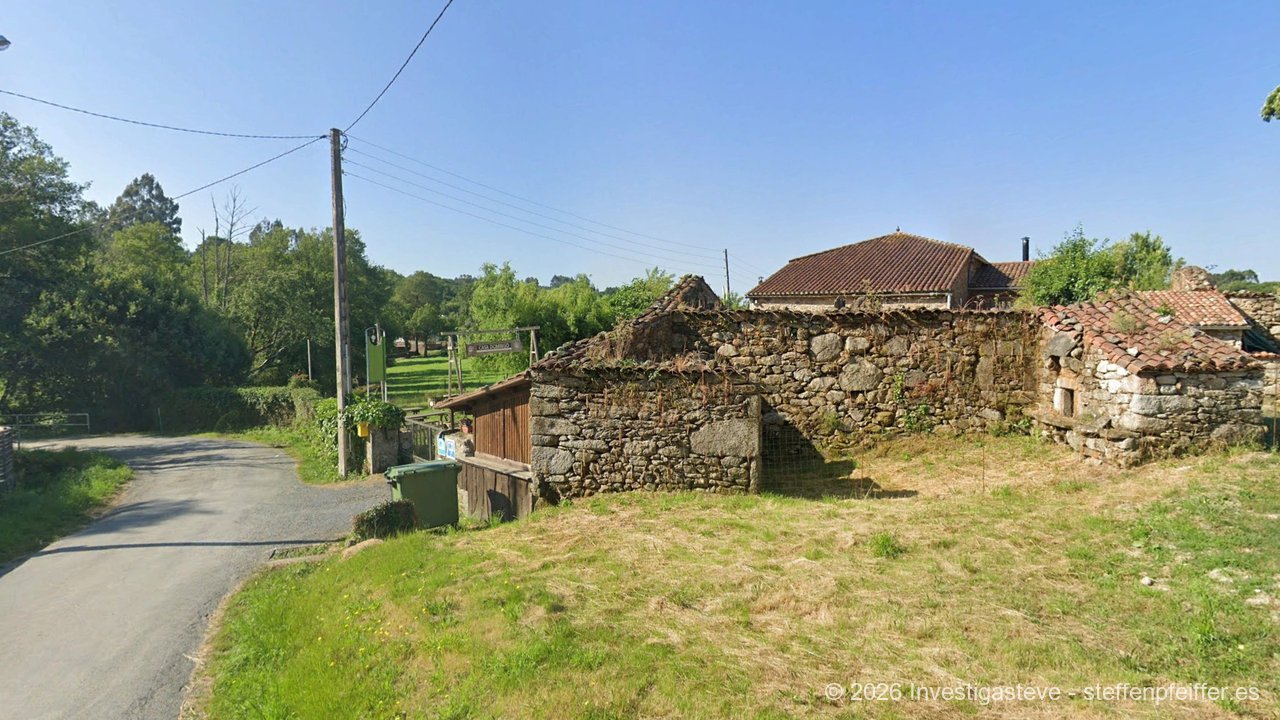
Historically, Pontecampaña belonged to the sphere of influence of the powerful noble family of Ulloa, whose spirit is still felt in the massive walls of the old farmsteads. The Casa Domingo, today a cherished hostel, is a perfect example of this rural architecture of Galicia. Once a functioning agricultural centre, the building tells of the symbiosis between man, animal and soil. In the spacious courtyards where pilgrims now wash their clothes, oxcarts once stood, and the smell of fresh hay mingled with the aroma of smoked ham. This tactile reality of work is preserved in the deep furrows of the wood and the weight of the stones. The psychological effect of this setting is immense: it conveys a feeling of protection and security deeply rooted in the DNA of the Camino Francés.
A special chapter of local history is written by the “Corredoira”, that spectacular forest corridor that begins immediately behind Pontecampaña. These sunken paths are not random products of nature, but the result of centuries of use by drovers and pilgrim streams. The historical causality of these paths lies in their function as protected corridors that shielded travellers from wind and weather. When you walk through these green tunnels today, you enter a space where time seems suspended. The acoustic isolation within the corridor, where every sound is muffled, creates an atmosphere of sacred silence. It is as if the path itself whispers its history – stories of hope, exhaustion, and the unwavering will to reach distant Santiago. Pontecampaña is thus the guardian of this portal, the transitional place where civilisation finally yields to the mystical power of the Galician forest.
Addresses & tips in Pontecampaña
| Accommodation | 2 |
| Sights | 1 |
Opening hours
Opening hours
Camino Distances
Pontecampaña lies as an idyllic stop on stage 31 of the Camino Francés, deeply embedded in the rolling hills of the province of Lugo.
| Previous Town | Distance (km) | Next Town | Distance (km) |
|---|---|---|---|
| A Graña | ca. 1.2 km | Casanova | ca. 1.5 km |
Sleeping & Arriving
Arriving in Pontecampaña is an act of deceleration that has an almost ritual character. When you have crossed the bridge and stand before the Casa Domingo, you immediately feel the inviting weight of this historic place. The hostel is far more than just a place to sleep; it is an emotional filling station. The tactile experience begins as soon as you pass through the massive farm gate: you feel the coolness of the shade and hear the soft clatter of dishes coming from the kitchen. Arriving here is shaped by the personal touch of the hospitaleros, who welcome every pilgrim not as a number, but as a guest of the house. The psychological relief is immediate – the backpack is set down, and with it the weight of the day’s worries.
In the dormitories of the Casa Domingo, historical immersion continues. The massive wooden beams in the ceiling and the metre-thick stone walls create a microclimate of security. The acoustic backdrop is characterised by the absence of any mechanical noise; instead, you only hear the distant murmur of the Río Pambre, which acts like a natural lullaby. It is a tactile blessing to lie down on the bed after a shower and feel the cool sheets on your skin, while your gaze through the small windows falls on the lush green of the surrounding gardens. The communal areas, often equipped with an open fireplace, are places of social metamorphosis. Here stories are shared, blisters are treated, and new friendships are made, while the scent of burning oak wood fills the rooms.
For many pilgrims, Pontecampaña is the place where they consciously choose against the anonymity of the larger towns. The limited bed capacity ensures that the group remains small and manageable, which strengthens the feeling of togetherness. Arriving in this hamlet also means submitting to the rhythm of nature. When dusk sets in and the mist creeps over the river, Pontecampaña transforms into an almost unreal scene. The visual experience of the fading light on the lichen-covered stones is of a melancholic beauty that inspires reflection. Sleeping here means diving deep into the soul of Galicia and gathering strength for the last great stage to Santiago.
The sanitary facilities in the hostel are a successful mix of rustic charm and modern standard. The tactile feeling of hot water on tense shoulders is a true luxury after a day in the changeable Galician weather. In Pontecampaña, there is no rush at checkout the next morning. The day often begins with the scent of freshly brewed coffee and the acoustic signal of the first pilgrim staffs hitting the pavement at dawn. Those who stay here take a piece of the peace of the Pambre valley with them on their way. It is a place that shows you that the destination does not always have to lie in the distance, but can sometimes be found right under your feet in a small, stone paradise.
Eating & Drinking
The culinary experience in Pontecampaña is a homage to the honest, powerful cuisine of the Ulloa. In the Casa Domingo, the tradition of the “Cena Comunitaria”, the communal dinner, is celebrated, which for many is the highlight of their stay. The smell that wafts from the kitchen in the late afternoon is an olfactory promise: it smells of bay leaf, garlic, and the savoury aroma of slowly cooked meat. The star of the evening is often the homemade Caldo Gallego, a stew whose consistency is so creamy and nourishing that it fills every fibre of the body with new energy. The tactile warmth of the soup bowl in your hands is the first stage of regeneration.
The taste of the dishes is deeply rooted in the region. You taste potatoes that come directly from the surrounding fields and meat from animals that graze on the pastures of the Ulloa. It is a culinary causality that you taste with every bite. Particularly noteworthy is the artisan bread, whose crust is so crispy that it gives a loud, auditory signal of quality when broken. The tactile chewing of the firm dough, combined with the mild, buttery taste of the Arzúa-Ulloa cheese, is a sensory feast. To drink, a simple but characterful red wine of the region is often served, offered in traditional ceramic bowls. The cool weight of the bowl in your hand and the earthy taste of the wine form the perfect end to a strenuous day of walking.
For small hunger in between, Pontecampaña offers simple but effective snacks. A piece of homemade empanada, filled with juicy tuna or peppers, is the ideal trail food. The psychological effect of a good meal in this setting should not be underestimated: amidst the stone walls and the green nature, eating becomes an act of community and peace. You taste not just calories, but the hospitality and the history of Galicia. Those who eat in Pontecampaña learn the true meaning of “food for the soul” – simple, honest, and of a quality that needs no extravagance.
Supplies & Logistics
Pontecampaña is a place of logistical concentration. Those who come here are not looking for supermarkets, but for reduction to the essential support of the pilgrim journey. The strategic location immediately before the great forest corridor makes the hamlet an important checkpoint for your own equipment and mental state.
Shopping: There are no independent shops or stores on site. Small essential items like water or snacks can only be obtained through the hostel’s offerings. For everything else, Palas de Rei (about 4 km back) or Melide (about 10 km ahead) is the next stop.
Gastronomy: Catering is completely concentrated on the Casa Domingo. The meal offerings are excellent and tailored to the needs of walkers, with the dinners being legendary.
Sleeping: With the Casa Domingo, a high-quality hostel is available, but it has limited capacity. Advance reservation is strongly recommended in high season for psychological planning security.
Public Facilities: There are no medical facilities, banks or post offices. All formal infrastructure must be used in Palas de Rei, which is unproblematic due to the short distance.
Safety in Pontecampaña is exceptionally high due to the seclusion and family structure of the settlement. There is practically no through traffic, which preserves the acoustic silence and increases physical safety for pilgrims. Logistically, the place acts as a “preparation zone” for the more demanding and solitary forest section after Casanova. Those who rest here should have checked their supplies. The efficiency of the hostel’s services ensures that you can concentrate entirely on spiritual and physical recovery without having to worry about administrative details. Pontecampaña is proof that good logistics on the Camino often consist of offering exactly the right thing in the right place.
Don’t Miss
- The bridge over the Río Pambre: Stop in the middle and listen to the water – it is one of the acoustically purest places on the stage.
- The courtyard of Casa Domingo: Feel the atmosphere of an authentic Galician farmstead and observe the centuries-old stonework.
- The start of the Corredoira: Immediately after the hamlet, the spectacular forest tunnel begins – prepare yourself visually for this green portal.
- The evening community: Take part in the communal dinner to experience the social depth of the Camino in an intimate setting.
- The small details in the granite: Look for the moss and lichen formations on the old walls, which look like natural works of art.
Insider Tips & Hidden Places
Away from the marked path, only about fifty metres downstream from the bridge, a place of almost ethereal peace hides. A narrow footpath leads through dense undergrowth directly to the bank of the Río Pambre. Here the bank is flat and consists of fine, dark river sand and round pebbles. The tactile experience of taking off your hiking boots and dipping your feet into the crystal-clear, ice-cold water is a revelation. The temperature contrast acts like an immediate reset for the nervous system. In the air here hangs an intense scent of water mint and damp alder, often lost at the official rest stops. This is the perfect place for a private meditation, far away from the cameras and conversations of fellow pilgrims.
Another hidden treasure is an old fountain, almost completely overgrown with ivy, on the western edge of the hamlet. It is hardly used today, but its stone casing is a masterpiece of rural architecture. When you run your fingers over the cool, damp stone, you touch the centuries-old history of water supply in the Ulloa. The acoustic echo of the fountain, a deep, hollow dripping, forms a fascinating contrast to the bright rushing of the nearby river. It is a place of psychological grounding that reminds you how valuable and central the element of water was and is for survival on this path.
Did you know that there is a spot in the forest corridor shortly after Pontecampaña where the trees stand so densely that even in heavy rain the ground remains almost dry? The locals call these natural shelters “Paraugas de Natureza” (umbrellas of nature). When you stand there, you hear the drumming of the rain on the leaves high above you, while you yourself remain in an acoustic bubble of dryness. This tactile feeling of protection amidst the elements is a profound experience of safety. Such places of isolation are what make the section around Pontecampaña one of the most mystical of the entire Camino de Santiago. Those who take the time to perceive these nuances discover a world behind the yellow arrows.
Moment of Reflection
In Pontecampaña, you stand at a threshold that is marked physically by the bridge and psychologically by the beginning of the Corredoira. The water of the Pambre, flowing ceaselessly beneath you, is a powerful memento mori for your own journey. In the silence of this place, ask yourself: “What from my previous life do I leave behind on this bridge before I enter the deep forest of transformation?” The psychological metamorphosis that takes place here is the change from outward movement to inward reflection. The stone of the houses gives you the necessary stability, while the flowing water teaches you to let go.
The historical causality of your being here connects you with the generations of Ulloa inhabitants and pilgrims for whom this place was a safe haven. Do you feel the responsibility to carry forward this heritage of silence? In Pontecampaña, you become aware that the Camino is not a race against the kilometres, but a search for your own centre. The tactile reality of the rough granite under your hands reminds you of your own resilience. Use this moment of reflection to clear your mind for the coming forest paths. When you leave Pontecampaña tomorrow, you take not only your backpack, but also the certainty that in the whisper of the Pambre you have found an answer to a question you had not yet asked.
Camino of the Stars
This place lies on the Camino Francés, on the stage from Palas de Rei to Arzúa. The sequence of places is:
Palas de Rei → San Xulián → Ponte Campaña → Casanova → O Coto → O Leboreiro → Furelos → Melide → Carballal → Barreiro de Abaixo → A Peroxa → Boente → Castañeda → Ribadiso → Arzúa
Did you also feel that moment of absolute peace when crossing the bridge in Pontecampaña, or experience one of the unforgettable Cenas Comunitarias at Casa Domingo? Perhaps you have found your own secret spot on the banks of the Río Pambre? Share your personal impressions, your photos of the moss-covered bridge, or your thoughts about this stone haven of peace with us. Your story helps others to consciously perceive the magic of this small hamlet on the Camino!
About the Author