A First Glance – Introduction & Atmosphere
When the dense, almost sacred fog of Galicia gradually lifts in the late morning and the first rays of sun break through the silver-green canopy of the eucalyptus forests like golden spears, the pilgrim reaches Santa Irene. It is a place that announces itself not through monumental splendor or urban hustle, but through a sudden, almost awe-inspiring silence. Here, on the gentle high plateau of O Pino, about 380 meters above the distant sea level of the Atlantic, time seems to possess a different consistency. The path, which previously wound through the hilly landscape, leads you into a small enclave of spirituality and nature that feels like a final bastion of rural solitude before the suburbs of Santiago de Compostela take over.
The atmosphere in Santa Irene is dominated by a deep, earthy calm. The ground beneath your feet is often soft here, covered with a layer of dead eucalyptus leaves that emit a characteristic, dry rustle with every step. In the air lies an intoxicating scent – a mixture of the ethereal sharpness of eucalyptus oils, the tart aroma of damp fern, and the sweetish smell of rotting wood after a typical Galician rain shower. It is an olfactory experience that burns itself deep into your memory and marks Santa Irene as a place of purification and deep breathing. The auditory panorama is not determined by engine noise, but by the steady rustling of the wind in the high treetops, which sounds like the distant murmur of a prayer, interrupted only by the rhythmic clicking of pilgrim poles on the stony sections of the path.
What This Place Tells
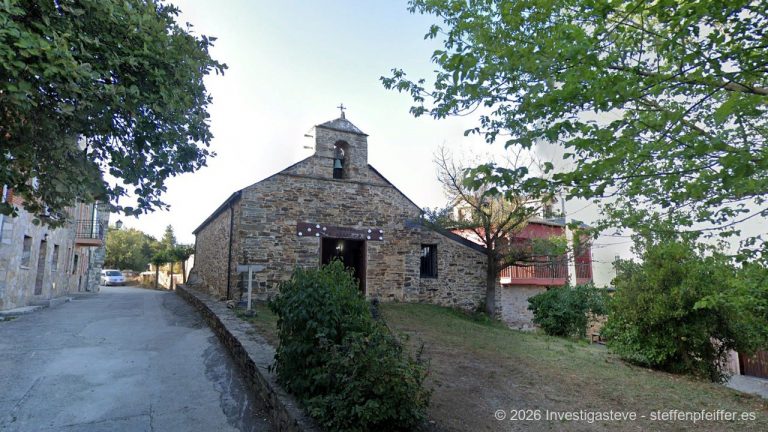
Santa Irene is a place whose history is deeply rooted in Christian iconography and local legends. The heart of the hamlet is the Ermita de Santa Irene, a simple but characterful chapel from the 17th century. It is dedicated to Saint Irene of Portugal, a martyr whose life and death speak of purity and steadfastness. The architecture of the chapel is a lesson in Galician Baroque modesty: walls of roughly hewn granite that have acquired a silver-gray patina and thick carpets of emerald-green moss over the centuries. These stones have heard the prayers of millions of pilgrims who have paused here for over 300 years to draw strength for the final kilometers to Santiago. It is documented that the chapel was once donated as a private refuge by a local noble family before becoming an integral part of the official Camino de Santiago heritage (UNESCO).
Particularly fascinating is the connection between sacred architecture and mystical natural power, which reveals itself at the “Fountain of Eternal Youth” located right next to the chapel. Legend has it that the water of this spring not only quenches thirst but also washes the traces of time and effort from the faces of the walkers. Historically, such fountains were often pagan cult sites that were reinterpreted in the course of Christianization – a fascinating example of Galicia’s spiritual stratification. In the annals of the Way, Santa Irene is often mentioned as the point where the physical exhaustion of the Meseta and the Galician mountains transitions into a phase of psychological transformation. Here, you are no longer just a hiker; you become an arrival. The place tells of the constancy of faith and the indomitable power of nature, which manifests in the giant oaks and eucalyptus trees that surround the sanctuary like living guardians.
Psychologically, Santa Irene functions as a kind of lock. Whoever passes through here leaves the wilderness behind and unconsciously prepares for the urban destination. It is a place of causality: the arduous ascents of the past days find their reward here in the gentle topography of O Pino. The haptic experience of the cold spring water on your heated skin and the sight of the simple altar inside the hermitage create a connection between physical effort and the spiritual meaning of the journey. Up here, on the border between the yesterday of long marches and the tomorrow of arrival in the holy city, Santa Irene stores the collective hope of all who have touched this ground before us.
Addresses & tips in Santa Irene
Camino Distances
At Santa Irene, the geographical final phase of the journey becomes tangible. The distances are short, but every kilometer is charged with meaning.
| Previous Location | Distance (km) | Next Location | Distance (km) |
|---|---|---|---|
| O Empalme / Salceda | ca. 1.5 km | A Rúa | ca. 1.8 km |
Sleeping & Arriving
Arriving in Santa Irene is a haptic experience of deceleration. Anyone who decides to stay here instead of walking the final two kilometers to the bustling O Pedrouzo seeks conscious isolation. When you stand in front of the Albergue Municipal, a functional but welcoming building, you feel the weight of your backpack one last time with real intensity. Putting down your luggage here is a ritual act of liberation. The cool tile floors of the hostel under your bare feet offer a pleasant contrast to the heat of the path. There is an atmosphere of camaraderie that is characterized less by loud celebration than by a respectful, shared silence. You are among like-minded people who appreciate the value of rest just before the destination.
The private Albergue Santa Irene offers a slightly more intimate experience. Here, arriving is defined by the haptic warmth of wooden furniture and the personal greeting of the hospitaleros. It is a place where you don’t feel like a number in a mass quarters, but like a guest in a house entirely devoted to the spirit of the Way. The rustling of sleeping bags at night and the soft light falling through the windows, illuminating the dancing dust particles in the sunrise, create a feeling of security. The psychological effect of this calm is immense: in Santa Irene, the soul, which may have lost touch on the fast-paced stages before, is allowed to catch up. It is a place where you allow yourself to be tired without feeling the pressure of the nearby big city.
Arriving here is also framed by the physical environment. The small forest of oaks and eucalyptus trees that surrounds the accommodations acts like a natural soundproofing. You hear the distant roar of the national road only as a muffled background, while the cracking of branches and the song of birds form the actual soundscape. Anyone who stays here chooses the “slow entry” into Santiago. You feel the cool evening air rising from the valleys, bringing with it the scent of damp grass. It is the last night in relative wilderness, and this knowledge gives arriving in Santa Irene an almost melancholic depth. You organize your gear, tend to your feet, and mentally prepare for the next day, which will change everything.
Eating & Drinking
Culinarily, Santa Irene is a place of honest, powerful fortification. The center of physical well-being here is the restaurant “Asador Andaina,” a place known among pilgrims for its excellent grilled specialties. As you approach the building, your nose immediately catches the tempting smell of burning oak wood and roasting meat – “Carnes a la Brasa.” It is an archaic, haptic scent that instantly stimulates saliva production and awakens the spirits. Here, eating is celebrated as a ritual of restoration. The crust of the meat is crispy and smoky, while the inside remains juicy – a sensory delight after days of meager trail provisions.
You often sit at heavy wooden tables and share the “Menú del Día,” which is served here with a Galician generosity unparalleled. A deep bowl of Caldo Gallego, steaming hot and rich with cabbage and potatoes, warms your body from the inside and drives away the moisture of the Galician fog. Alongside, hearty country bread is served, whose rough crust you break with your hands – a haptic experience of tradition and craftsmanship. The wine is often served in the typical white ceramic bowls, the Cuncas; the coolness of the ceramic in your hand and the mineral taste of the regional wine form the perfect accompaniment to the hearty cuisine. It is a loud, lively panorama of clattering cutlery, the hiss of the grill, and the animated conversations of pilgrims enjoying their last big communal meal before Santiago.
Psychologically, the food in Santa Irene fulfills an important function: it is the reward for physical hardship. In an environment that is otherwise so quiet, the liveliness of the restaurant acts like an emotional anchor. You share not only bread but also the stories of the Way. The taste of Pimientos de Padrón, whose spiciness occasionally zaps across your tongue like a small electric shock, provides cheerfulness and conversation. Anyone who eats in Santa Irene refuels not only carbohydrates but also social energy. It is the preparation of the body for the final march, a feast of the senses that solidifies the pilgrim community once more before paths diverge again in Santiago.
Supplies & Logistics
Logistically, Santa Irene is a prime example of focused infrastructure. The place offers exactly what a pilgrim needs at this stage of the Way, without distracting them with unnecessary commerce. The provisions are pragmatic and oriented towards the core needs – sleeping and eating.
Shopping: There are no large supermarkets in Santa Irene. If you need specific supplies or specialty items, you should have gotten them in Arzúa or wait until O Pedrouzo. However, there are often small sales points in the hostels for the bare essentials.
Gastronomy: The gastronomic heart beats at the “Asador Andaina.” With its focus on high-quality grilled dishes and an affordable Menú del Día (approx. 12 euros), it offers excellent sustenance for travelers and overnight guests.
Accommodation: Two hostels (one public, one private) provide a total of about 51 beds. The prices are very budget-friendly, with approx. 10 euros for the Municipal and approx. 16 euros for the Private, offering something for every preference.
Public Facilities: There are no post offices, banks, or pharmacies directly in the hamlet. However, the logistical connection is provided by the proximity to the national road N-547, which enables rapid accessibility in an emergency (emergency number 112).
Logistically, Santa Irene functions as a “mid-stage option.” For many, it is a strategic point for an extended lunch break or a spiritual stop at the chapel. The proximity to the road also makes the place easily accessible for backpack transport services. Haptically, logistics here means: short distances between bed, chapel, and restaurant. You don’t have to cover long distances within the place, which massively supports the regeneration of joints and muscles. It is a functional simplicity that relieves the mind; you don’t have to worry about complex errands but can focus entirely on your own condition. Santa Irene is a logistical calm point on an otherwise increasingly hectic final stage.
Don’t Miss
- The Ermita de Santa Irene: Enter the chapel and let the cool, silent atmosphere work on you; the contrast between the massive stone walls and the spiritual lightness is unique.
- The Holy Fountain (Fuente de Santa Irene): Wash your face with the legendary water; feel the ice-cold freshness on your skin and take a moment for the legend of eternal youth.
- The picnic area in the oak grove: Right next to the chapel, stone tables under ancient oaks invite you to rest – a place where the wind in the leaves is the best company.
- The evening light in the eucalyptus forest: When the sun is low, the forest around Santa Irene transforms into a sea of silver and gold; a haptic experience for the eyes that perfectly captures the magic of Galicia.
Insider Tips and Hidden Places
Beyond the chapel and the hostels, Santa Irene hides small, almost forgotten paths that lead deep into the thicket of the surrounding forests. If you follow the main path only a few hundred meters and then turn into a small, inconspicuous side trail, you reach a spot where the eucalyptus trees are particularly old and majestic. Here, far from the noise of other pilgrims, you can touch the bark of the trees, which peels off the trunk in long, paper-thin strips. It is a haptic pleasure to rub these layers between your fingers and release the intense scent of the essential oil that makes the air so pure and healing here. This place is an insider tip for a short meditation; the silence here is so dense that you can hear your own heart beating.
Another hidden place is a small, overgrown pile of stones behind the chapel, probably originating from an old building long since reclaimed by the forest. Between the stones grow rare ferns and delicate wildflowers that thrive magnificently in the damp, shady world. Here, you can almost grasp the historical causality of the region: nature takes back everything that humans do not tend. It is a place of melancholy, but also of hope. If you take five minutes here, you often discover small insects or lizards basking in the few sunspots on the warm stones. Observing these micro-worlds grounds the pilgrim and shifts the gaze away from the big goals toward the small wonders along the wayside. It is these quiet corners that make Santa Irene a spiritual power place that goes far beyond the official stage description.
Moment of Reflection
Santa Irene invites you to shed the mask of the wanderer. In the silence of the eucalyptus grove, at the edge of the holy fountain, the existential question arises: What do I leave behind here? The place is a psychological filter. The water of the fountain washes not only the dust of the Way but also, symbolically, the worries and fears you have carried with you for hundreds of kilometers. Here, you feel the haptic reality of your own transformation. Your hands have become rougher, your legs stronger, but your spirit in Santa Irene is as calm as rarely before on the journey. It is a moment of absolute presence.
You reflect on the causality of your own decisions: Why am I here? What led me to this point? The 1,200-year history of the Camino de Santiago becomes a personal experience here. You are part of a chain, a link in an infinite series of seekers. In Santa Irene, you become aware that although Santiago is physically close, the actual place of realization can lie right here – in the silence of a small Galician hamlet. The smell of the forest, the cold water, the rough bread: all these are haptic anchors that remind you that life consists of moments, not destinations. You breathe deeply, feel the cool air in your lungs, and realize that you have already arrived – not in a city, but within yourself.
Camino of the Stars
This place lies on the Camino Francés, on the stage from Arzúa to O Pedrouzo (or Santiago). The sequence of locations is:
Arzúa → Pregontoño → A Peroxa → Tabernavella → Calle → Boavista → Salceda → O Empalme → Santa Irene → A Rúa → O Pedrouzo
Did you feel the spiritual power of the holy fountain in Santa Irene or recharge your energy with traditional grilled meat at Asador Andaina? Which scents of the eucalyptus forest particularly stand out in your memory, and did you find a moment of inner reflection in the chapel? Share your personal experiences and insider tips from this sacred refuge with us – your story keeps the Camino alive for everyone!
About the Author