A First Glance – Entry & Atmosphere
You set foot in Roxos – and immediately feel the monumental echo of Santiago de Compostela finally receding into the background. Behind you lies the Praza do Obradoiro, that place where the paths of thousands cross, and before you opens a corridor of green and granite that leads you deeper into the heart of Galicia. Roxos is not a place of spectacular skylines; it is a hamlet of quiet tones, an atmospheric filter you walk through to shed the urban hustle. At this moment on the first stage of your journey to the Atlantic, the cobblestones of the cathedral become a distant, almost surreal memory, while the rhythmic clicking of your hiking poles on the softer ground of the suburbs sets the pace for the days to come. Roxos acts like a lock: here you leave the tourist bustle behind and immerse yourself in a world that smells of fresh eucalyptus, damp earth, and the unhurried persistence of the Galician hinterland.
The mood in Roxos is characterized by a gentle, almost meditative transition. The air here already has a different texture than in the basin of the city – it is clearer, cooler, and often saturated with that fine Galician moisture that rests on the skin like an invisible veil. The light breaks in a fascinating way through a dense canopy of ancient oaks, chestnuts, and ashes, giving the place a protective, almost sacral atmosphere. As you wander through the scattered groups of houses, the distant, steadily fading roar of civilization mingles with the polyphonic chirping of forest birds and the deep, soothing murmur of small watercourses. It is a place of arrival while walking – a first psychological rest stop for the soul that is still processing the overwhelming impressions of arriving at St. James’s tomb, while the body already craves the distant horizon of the sea.
In Roxos, you feel the “Morriña,” that Galician homesickness or longing for the unknown, in a completely new form. The houses made of characteristic gray granite stand here proudly amidst enchanted gardens where lemon trees bear their bright yellow fruits and old grapevines climb the rough stone walls. It is an honest, down-to-earth place that needs no staged gestures to welcome you. Here, it becomes clear to you with every fiber of your being: the Camino a Fisterra is not a mere appendix or a sentimental epilogue, but an independent, primal journey that finds its true, unadulterated beginning right here, in the silence of these green suburbs. You breathe in deeply, taste the resin of the nearby forests, and feel how the freedom of the path begins to take possession of you.
What This Place Tells
Roxos tells the story of an outpost and a border-crosser. Historically, this hamlet in the Parroquia de Villestro has always been a crucial passage point for those merchants, farmers, and pilgrims who left Santiago de Compostela heading for the western coast. In old archives, Roxos is often mentioned as a striking boundary marker between the urban jurisdiction of the Archbishops of Santiago and the fertile, wide lands of the Ames Valley. It was a strategic place of testing where medieval travelers checked their final gear, replenished their supplies, and perhaps felt the city’s blessing at their backs one last time before venturing into the then much wilder, unexplored forests of the West. The historical causality is palpable at every step here: the path you walk today is the “Camiño Real,” the Royal Road, documented in the famous Codex Calixtinus since the 12th century.
The architectural centerpiece and silent witness to this long history is the medieval bridge over the Río Roxos. Built in the 13th or 14th century from massive granite blocks (Sillería), it served for centuries as an obligatory crossing over the Tambre corridor. When you walk over the stone arch, you step into the invisible footsteps of millions who were here before you. The bridge is a ritual place; those who look closely often discover small devotional offerings on the vaults – a discarded glove, a braided bracelet, or a written note – that bear witness to the emotional burden and hope carried across the water here. It is a tactile experience to touch the cool, rough surface of the medieval granite and feel the persistence of the craftsmanship that granted safe passage to generations of pilgrims and merchants.
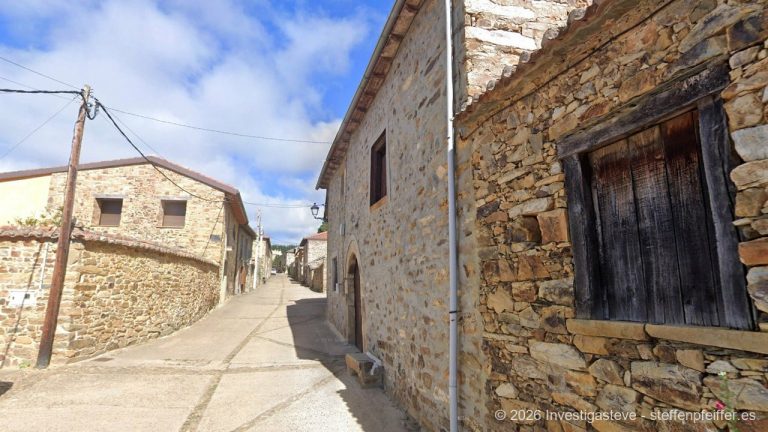
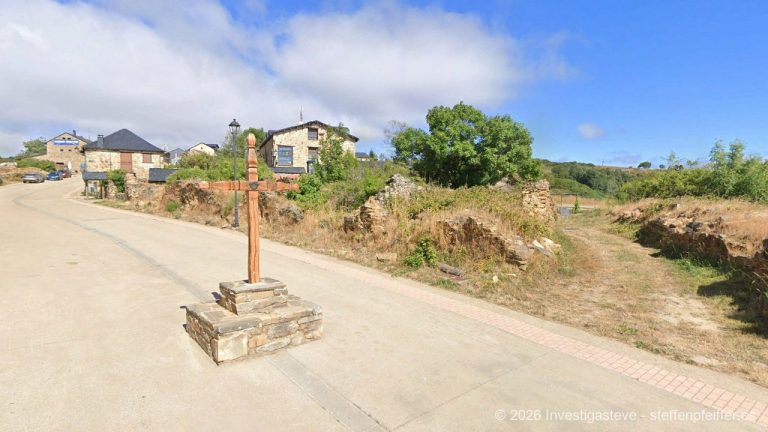
Culturally, Roxos is deeply rooted in the rural tradition of Galicia. The village landscape is shaped by the typical “Casas de Piedra,” square granite houses with heavy slate roofs that look like fortresses against the Atlantic storms. An indispensable element of local identity is the “Cruceiro de Roxos,” a historical stone cross of rare beauty. With its circular cross shape and detailed depiction of Christ, it stands as a spiritual signpost at the crossroads of the paths. It tells of the deep religiosity of a rural population for whom the Camino is not an event, but part of their DNA. Legends tell that pilgrims once paused in Roxos to strengthen themselves with the famous local bread, baked in massive wood-fired ovens – a custom that shapes the hospitality of the place to this day. Roxos is a symbol of permanence: while the world around the cathedral changes rapidly, this place preserves its character as a quiet, wise observer by the roadside.


Camino Distances
🗺️ After about 6.4 kilometers of hiking from the Praza do Obradoiro, during which you left the urban fabric of Santiago through San Lorenzo Park and the green valleys of Villestro, Roxos marks the first real milestone in rural solitude.
| Previous Location | Distance (km) | Next Location | Distance (km) |
|---|---|---|---|
| Sarela da Baixo | approx. 4.3 km | Alto do Vento | approx. 3.5 km |
Addresses & tips in Roxos
Staying Overnight & Arriving
Arriving in Roxos means starting the first stage of your new path with care and mindfulness. Since the place is relatively close to Santiago, many pilgrims choose to take only a short rest here, but those who consciously decide to stay overnight in this environment are rewarded with a quality of silence that the big city can never provide. The accommodation options here are of a private nature – charming Casas Rurales or small guesthouses often housed in painstakingly restored old stone buildings. Here you experience hospitality that is personal, unobtrusive, and deeply honest. It is not a mass operation, but a welcoming into the bosom of a family or a house steeped in history.
The tactile sensation of setting down your backpack in one of these granite houses and letting the heavy straps slide from your shoulders is indescribably liberating. In Roxos, you don’t sleep in the hustle and bustle of a large hostel; you sleep in rooms that often smell of fresh lavender and sun-dried laundry. When you stand at the window in the evening, you don’t hear the noise of bars or car traffic, but the soft, rhythmic clanging of the bells from the distant village chapel and the gentle rustling of the wind in the eucalyptus groves. The psychology of arriving here is that of recalibration: you have mastered the most difficult part of the first day – the emotional farewell to Santiago and the exit from the city. In Roxos, you are allowed to sleep deeply and dreamlessly while nature all around you regenerates the energy for the next day.
The Casas Rurales often offer sprawling gardens where you can stretch out your feet in the cool grass. You sit here among lemon trees and hydrangeas, reviewing the first stage and feeling the tension of travel preparation fall away. It is the perfect place to open your journal and record the first impressions before the paths become lonelier and wilder in the coming days. The certainty of being a guest in a functioning village community gives the pilgrim a deep sense of security and grounding.
Eating & Drinking
The culinary world of Roxos is a passionate homage to the simplicity and outstanding quality of Galician products. In the few local bars and taverns, such as the popular Café Os Arcos or the restaurant in Hotel O Desvio, food is often still cooked according to old family recipes that know no short-lived trends. Here, the “Menú del Día” is an honest promise for the hungry wanderer: a hearty soup beforehand – perhaps a Caldo Galego with kale and potatoes – followed by tender lomo (pork loin) or freshly caught fish from the nearby rías, accompanied by potatoes that taste more aromatic in the mineral granite soil here than almost anywhere else in the world. The scent of roasted meat and freshly prepared tortilla wafts through the open doors and acts like a magnetic attraction for the senses.
An absolute must for every pilgrim in Roxos is a rest with a cool glass of local white wine, an Albariño or Ribeiro, or the traditional “Café de Pota” – Galician coffee prepared in a pot over the fire, which has its very own earthy note. This pairs perfectly with a piece of the famous Tarta de Santiago, whose fine almond aroma harmonizes wonderfully with the fresh country air. Roxos is not about pretentious gourmet experiments, but about essential strengthening for the body and pure enjoyment of the moment. When you sit on one of the rustic terraces and watch the sunlight dance through the grapevines, you understand that the true magic of the Camino often lies in a simple, perfectly prepared meal served with love for the product.
Particularly noteworthy is the local country bread, “Pan de Cea” or similar regional variants, which here in Roxos still possess the traditional crust and succulent crumb. A simple bocadillo, filled with tangy Galician cheese (Queixo de Tetilla) or air-dried ham, becomes a revelation here. Those who stop in Roxos should take the time to truly explore the taste of Galicia – far away from the standardized pilgrim menus of the large tourist traps. Here you taste the earth, the rain, and the passion of the people who farm this land.
Supplies & Logistics
As for logistics, Roxos functions as a kind of practical safety check and strategic intermediate station. The hamlet offers exactly the right amount of infrastructure to feel safe without the place losing its original, rural charm. There are smaller shops and bars here where you can refill your water supplies or buy a quick, nutritious bocadillo for your backpack. While anyone in need of special medical equipment like blister pads or hiking accessories should ideally have taken care of this in Santiago, Roxos is well-equipped for a pilgrim’s basic daily needs. An ATM is usually located nearby or in the hotel, though it is advisable to always have some cash in your pocket for the small traditional bars.
An important and almost ritualistic point of contact is the village’s public drinking water fountain. It is an unwritten law of the Camino to pause briefly here, fill the bottles with the ice-cold, crystal-clear spring water, and lower the pulse before the path continues toward the strenuous climb to the Alto do Vento. The locals in Roxos are used to the steady stream of seekers; they are happy to provide information about the condition of the trails or point the way if you should be unsure at one of the many small, wall-lined turn-offs. This human provision through a friendly word or an encouraging “¡Buen Camino!” is often more valuable than any material supply.
Roxos also offers logistical advantages: the Hotel O Desvio has established itself as a “gateway accommodation” where you can not only sleep but also gather important information about the coming stages. Here, you often receive the first stamp (Sello) for the pilgrim pass on the Fisterra Way, which for many hikers represents an important psychological act of confirmation. In Roxos, you learn that good logistics does not consist of abundance, but of the availability of what you truly need in that moment to continue your path with ease.
Don’t Miss
The Medieval Bridge (Puente de Roxos): An impressive monument from the 13th/14th century spanning the Río Roxos with just one massive arch.
The Stone Cross (Cruceiro de Roxos): Note the fine details of the stonework on this crucifix, considered one of the region’s most beautiful spiritual signposts.
The traditional granite houses: Observe the construction of the old walls – they are a testament to the craftsmanship of Galician ancestors who layered stone on stone without mortar.
The view back to Santiago: At certain clearings just before Roxos, you can once again catch a glimpse of the silhouette of the cathedral between the eucalyptus trees – a poignant moment of farewell.
The small channels: Along the way, you will often find historical water management systems that still feed the residents’ lush gardens today.
Insider Tips and Hidden Places
A true insider tip for nature lovers is the “Fervenzas do Río Roxos,” small, hidden waterfalls concealed in the dense forest above the village. While most pilgrims follow the main path, it is worth a short detour of about 15 to 20 minutes uphill. There, where the river has carved deep into the granite terrain, the water plunges in cascades over mossy rocks. It is a magical place of absolute silence, where only the thundering of the water and the rustling of the ferns can be heard – ideal for a brief meditation or to regenerate tired feet in the ice-cold mountain water. The scent of damp moss and mineral stone is so intense here that it acts like natural aromatherapy.
Another hidden spot is the shaded bench right by the old drinking water fountain. Located away from the direct flow of pilgrims, it offers the perfect place for a fifteen-minute break. Here you can watch how the locals get their water or meet for a quick chat. It is a place of authentic Galician everyday life. Additionally, it is recommended in late summer or early autumn to keep an eye out for the residents’ gardens; Roxos then often smells beguilingly of ripe figs and dark grapes hanging heavy on the vines. Sometimes residents place small bowls of fruit at the roadside – a gesture of quiet connection that embodies the spirit of the Camino in its purest form. For the brave, look for the bar in the side street where the elders play cards; the coffee is often strongest there, and the stories you intuit (even without Spanish skills) are the most honest.
Reflection Moment
In Roxos, the silence begins to grow within you. The long shadow of the cathedral towers no longer protects you, and the responsibility for every further step lies entirely with you. Here, on the threshold of rural Galicia, the question arises: are you ready to leave the safety of the known behind and engage with the raw, unadulterated beauty of the West? Do you stop for a moment to thank the landscape for the welcome, or does the impatience of your mind already push you on to the next kilometer stone? Roxos teaches you the art of transition – that every great path consists of small, inconspicuous sections that are just as valuable in their simplicity as the monumental goal. Do you feel how, with the fading of the urban noise, the space for your own thoughts grows larger?
Camino of the Stars
This place is located on the Camino a Fisterra y Muxía, on the first stage from Santiago de Compostela to Negreira (CFM 1). The sequence of towns is:
Santiago de Compostela → Sarela da Baixo → Roxos → Augapesada → Trasmonte → Ponte Maceira → Negreira
Did you find that magical moment in Roxos where Santiago was finally behind you, or did you discover a detail at the medieval bridge that we should absolutely add here? Perhaps you even found the hidden waterfalls? Write to me via the contact form – in German, English, Spanish, Galician, or French. Your personal experiences make this image of Roxos even more vivid and valuable for all subsequent pilgrims.
About the Author