A new stage day – entering the stage
The morning in Pamplona begins with an almost solemn weight, as the city slowly sheds its nocturnal mask of the “Sanfermines” and immerses itself in the cool, clear silence of the Navarrese highlands. When you close the heavy wooden doors of your hostel in the old town behind you, a fine, silvery mist often still lies over the Plaza del Castillo, enveloping the massive granite facades of the palaces and muffling the sounds of the early street cleaning. The air is sharp, laden with the moisture of the nearby Pyrenean foothills and the distant, already familiar scent of freshly roasted coffee wafting from the still half-closed doors of the “Café Iruña.” It is a ritual departure. As your hiking boots click rhythmically on the smoothly polished cobblestones of the Rúa de Curia, you feel the transition: the urban comfort of Pamplona gives way to the serious determination for the coming 24 kilometers. Your gaze wanders to the southwest, where the Sierra del Perdón stands like a stone bolt on the horizon, ready to subject the pilgrim to one of his first great physical tests today.
The step out of the city inevitably leads you through the monumental fortifications, past the silent bastions, while the rhythmic clicking of your hiking boots on the asphalt of the suburbs acts like a metronome, pulling you out of the trance of the city. You leave behind the legacy of Hemingway and step out into the open agricultural landscape of the Valdizarbe. The air suddenly becomes sharper, clearer, and already carries the dusty, pungent scent of the distant grain fields and first olive groves. A slight tingling in your fingertips – a mixture of awe at the silhouette of the Perdón and curiosity about the geometric mysticism of Eunate – accompanies you as you watch the towers of the cathedral disappear behind you in the morning mist. Today is the day of forgiveness and wind. You feel the weight of your backpack, which now feels like a part of your own skeleton, and you mentally prepare for an ascent that will challenge not only your lungs but also your inner balance.
Route and elevation profile
Distance: 24.0 km
Elevation gain: ↑ 450 m / ↓ 530 m
Difficulty: Moderate. While the ascent is steady and manageable, the technically demanding descent from the Alto del Perdón on loose scree is a true test of endurance for knees and concentration.
Special features: Lengthy urban exit from Pamplona, steady ascent to the wind farm at Alto del Perdón, steep and stony descent, followed by the idyllic passage through Obanos to the monumental bridge of Puente la Reina.
Today’s route is a dramaturgical composition of urban linearity and archaic natural power. After leaving the sheltered alleys of Pamplona, the path initially leads across the university campus and through the functional suburbs of Cizur Menor and Zariquiegui. Here, the ground is firm, often asphalted, which challenges the joints in the morning coolness. The elevation profile shows a gentle but incessant upward curve. This is the phase of preparation, in which the legs must find their rhythm while the landscape around us becomes increasingly barren and exposed.
The apex is reached at the Alto del Perdón at just under 770 meters. Up here, the wind takes command, and the terrain changes radically from agricultural paths to an exposed ridge walk between huge wind turbines. The subsequent descent is arguably the most notorious part of the stage: over a short distance, the path plunges into the valley. The ground of uneven, loose limestone and slippery gravel demands the highest attention. After that, the topography calms down. The path leads through the gentle waves of the Valdizarbe, past small villages like Uterga and Muruzábal, until it finally ends in the basin of Puente la Reina. It is a stage that trains focus – from the wide view into infinity at the top of the ridge to the precise gaze for the next safe step in the scree.
Variants and small detours
On this stage, the Camino offers one of the most spiritually significant variants of the entire Camino Francés. Shortly after Muruzábal, the pilgrim faces a decision that significantly influences the character of the afternoon. The official main route leads directly to Obanos, a busy and historically important junction. However, those seeking solitude and architectural mysticism should definitely choose the turn-off to Santa María de Eunate. This variant extends the path by about three kilometers but leads through the silent expanse of the fields to one of the most enigmatic Romanesque churches in Spain. The octagonal building, surrounded by a free-standing arcade, radiates an energy that is far removed from the tourist bustle.
Another small, often overlooked detour presents itself immediately in Pamplona when leaving the citadel. Instead of rigidly following the yellow arrows through the modern residential areas, it is worth pausing for a moment in the ditches of the city fortifications. These short, often only one-hundred-meter-long zigzags allow you to feel the immense dimensions of Pamplona’s military architecture once more from a frog’s-eye perspective before finally surrendering to the horizontal world of the fields. In Obanos itself, the Camino Aragonés finally joins our path. Here, awareness is sharpened that you are now part of an even larger stream. The choice of the Eunate variant is a decision for introspection, while the direct route via Obanos celebrates the historical causality of the union of paths.
Description of the path – with all senses
The path leading out of Pamplona begins with a haptic experience of hardness. The transition from the cobblestones of the old town to the asphalt of the suburbs is a sensory break. You feel the unyielding cold of the concrete under your soles as you cross the university campus. The acoustics here are characterized by the sounds of the awakening city – the distant roar of traffic mixes with the rhythmic clicking of your poles. In Cizur Menor, the atmosphere changes subtly. As you walk past the Romanesque church of the Order of Malta, you feel the first cool breeze blowing down from the mountains. The smell of freshly mown grass and the mineral note of damp asphalt accompany you as the path begins to steadily spiral up into the hills.
As soon as you reach Zariquiegui, the historical causality becomes materially tangible. The massive stone houses with their family coats of arms seem to store the heat of the day in advance. When you place your hand on the rough walls of the church of San Andrés, you feel centuries of constancy. The smell in Zariquiegui is earthy and sweet – a bouquet of dry hay, wild thyme, and the distant scent of sheepfolds. The acoustics condense into an auditory phenomenon: the soft whistling of the wind in the telephone wires grows louder and heralds the approaching Sierra. The ascent behind the village is a haptic experience of exertion; your calves burn, your breath becomes shallower, and the taste of salty sweat lies on your lips.
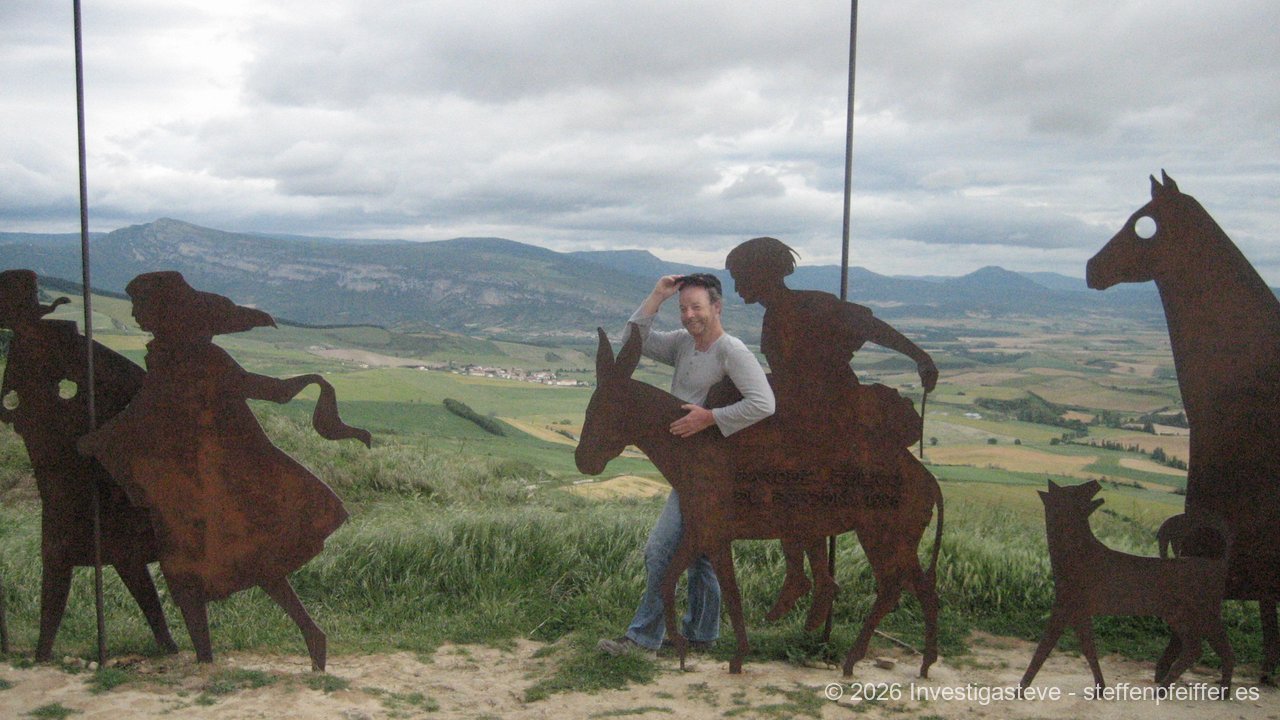
At the top of the ridge of the Alto del Perdón, the five-dimensional immersion reaches its first peak. Suddenly, the wind breaks over you with an eerie force. You hear the eerie, rhythmic “whoosh-whoosh” of the huge rotors of the wind turbines, a technological bass rumble that stands in stark contrast to the silence of the mountains. Up here, the wind is not just a breeze; it is a tactile actor, tugging at your clothes and instantly cooling the sweat on your forehead. The visual spectacle of the metal sculpture “Monument to the Pilgrims” is overwhelming. You see the pilgrim silhouettes made of iron, with rust and time etched into their surfaces. Your fingers run over the cold metal of the figures, and you feel the connection to the millions who paused right here where “the path of the wind crosses that of the stars.”
The descent from the Perdón is a haptic ordeal for your senses. The ground beneath you is restless, treacherous, and full of life. Small stones slip away under your steps; the sound is a constant, dry crunching and grinding. You feel the pressure in your toes and the trembling of your knee joints as your entire body acts as a shock absorber. The smell of hot limestone and dry dust rises to your nose, mixing with the aroma of wild rosemary glowing on the slopes in the sun. Your eyes focus only on the next half meter, while the psychological relief upon reaching the flatter terrain at Uterga feels like an emotional dam breaking.
In Uterga, the architecture of comfort welcomes you. The alleys are narrow and shady; the air down here is heavier and warmer than on the ridge. You hear the distant barking of a dog and the clatter of dishes in the bars along the way. The smell changes from mineral-sparse to culinary-inviting: a hint of garlic and olive oil wafts from the kitchens. In Muruzábal, you feel the historical density of the palaces; the haptic experience of the smoothly polished wood of the church doors offers a welcome contrast to the rough stone of the pass. If you choose the variant to Eunate, the acoustics suddenly become minimalist. Civilization recedes, and what remains is the rustling of grain stalks in the wind – a papery, dry sound that accompanies you all the way to the mysterious chapel.
Santa María de Eunate is a five-dimensional revelation. You step out of the shimmering heat of the fields into the cool arcade. Here it smells of damp limestone, old dust, and an inexplicable spiritual freshness. The acoustics inside the octagon are concentrated; the silence here seems to possess its own mass. You place your hand on the unusual column capitals, and the coolness of the stone travels straight to your heart. The psychological metamorphosis here is almost tangible: the hustle of the morning and the pain of the descent dissolve in a deep, geometric calm. It is a place outside of time, where the historical causality of the Knights Templar or secret brotherhoods resonates in every stone.
The path to Obanos leads you back into the world of people. You hear the polyphonic murmur of pilgrims joining here from the Camino Aragonés. Obanos smells of departure and gathering. The architecture is proud, almost urban. The ground beneath your feet is now firm clay again, gently cushioning your steps. The haptic experience of the massive stone arches in the town center reminds you that you are approaching the end of today’s stage. Your body now carries the exhaustion of the day like a medal of honor, while your mind sorts the impressions of the Sierra and the chapel.
The approach to Puente la Reina is a visual crescendo. You see the monumental statue of St. James greeting you at the town entrance. The smell changes again: it becomes damper, more alive, heralding the river Arga. The acoustic backdrop of Pamplona now seems miles away, replaced by the concentrated life of a medieval small town. As you enter the Calle Mayor, your field of vision narrows to the splendid facades and the dark doorways. You feel the sudden coolness of the shadows, which feels like an embrace.
When you finally stand before the Romanesque bridge, the sensory immersion reaches its crowning conclusion. You feel the massive, smooth railing under your hands, polished smooth by millions of pilgrims’ hands over centuries. Below you, you hear the deep, steady gurgling of the Arga, a bass murmur that seems to wash away all exhaustion. The smell of river water, algae, and damp stone hangs in the air. You feel dusty, heavy, and at the same time infinitely light. Arrival is not merely the end of a hike; it is entering a historical continuity in which the Queen’s Bridge serves as an unshakeable anchor.
The evening reflection, as you sit in one of the hostels by the river, is marked by deep gratitude. Your body is tired, your knees still throbbing from the limestone of the Perdón, but your mind is as wide as the Valdizarbe. The 24 kilometers have filtered you; they have washed away everything unnecessary and made room for the silence of the stones and the power of the wind. You realize that the descent was harder than the ascent, and that true forgiveness often lies in accepting your own physical limits. In the cool of the night, as the murmur of the Arga rocks you to sleep, you become aware: the path has taken you deeper into itself today.
Intermediate places & special features
Cizur Menor – This suburb of Pamplona is far more than just a transit point. It houses the church of San Juan de Jerusalén, an impressive Romanesque building of the Order of Malta. The architecture is defensive and simple, characterized by massive buttresses and an almost monastic calm. For the pilgrim, Cizur Menor is the place of the first short rest, where you finally leave the urban pulse of Pamplona behind and immerse yourself in the rural structure of Navarre. Particularly noteworthy is the atmosphere of the hostel of the Order of Malta, which still breathes the spirit of chivalric care to this day.
Zariquiegui – The last village before the ascent to the Perdón looks like a stone guardian on the mountainside. Particularly worth seeing is the parish church of San Andrés with its magnificent Romanesque portal. In Zariquiegui, you feel the proximity of the mountains; the architecture becomes more robust, the air clearer. The place is known for its excellent fountains, offering pilgrims the last refreshment before the exposed summit ridge. Whoever walks through the narrow alleys here feels the historical weight of the path, which winds steeply upward immediately behind the houses.
Alto del Perdón – This is the geographical and emotional highlight of the stage. The Sierra del Perdón (770 m) offers a 360-degree panoramic view: back to Pamplona and the Pyrenees, ahead into the endless plains of Navarre and Castile. The absolute special feature is the iron pilgrim monument by Vicente Galbete. The inscription “Donde se cruza el camino del viento con el de las estrellas” (Where the path of the wind crosses that of the stars) is one of the most quoted on the Camino. The huge wind turbines on the ridge give the place an almost surreal, futuristic note, entering into a tense dialogue with the archaic group of sculptures.
Santa María de Eunate – An architectural enigma in the midst of lonely fields. This Romanesque church from the 12th century has an octagonal floor plan, placing it in close connection with the Knights Templar or the Order of the Holy Sepulchre. The special feature is the surrounding arcade, whose purpose remains unclear to this day – was it a walkway for the sick or a symbolic atrium? The simple beauty of the interior and the absolute tranquility of the place make Eunate one of the most spiritually significant fixed points of the entire Way. It is a place of geometry and silence that deeply touches every pilgrim.
Obanos – Here, the threads of the Camino meet: the Camino Francés (from Roncesvalles) and the Camino Aragonés (from the Somport Pass) unite on the Plaza of Obanos. The village is a historic monument of Navarrese autonomy. The Gothic church of San Juan Bautista dominates the townscape. A local special feature is the Mystery Play of Obanos, which celebrates the legend of San Guillén and Santa Felicia. The place exudes a bourgeois solidity that clearly sets it apart from the smaller villages of the stage.
Puente la Reina (Gares) – The “Bridge of the Queen” is a total work of urban art. The village was founded in the 11th century by Queen Mayor (or Estefanía) to channel the flow of pilgrims across the Arga. The absolute highlight is the six-arched Romanesque bridge, considered one of the most beautiful on the entire Camino. The Calle Mayor with its stately houses and the church of Santiago with its impressive Moorish-influenced portal make the place a treasure trove of the Middle Ages. Puente la Reina is the epitome of Camino infrastructure – a town that exists only because the Way exists.
Dining, accommodation & supplies
The supply situation on this stage is excellent, which somewhat mitigates the physical exertion of the Sierra. In almost every village passed, there are strategically located bars specializing in the pilgrim breakfast.
Gastronomy: In Zariquiegui, you should definitely refill your water supplies. In Muruzábal and Uterga, the bars offer rustic Navarrese home cooking – be sure to try the “Chorizo a la Sidra.” In Puente la Reina, the numerous bakeries lure with the famous “Garroticos” (chocolate croissants).
Accommodation: In Puente la Reina, the selection of accommodations is immense. The Albergue de los Padres Reparadores is one of the most traditional and offers space for hundreds of pilgrims. For those who prefer it more private and comfortable, the Albergue Jakue offers modern rooms and excellent gastronomy. For a truly spiritual overnight stay, if capacity permits, the simple accommodation directly in Santa María de Eunate is recommended.
Public facilities: As a regional center, Puente la Reina offers all amenities: pharmacies, ATMs, a small supermarket, and a health center.
The special thing today
The absolute unique selling point of this stage is the experience of “forgiveness” at the Alto del Perdón. In the Middle Ages, this pass was a place of ritual purification. The physical effort of the ascent was understood as a form of penance, and those who reached the ridge and felt the wind of freedom were considered “absolved” of their sins. The special thing today is the psychological effect of this place: when you stand before the Monument to the Pilgrims and the wind sweeps away your thoughts, you feel a form of mental relief. It is the point where many pilgrims really “arrive on the Way” for the first time. The group of sculptures shows pilgrims from different eras – a ritual anchor in the infinity of time.
A second special aspect is the geometric mysticism of Santa María de Eunate. In a world of rectangular church buildings, the octagon of Eunate is a radical breakout. The special thing today is the sensory quality of the place: when you sit in the shade of the arcade and watch the birds nesting in the capitals, you feel a connection to the sacred geometry of the Middle Ages. It is a place of “wonders,” not in the sense of magic, but in the sense of deep awe at the harmony between architecture and landscape. Eunate teaches the pilgrim that the path sometimes demands a detour to find the essential.
Finally, the theme of union in Obanos and Puente la Reina deserves emphasis. The fact that two mighty streams of European culture – the Aragonese and the Navarrese – flow together here gives the stage a historical causality of enormous significance. The special thing today is the awareness of diversity: you suddenly encounter new faces, hear new stories from pilgrims coming from the Somport. Puente la Reina is the symbol of this union. The bridge is not only a river crossing; it is the stone seal of European connectedness on the Camino. Here, many paths become one single path.
Reflection at the end of the stage
When you walk through the Calle Mayor of Puente la Reina in the evening, as the warm light of the street lamps illuminates the dark gateways, a strange kind of clarity sets in. You notice how your perception has sharpened over the last 24 kilometers. The noise of Pamplona is now only a distant memory, a necessary level of noise that first made the silence of the Arga audible. In the quiet of the evening hours, surrounded by the majestic architecture, you become aware that you have passed a test of the senses today. The wind of the Perdón has filtered your mind and washed away everything unnecessary.
Puente la Reina is a place of pause and reward. Here, in the shadow of the mighty stone arches, the effort of the day is put into perspective. You realize that the Camino today was a journey through the layers of history – from the military strictness of the Knights of Malta to the benevolent gesture of the Queen. In the reflection of the day, it becomes clear to you that the bridge is not just a structure, but a mirror of your own journey: laboriously fought for over stony paths, just as your own path of realization consists of thousands of small resistances. You are ready for what is to come, because today you learned that true forgiveness often awaits where paths converge.
Camino de las Estrellas
This stage lies on the Camino Francés, on the stage from Pamplona to Puente la Reina. The sequence of places is:
| Stage | Start | Destination | Distance (km) | Elevation gain | Difficulty | Intermediate places |
|---|---|---|---|---|---|---|
| 04 | Pamplona | Puente la Reina | 24.0 | ↑ 450 / ↓ 530 | moderate | Cizur Menor → Zariquiegui → Alto del Perdón → Uterga → Muruzábal → Obanos |
Did you feel the moment when the wind of the Perdón blew away your doubts, or did you find your own story in the geometry of Eunate? What face did your “forgiveness” have when you stepped onto the Queen’s Bridge? Share your moment of transformation with us – your experience is another star in the sky of the pilgrim community.
About the Author