569,532 Pilgrims and an Old Pair of Boots …
 By Investigasteve
Founder and publisher of steffenpfeiffer.es, journalist and photojournalist in Fisterra
Why Half of Europe Is Suddenly “Waddling” to Galicia
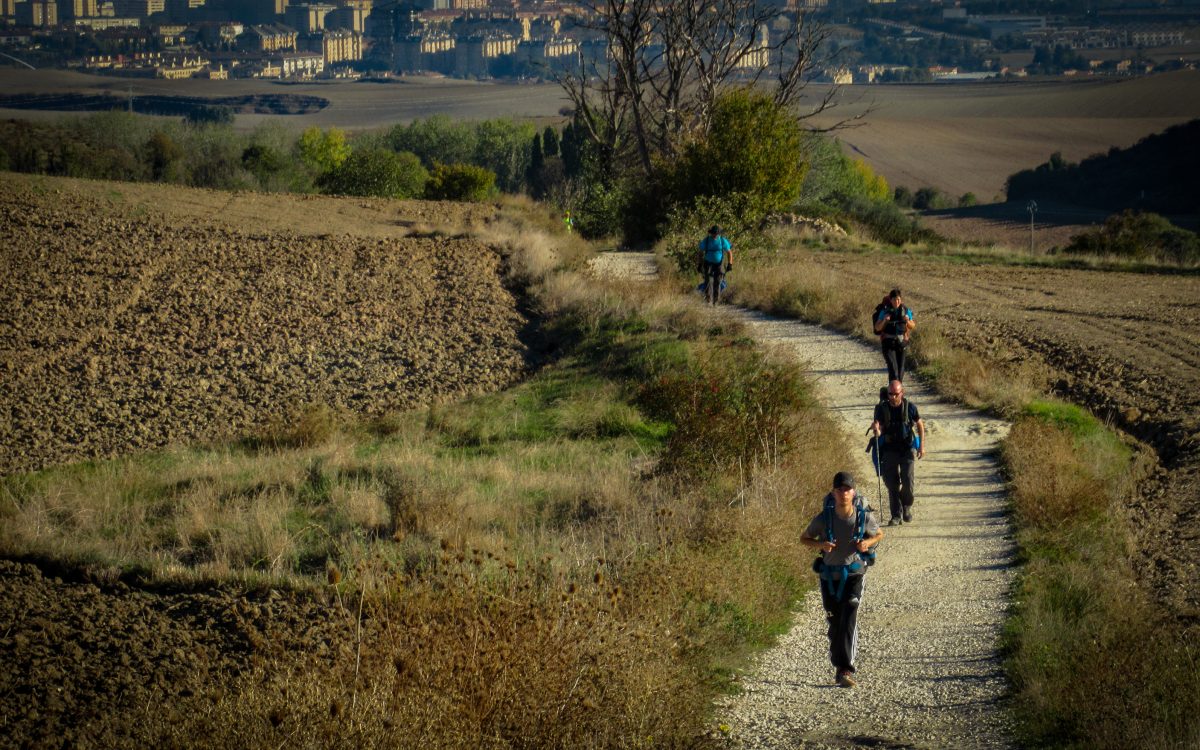
Pilgrimage on the Way of St. James has been experiencing a hype for twenty years now—one where even seasoned innkeepers all the way across Spain to Galicia eventually run out of the “traditional Menu Peregrino,” or rather the traditional casserole of clams and prawns (Cazuela de Almejas con Gambas). By November 24, 2026, 569,532 people had already officially reached Santiago de Compostela and picked up their Compostela. That makes it well over half a million people for the second year in a row—and mind you, the year isn’t even over yet. Whereas in the past it was mainly pious souls, saving their own salvation, who set out on the arduous trek, today the Camino resembles a massive migration on the high-tech functional soles of specialized hiking boots—or occasionally sandals with white socks. Though for the latter, older North American men have by now become rather more notorious than German leisure hikers. Take a closer look at why hundreds of thousands voluntarily walk themselves into blisters, and four very different motives emerge.
Spiritual and religious reasons
Although the route is deeply rooted in Christian tradition and officially leads to the tomb of the Apostle James, purely religious motives are today the main reason for only around 44 percent of walkers. And “religious” is no longer restricted exclusively to the Christian penitential pilgrim, since Muslims, Buddhists, Hindus, and atheists (in other words, religious people without a divine background) have also discovered the spiritual path for themselves. For these pilgrims, it is still about getting closer to God, fulfilling an old vow, or simply saying thank you. Many others, by contrast, set off on what is—if anything—a rather open-ended search for meaning: they trudge across the Castilian plateau and through the green hills of Galicia hoping to find answers out there to life’s biggest questions—true to the motto: “Who am I, what comes next, why is my work phone beeping again, and if so, why not—and right in the middle of the night?”
Psychological relief and the great “time-out”
In our non-stop, tightly scheduled world, the Camino has long served as the best therapy against stress and impending burnout—completely without health-insurance approval or a waiting list. For many, the real miracle begins with digital detoxing, when deadline pressure, emails, and constant availability are traded in for simply moving forward. The route is also frequently chosen as a deliberate fresh start after life-altering ruptures such as bereavement, breakups, bankruptcy, or job loss. The secret lies in the soothing monotony: when you simply put one foot in front of the other for days on end, even the most stubborn merry-go-round of thoughts in your head eventually gives up in exasperation and waves the white flag.
Physical challenge and sport
Quite a few, however, lace up their boots out of pure athletic ambition. Anyone knocking out 20 to 25 kilometers every day tests their own limits—and eventually realizes that their inner couch potato usually hoists that aforementioned white flag voluntarily after the third stage. Overcoming sore muscles, headwinds, heat, cold, dryness, or wetness depending on the season—along with the aches and pains that come with them—delivers a tremendous sense of self-efficacy. Happy hormones included. The fact that the varied landscapes of Spain and Portugal pass by along the way makes the whole thing considerably more pleasant than any treadmill at the gym.
Social encounters and culture
It is not without reason that the Camino is fondly described as the “world’s largest summer camp.” On the trails, people from 198 different nations cross paths—around 38.4 percent hail from Spain itself, while a proud 61.6 percent travel in from 197 other countries around the globe. Algorithm-trained social media like Facebook, Instagram, and TikTok can’t offer you that—let alone Lovoo or Tinder. Because everyday life is stripped down to the bare essentials—walking, eating, sleeping, and drying socks—that special sense of community everyone simply calls the “Camino spirit” arises almost automatically. After all, everyone is equal in the face of the same rain and the same blisters. Only the snoring at night varies in intensity and volume. And by Santiago de Compostela at the latest, you get used to even the fiercest chainsaws in the dormitory.
And one more remarkable detail from the latest figures: the urge for this path is distributed with astonishing balance—in 2026, roughly 52 percent women and 48 percent men were out on the routes, of which the Camino Francés and the 3 variants of the Camino Portugués account for two-thirds of the volume with ~380,000 pilgrims. The remaining third is split across 23 other routes. We can already look forward to the numbers for 2027—the next Holy Jacobean Year.
Leave a Reply