Estorde – The emerald promise between the tides
 investigasteve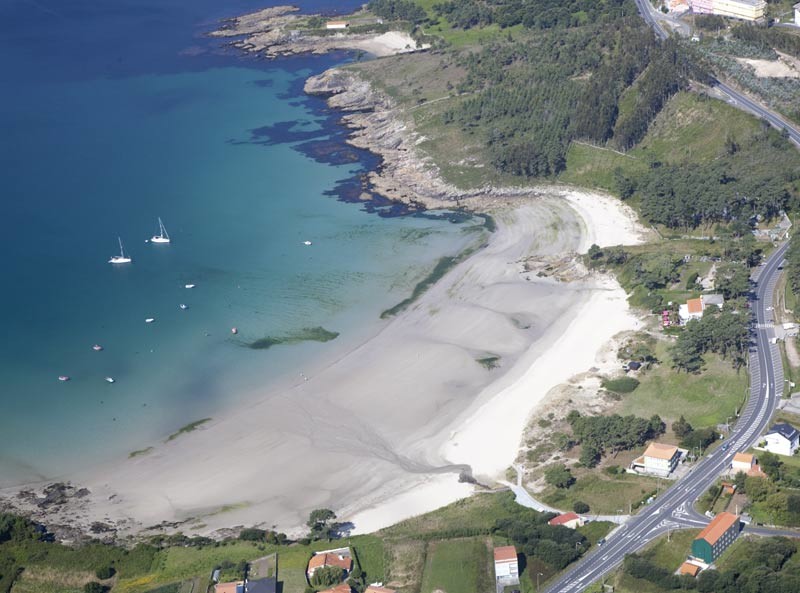
A first look – Entry & Atmosphere
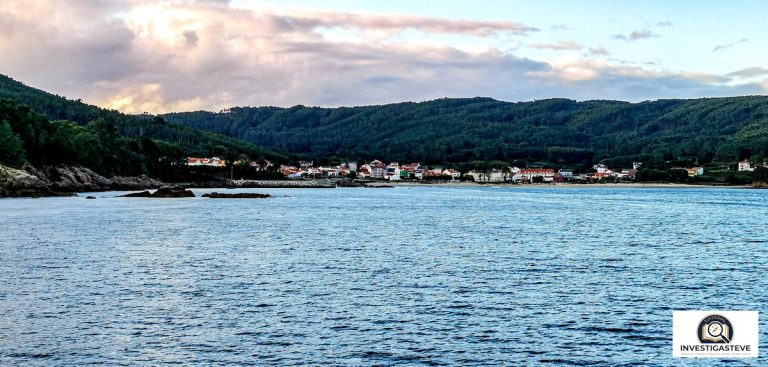
When you leave the narrow coastal strip of Sardiñeiro behind you and the path stretches gently but steadily between the granite foothills of the coast and the deep blue of the Atlantic, you reach Estorde. It is a place that does not welcome you with monumental force, but with an almost tender calm that lies like a protective cocoon over the small bay. You feel it first in the change of the ground: the hollow clicking of your walking sticks on the asphalt of the AC-445 gives way for a moment to the muffled, almost reverent sound when your boots touch the soft floor of the pine groves that line the beach like a green canopy. The air here has a special texture; it is cooler, saturated with the moist saltiness of the surf, which, however, mixes inseparably with the heavy, sweet-resinous scent of the pines. It is an aroma that smells of arrival and, at the same time, of infinite expanse.
In Estorde, the acoustics of your journey change. The constant rustling of the wind, which may have accompanied you since Cape Fisterra, is filtered here by the topography of the bay. You hear the rhythmic, gentle receding of the waves on the fine, light gray sand – no brutal hammering against cliffs, but a constant whispering that involuntarily slows the pulse of the wanderer. The light in Estorde possesses an almost magical quality, especially when the sun begins to sink behind the hills of Toba in the late afternoon. Then the surface of the sea transforms into a sheet of liquid silver, while the shadows of the mighty trees stretch long, skeletal fingers across the beach. To arrive here means to finally cast off the hustle and bustle of the hunt for kilometers. Estorde is not a place you simply pass through; it is a place that invites you to loosen the backpack straps, close your eyes, and deeply absorb the raw, unfiltered healing power of the Galician coast.
What this place tells
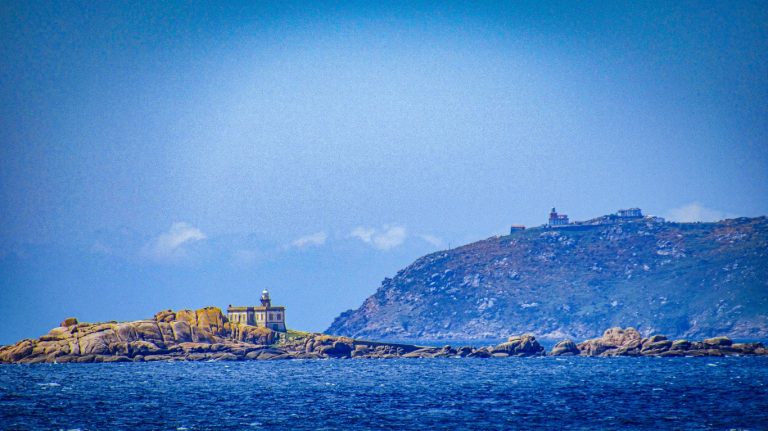
Estorde is a geographical and administrative curiosity that whispers its own quiet story in the shadow of its large neighbors Cee and Fisterra. Although you might physically think you are in the heart of the Costa da Morte, this hamlet officially belongs to the Parroquia Toba of the municipality of Cee, yet geographically it lies like a small wedge between the borders of Corcubión and Fisterra. This location at an invisible intersection lends the place an identity of detachment. Historically, Estorde was never the center of political power or clerical splendor, but always a refuge for fishermen and an important waypoint on the ancient “Camino Real”, the Royal Way, which connected the port towns. The few traditional fishing houses that today mingle with more modern buildings tell of a time when life here was radically determined by the rhythm of the tides and the yield of small nets.
The history of Estorde is inseparably linked to the beach, the Playa de Estorde. Centuries ago, pilgrims who avoided the arduous mountain paths on their way to the “end of the world” sought out the flat coastal sections to cool their sore feet in the cold Atlantic water. The beach was a natural sanatorium of nature. In local folklore, Estorde is often described as the “place of the peaceful sea” – a sharp contrast to the dangerous surf on the west side of the cape. This climatic and geographical advantage made the place a preferred anchorage for small boats seeking refuge in the protected bay during storms. The stones of the old walls here have been polished smooth by the salt and wind of centuries; they are silent witnesses to countless fates, of sailors who felt solid ground under their feet here for the first time again, and of pilgrims who took new courage for the last stages in the face of the nearby Bay of Corcubión.
In the 20th century, Estorde experienced a gentle metamorphosis. The isolated fishing hamlet became a valued destination for those seeking the combination of rural seclusion and maritime comfort. The emergence of modern pilgrimage has solidified this role. Today, Estorde tells a story of balance: it has found its connection to modernity without losing its soul to mass tourism. When you wander through the village today, you feel this pride of the 147 inhabitants in their “Blue Flag” bay, an award for water quality and environmental protection that is understood here as a commitment to nature. Estorde is a living example of a Galicia that honors its maritime past by protecting its natural present. It is a place of transitions, where the wanderer realizes that even the smallest stations on the path carry their own weighty history.


Camino Distances
On the route between Cape Fisterra and the administrative center of Cee, Estorde represents an important point of orientation:
| Previous Location | Distance (km) | Next Location | Distance (km) |
|---|---|---|---|
| Sardiñeiro | approx. 1.4 km | Amarela | approx. 1.5 km |
| Fisterra (Center) | approx. 6.5 km | Corcubión | approx. 2.0 km |
Overnight Stay & Arrival
Arriving in Estorde is a moment of physical salvation. After having perhaps put the wind-swept ridges or the long asphalt passages of the AC-445 behind you, the sudden appearance of the bay acts like a mirage, yet one that is tangible and cool. There is no grand reception or a prominent city gate here; instead, it is nature itself that reaches out its hand to you. When you take the curve and see the hotel and the adjacent camping area, you feel an immediate relaxation of the neck muscles. To arrive in Estorde means to stop the struggle against the elements for a while. It is a place that seems specifically designed for regeneration, far from the often overcrowded hustle and bustle of the center of Fisterra.
The accommodation options in Estorde are concentrated but of high quality. The Hotel Playa de Estorde is the centerpiece of the hamlet. To arrive here, put the heavy backpack in the corner, and open the window to the sea for the first time is an experience that rewards the entire previous journey. The view of the protected bay, where the small boats dance like toys on the water, calms the eye and the spirit. For those who want to be even closer to the ground, the campsite offers an excellent infrastructure. Staying here, in a tent or in one of the small huts, means synchronizing falling asleep and waking up with the rhythm of the waves. It is a form of grounding that many pilgrims feel as a ritual conclusion or as a powerful restart of their journey.
The psychological moment of staying overnight in Estorde lies in the silence of the night. Since there are no discos, no loud bars, and hardly any through traffic after sunset, the ocean takes over the acoustic direction. Many pilgrims report that they found the deepest sleep of their entire journey in Estorde. The absence of light pollution also allows a view of the firmament that, on clear nights, makes the Path of Stars, the “Camino de Estrellas”, appear almost three-dimensionally over the sea bay. You feel secure in infinity here – a paradoxical but deeply satisfying feeling.
In the morning, waking up in Estorde is a gift for the senses. When the first mist, the typical Galician “Brétema”, slowly clears over the water surface and the first gold of the sun brushes the pine crowns, an atmosphere of absolute purity prevails. Arriving in this place is thus not a static event, but an ongoing process of purification. Whoever stays here consciously chooses the quality of peace. You usually leave Estorde with a feeling of lightness, as if you had not just spent a night in a hotel, but had taken a bath in the essence of the Galician coast.
Eating & Drinking
To dine in Estorde is a ritual act of gratitude towards the Atlantic. The gastronomy of the place focuses primarily on the hotel restaurant and the small facilities at the beach, but what comes to the table here is of a freshness that can only be found where the catch is landed directly at the door. An absolute must for every pilgrim are the “Navajas” (razor clams), which are often prepared here on the grill with a simple but perfect mixture of olive oil, garlic, and parsley. The meat is firm, sweetish, and carries the pure aroma of iodine within it. When you enjoy a thick slice of dark Galician farmhouse bread with it to soak up the juice, you understand the culinary soul of this region.
Another highlight of the local cuisine is the “Pescado del día”, the fish of the day. Whether it is a sole, a sea bass, or the rustic “Merluza” (hake) – the preparation here is often minimalistic, so as not to overwhelm the fish’s own flavor with heavy sauces. The chefs in Estorde master the art of the perfect cooking point, so that the meat remains juicy and tastes of the sea and freedom. For those who need a meaty strengthening after the exertions of the path, the hinterland of Toba offers first-class beef, often served as “Chuletón” – a powerful piece of home on the plate.
Drinking in Estorde is inseparably linked with the view. There is hardly anything more beautiful than sitting on the terrace with a cool glass of Albariño or a sparkling Ribeiro wine and watching the tide slowly reclaim the sandy beach. The wine, with its mineral notes, corresponds perfectly with the salty air. For a sweet conclusion, the “Tarta de Santiago” is often served, whose almond flavor is sometimes varied here with a nuance of lemon or a shot of local orujo liqueur. Eating in Estorde is not fast food; it is a feast of deceleration that nourishes the body and strengthens the soul for the coming kilometers.
Supply & Logistics
Although Estorde is a small hamlet, its logistical importance for pilgrims on the way between Fisterra and Corcubión should not be underestimated. It acts as a kind of “comfort oasis” in an otherwise rather functionally shaped coastal section. While there is no large supermarket or pharmacy here – for that, one must visit Cee or Corcubión, two kilometers away –, the basic supply is excellently covered by the hotel and the attached kiosk of the campsite. Here you can find the most important things for everyday pilgrim life: water, snacks, batteries, and first-aid materials for minor injuries.
The connection to public transport is surprisingly good for such a small place. The bus stop directly on the AC-445 is regularly served by the lines connecting Santiago with Fisterra. This is particularly important for pilgrims who need to shorten a stage due to injury or exhaustion or who are planning an excursion to the larger neighboring towns. Furthermore, Estorde is an ideal point for the luggage transport service; bags are reliably deposited here at the hotel or at the campsite, allowing hikers to enjoy the path with light luggage and a clear head.
Shopping: A small shop at the campsite and in the hotel offers basic foodstuffs, drinks, and pilgrim supplies for
emergencies.Gastronomy: The hotel restaurant is the primary point of contact for high-quality regional cuisine; on the beach, there are seasonal kiosks for refreshments.
Accommodation: The Hotel Playa de Estorde and the campsite offer options for different budgets and preferences.
Public facilities: No banks or offices; for medical emergencies, the hospital in Cee (approx. 4 km away) is quickly
reachable.
The logistical infrastructure in Estorde is designed to offer the wanderer a worry-free zone. You don’t have to worry about the organization of the next few hours here, as everything is within walking distance. The hotel staff is also extremely experienced in dealing with the specific needs of pilgrims and is happy to help with organizing taxis or sending mail. Estorde is functional enough to be safe, but modest enough not to disturb the natural character of the journey.
Don’t miss
The beach of Estorde: A “Blue Flag” beach with crystal clear water and finest sand – take the opportunity for a ritual footbath or a complete immersion in the Atlantic.
The pine forests: Hike consciously through the shady groves behind the beach; the combination of forest scent and sea breeze is a natural remedy.
Panoramic view of Corcubión: From the end of the bay, you have a fantastic view across the ría to the mountains on the opposite side.
The “Camino Real” section: Pay attention to the condition of the path; some sections still hint at the ancient route of the historical Royal Road.
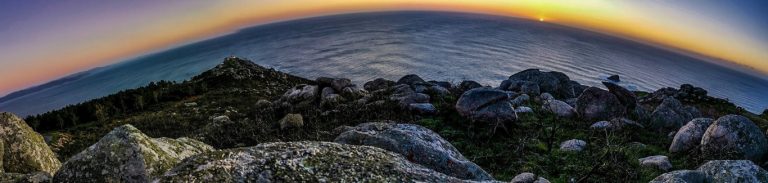
The Blue Hour: Experience the moment after sunset when the sky and the sea merge in an unreal deep blue – the perfect time for photography or silent meditation.
Insider tips and hidden places
Away from the main beach, Estorde hides small corners that only catch the eye of those willing to lift their gaze from the ground. If you follow the narrow, almost overgrown path along the rocks at the eastern end of the bay, you will reach small, isolated coves that are revealed at low tide. Here you are absolutely alone. The only sound is the gurgling of the water in the rock crevices and the distant cry of the gulls. These are places of total seclusion, perfect for a diary intermezzo or to simply let your thoughts drift like the passing clouds. Here you often find rare shells or smooth-polished pieces of granite that the ocean has left on the shore like small gifts.
Another secret tip is the small ascent behind the campsite towards the mountains of Toba. After only about ten minutes of walking, a view opens up that embeds Estorde into its entire geographical surroundings. From up here, you not only see the bay but can see the course of the pilgrim path stretching through the landscape like a ribbon. It is a place of overview, where one understands how small a human being actually is in the structure of this powerful nature. Especially in the early morning, when the haze still hangs in the valleys, this place seems like a scene from an old Galician epic.
For the culinary discoverers, there is an almost invisible “treasure”: the wild herbs that grow in the dunes and at the edge of the forest of Estorde. If you look closely, you will find wild fennel and sea fennel, whose aroma, when you rub a leaf between your fingers, releases the entire intensity of the Costa da Morte. It is a small, haptic, and olfactory moment of connection to the earth that costs nothing but sharpens the senses. Estorde is full of such tiny wonders; one only has to learn to use the slowness of the path to discover them.
Finally, a visit to the small chapel in the hinterland of Toba, which is only a short walk away, is worthwhile. It is often locked, but its simple stone architecture radiates a calm that forms a wonderful contrast to the lively energy of the beach. A moment of pausing at its walls connects you with the centuries-old religious tradition of the region. It is these small excursions away from the yellow arrows that make Estorde in memory a place that possesses far more depth than a fleeting glance might suggest.
Moment of Reflection
In Estorde, you stand at an invisible border. It is the place of the “in-between” – between the raw finality of Cape Fisterra and the busy civilization of Cee. While you sit on the beach and watch the tide untiringly smooth the sand, a question inevitably arises: What do I take with me from this path that does not fit in a backpack? Estorde offers you the space for a psychological cleansing. The sea here is a mirror of your own journey. Just as the water polishes the stones over thousands of years, so the path has polished you. The hardness of the first kilometers has given way to a supple endurance, and the noise of your worries has succumbed to the rhythm of your steps.
The administrative specialty of Estorde – this location between the municipalities – is a wonderful metaphor for the state of many pilgrims at this point in their journey. One no longer entirely belongs to the old world left behind at home, but one has also not quite arrived in the new reality that awaits after the end of the path. One is in a sacred vacuum. Estorde gives you the permission to enjoy this state of detachment. You don’t have to decide anything here, you don’t have to prove anything. You are allowed to simply be a part of the landscape, just like the pines and the waves.
Perhaps you realize in the silence of this place that the true transformation does not only happen at the kilometer stone 0.0, but in these quiet moments of preparation. The purity of the water in Estorde invites you to also wash your inner images. What of the expectations you had in Santiago or Fisterra was truly yours? And what of it was just the noise of the world? When you leave Estorde and direct your gaze toward distant Corcubión, you take something of the protected calm of the bay with you. You no longer walk as someone seeking, but as someone who has already found – namely the ability to be completely with oneself in the silence. Estorde is the gentle guardian of your inner contemplation, an emerald promise that every path ultimately leads to an inner peace.
Camino of the Stars
This place is located on the Camino Fisterra y Muxía (CFM 3a), on the stage from Olveiroa to Fisterra. The sequence of locations is:
Olveiroa → Hospital → O Logoso → Cee → Corcubión → Redonda → Amarela → Estorde → Sardiñeiro → Fisterra
Did you also experience this moment of complete silence in the protected bay of Estorde while the pines whispered above you in the wind? Or did you discover a detail on the beach that no other pilgrim noticed? Share your personal experiences, your photos of the “Blue Hour,” or your tips for the best rest in Estorde with us. Your story makes this guidebook alive and valuable for all subsequent hikers. We look forward to your comment!
About the Author