A First Glance – Arrival & Atmosphere
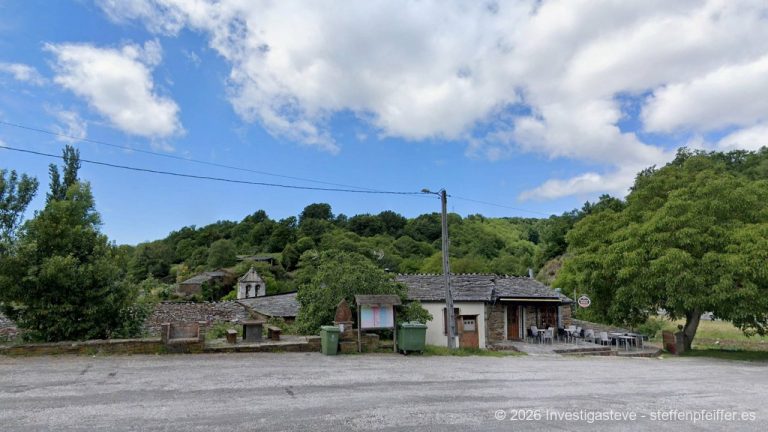
You reach the rise of Hospital after a climb that left your lungs burning and your calves pushed into a state of hard resistance. You step into this small hamlet that seems almost shy—and you immediately feel that you’ve arrived at a threshold place. Here, on Dumbría’s wind-swept high plateau, time seems to have a completely different consistency than in Santiago’s bustling lanes that you left behind days ago. Hospital receives you with an atmosphere shaped by an almost archaic, nearly tangible silence. Only the distant, rhythmic click of your own trekking poles on the rough asphalt and the soft whisper of the wind in the dense Atlantic mixed forest form the acoustic backdrop to your arrival. It smells here like an intoxicating blend of damp earth, the heavy scent of oak moss, and the tart, almost metallic note of the nearby river that has cut itself deep into the jagged terrain.
In Hospital, you feel the untamed power of the elements. Up here, the air is often saturated with the moisture of the Costa da Morte, which seeps as a fine, mystical mist—the Galician orballo—through the tiny cracks of ancient stone walls. The feel of this place is rough; the granite of the few houses is covered with lichen, like small gray-green maps telling of centuries of survival. You feel the resistance of the ground beneath your heavy pilgrim boots—the hard slate and coarse stone are the bones of this earth, carrying you with stoic calm across this exposed stretch of your journey. It’s a place that teaches you to endure the absolute solitude of the high plateau before coastal life draws you back under its spell.
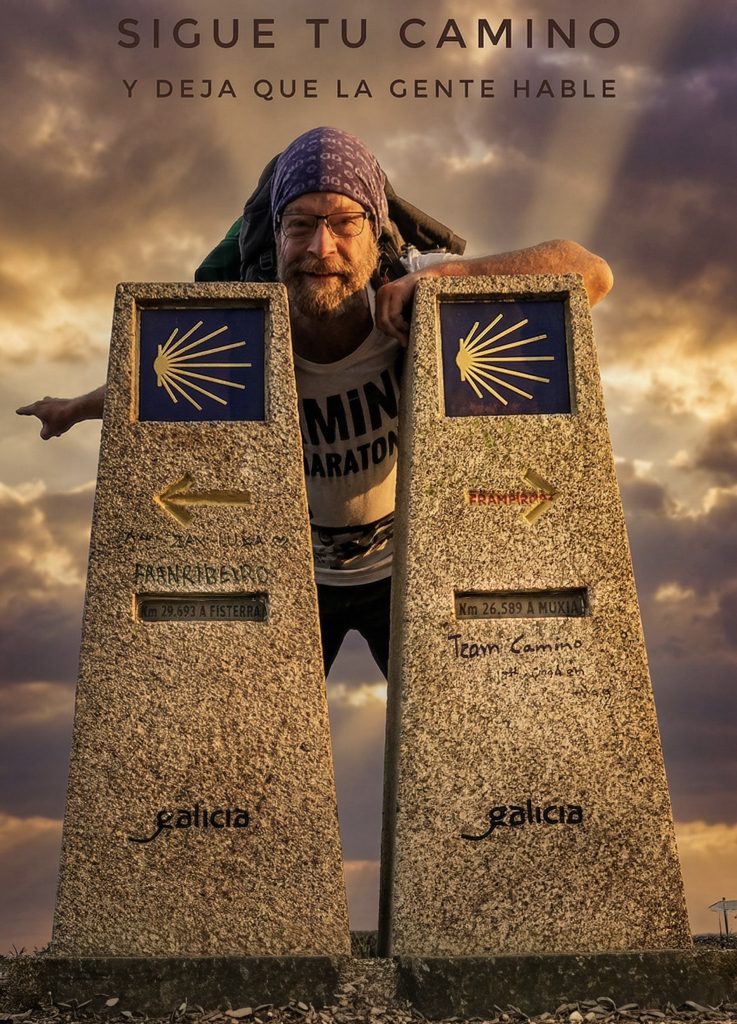
Hospital is not a place of loud spectacle; it’s a psychological gate. It’s the point where your individual spiritual journey takes a decisive turn. The vastness of the landscape that spreads out up here beneath a sky that often shifts dramatically puts your own efforts into perspective. When you stand at the famous fork in the road where the paths to Fisterra and Muxía split, you grasp the deep symbolism of this place: here, it’s no longer just about walking, but about choosing. Hospital absorbs you, pulls you out of the flow of time for a moment, and gives you the calm you need to complete the transformation from someone seeking a destination to someone choosing one. It’s an oasis of reduction that reminds you that the way has always been the destination—even as you now face the choice between two ends of the world.
What This Place Tells You
Hospital’s story is deeply interwoven with humanity’s ancient need for shelter and community in a hostile environment. When you walk through the scattered houses today, you’re treading ground that has been consecrated as a refuge for more than 800 years. This place’s roots reach back to the early 13th century, a time when walking to Fisterra was an adventure of life and death. Hospital de Logoso, as the place is historically correctly called, is one of the earliest documented pilgrim hospitals on this route. It was the priest Stephanus of Ulgoso who, between 1200 and 1209, donated his own house and a small church dedicated to Saint Mark to the cathedral chapter of Santiago de Compostela. The Latin deed of foundation in the famous Tumbo C still speaks to us today: he founded this place for the “care of poor travelers”—refectione pauperum transeuntium.
You have to imagine the harshness of that time to understand Hospital’s significance. The stage from Olveiroa to here was considered one of the deadliest on the entire Camino. Pilgrims had to fight their way through rugged highlands where wolves, bandits, and the Atlantic’s unpredictable storms were constant companions. Hospital was the first safe harbor after crossing the Río Xallas. Here, the exhausted found not only a straw pallet and a roof over their heads, but also spiritual strengthening through community and Saint Mark’s blessing. Stephanus and his companion Martín were the first “hospitaleros,” whose legacy you can still feel today in every friendly nod from the few residents. The place was so important that in 1230 the cathedral chapter guaranteed it an annual pension of 30 sueldos—an enormous sum meant to keep this lonely outpost of civilization operating.
But Hospital also tells darker stories—stories of destruction and an untamed will to rebuild. In April 1809, during the Napoleonic Wars, the hamlet became the scene of unspeakable brutality. French troops, leaving a trail of devastation behind them as they retreated through Galicia, burned down the historic Hospital and the church. Chroniclers such as the Englishman Basil Hall reported massacres of civilians who tried to defend their meager belongings and their sacred ground. Today, almost nothing of the medieval structure remains, except the name, which echoes like sonar from the past. The church of San Marcos is gone, but its cruceiro still stands as a silent witness by the roadside. It’s a reminder that Hospital is not a museum, but a living organism that has reinvented itself again and again—from a medieval hospice to a stark farming village to a modern, yet still archaic, hub for pilgrims from all over the world. In Hospital’s silence, you hear the whisper of 800 years: a story of resilience, compassion, and the eternity of the Way.
Camino Distances
After about one and a half kilometers of steady walking through dense green and over the stone ridges of O Logoso, the stone gate to Hospital opens up here.
| Previous place | Distance (km) | Next place | Distance (km) |
|---|---|---|---|
| O Logoso | approx. 1.5 km | Marco do Couto | approx. 1.5 km |
Staying Overnight & Arriving
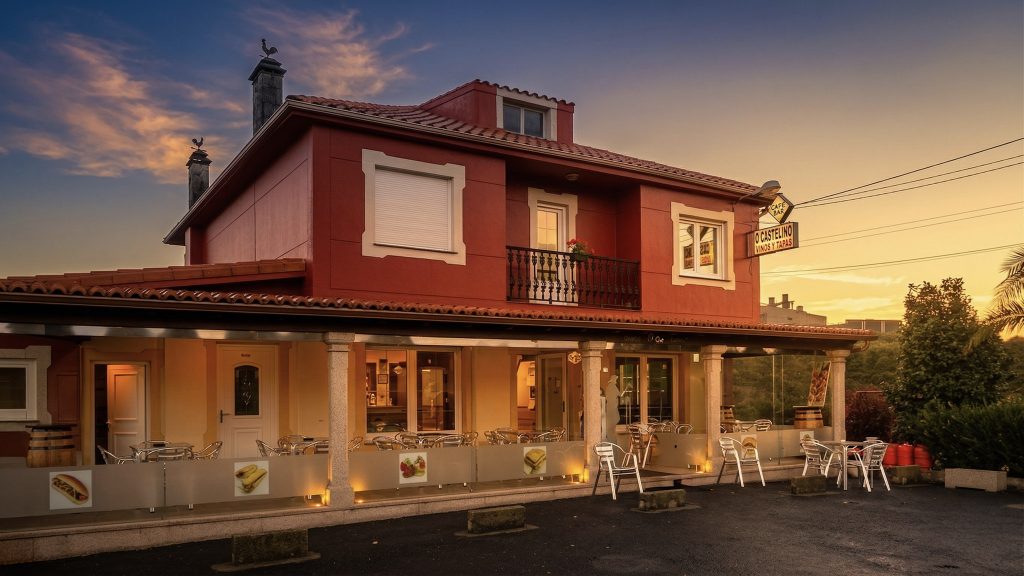
Arriving in Hospital means leaving the world of huge bed bunkers behind for good. The place offers a radical form of lodging that takes you back to the roots of pilgrimage. The only infrastructure in the immediate area is Albergue O Casteliño, which technically lies a few hundred meters before the actual village center of Hospital. Arriving here is marked by a deep, almost reverent sense of relief. When you let your backpack slide off your shoulders and feel the weight of the past miles sink into the ground, you sense this place’s protective function. The albergue is a modern refuge within old walls—a place where granite stores the coolness of the night and wood radiates the warmth of human encounters.
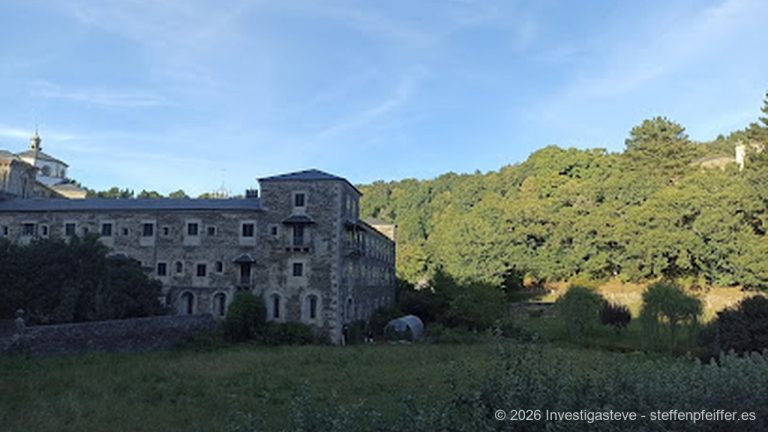
Sleeping in Hospital has a quality all its own. Because the place is so small and remote, at night there’s a darkness and silence you can hardly find anymore in Central Europe. When the lights in the hostel are turned off, the place belongs entirely to the elements again. You hear the distant roar of the Hospital and Logoso rivers, which can swell into impressive streams after heavy rains. The feeling of isolation is experienced here not as a lack, but as a privilege. In the old monastery hostel, the walls don’t whisper specific sentences, but they convey a sense of safety that pilgrims of the 13th century already sought here. It’s the certainty that, no matter how hard the climb was, you’ve found a home for one night.
If you stay overnight here, you should see the absence of urban luxury as an opportunity. In Hospital, there are no distractions. In the evening you might sit on the hostel’s small terrace, legs up, watching the fog swallow the valleys. Communication among pilgrims is often more intense here, because there are no bars or clubs to escape into. You share stories, you share the anticipation of the bifurcation, and you share the silence. It’s a place of arriving with yourself—a in-between realm between the strain of the mountains and the promise of the ocean. Hospitality here is less a service and more a continuation of Stephanus of Ulgoso’s ancient tradition—simple, honest, and heartfelt.
Food & Drink
Hospital’s culinary world is as austere and unadulterated as the landscape itself. Since there are no independent restaurants or supermarkets in the village, everything centers on the hostel’s communal kitchen or the small integrated bistro. A pintxo here replaces any energy bar—and stays in your memory because it’s often prepared with products from the immediate area. Agriculture in Dumbría is still shaped by small plots and self-sufficiency. When the scent of freshly prepared caldo galego drifts through the house, it’s more than just a meal; it’s an olfactory embrace. The smoky note of Galician bacon, the earthiness of the cabbage leaves, and the creamy consistency of the potatoes create a feast that tastes like a gift from God after the long hike.
Often, in Hospital, all you have is a short break on an old stone wall, enjoying your own provisions that you hauled along from Olveiroa. But it’s precisely this abstinence that sharpens your senses. In the air there’s often the smell of fireplace smoke, where traditional stews still simmer in the winter months. It’s an ascetic kind of food culture that keeps your focus on what matters: the pure quality of the water from local springs and the simple, good bread that smells of craft and hard work. When you eat in Hospital, you do so with a gratitude that is often lost in the tourist restaurants along the coast.
A special experience is the shared dinner in the albergue, where large bowls of pasta or rice come to the table. Here, the culinary traditions of the world blend with Galician down-to-earth simplicity. The wine—often a simple, robust red from the region—loosens tongues and makes you forget the ordeal of the climb. In Hospital, you learn that a simple piece of cheese and a slice of bread, eaten in the face of the setting sun over the Río Hospital, can be worth more than any three-course meal. It’s the cuisine of the moment that teaches you that less is often more.
Supplies & Provisioning
In terms of infrastructure, Hospital is a place of radical reduction. There are no supermarkets, no pharmacies, and no banks. This “supply desert” is a deliberate part of the experience on the stage to Fisterra. You need to make sure your water bottles are filled before you leave Hospital, because the next miles along the open DP-3404 road are windy and exposed. The pharmacist in Cee may later recognize you by your exhausted gait, but up here you’re entirely dependent on yourself and your supplies. The small shop in the hostel might sell a few bananas or chocolate, but you shouldn’t count on it.
Provisioning in Hospital is a lesson in self-reliance. You learn to think of your backpack as your entire universe. If you run out of water, the Hospital and Logoso rivers do offer crystal-clear water—but caution is required: only water from marked fountains is safe to drink. The strategic importance of water points in this area cannot be overstated; they are the lifelines of the Way. In Hospital, you don’t just refill your backpack—you also refill your mental strength for the moment of decision at the bifurcation.
Shopping: There are no shops of any kind in the village. You won’t find the nearest supermarkets and pharmacies until Dumbría (about a 4 km detour) or in Cee (about 12 km farther). Be sure to plan your supplies in Olveiroa.
Food service: No public bars or restaurants. The only food option is Albergue O Casteliño for its guests.
Overnight stay: The only option is Albergue O Casteliñoo. If it’s fully booked, you’ll have to continue on to Dumbría or Cee. A reservation in high season is essential here.
Public facilities: No government offices or banks. The Ermita de Nosa Señora das Neves nearby offers a place of quiet, but it has no fixed opening hours.
In Hospital, you experience the true meaning of “trail provisions.” It’s not just about calories, but about the certainty that you’re carrying everything you need to survive. This place challenges you to prove your logistical skills and to recognize the beauty of scarcity. It’s a valuable test shortly before the end of your long journey.
Don’t Miss
The bifurcation stone: Right behind Hospital, the path splits. An inconspicuous but emotionally powerful signpost decides your route to Fisterra or Muxía. Pause here—it’s the most important decision point on the entire Camino.
The Río Hospital: Cross the bridge over this small, clear river. Feel the spray and the rush of the water that has marked the boundary of this sacred territory for centuries.
The San Marcos cruceiro: Look for the remains of the old wayside cross. It’s the last physical proof of the 800-year history of the medieval pilgrim Hospital and a place of deep devotion.
O Cruceiro da Armada: Only about a kilometer south of Hospital, this hill offers the very first view of the Atlantic Ocean and Cape Fisterra on the horizon. It’s the moment when your pilgrim soul begins to fly.
The Ermita de Nosa Señora das Neves: A small detour to this chapel is worth it. It’s a place of protection from storms and has preserved the region’s spiritual energy since the 13th century.
Insider Tips and Hidden Places
Beyond the marked path, Hospital reveals small, almost invisible treasures that only catch the attentive pilgrim’s eye. One such place is the deep river valley of the Río Hospital, which lies immediately below the village. If you leave the official trail for a few hundred meters and push your way through the undergrowth to the bank, you’ll discover an untouched world of moss, ferns, and shimmering cascades. Here, nature is still the absolute ruler. You can sit down on one of the smooth granite stones washed by water and enjoy complete solitude. Only the rush of the water and the song of forest birds accompany you—a place for radical inner retreat before you rejoin the flow of pilgrims.
Another hidden spot is the ruins of the old stone walls around the entrance to the village. They’re completely covered in bright green moss and look like sleeping giants from a forgotten time. When the afternoon light hits the mica in the granite of these ruins at a low angle, they begin to shimmer softly. They are the silent witnesses of the French invasion of 1809; their melancholy is almost palpable. When you place your hand on the cool, damp stone, you feel the weight of history and the transience of all human striving.
An insider tip for the senses is watching the fog early in the morning. In Hospital, a very specific ground fog often forms, making the houses look like islands in a milky-white sea. If you set off at that time, you feel as if you’re walking through the clouds. It’s a magical moment when the boundaries between earth and sky blur. Only those who start early and don’t fear the hush of dawn are rewarded with this almost supernatural spectacle. It’s the moment when Hospital reveals its true, mystical soul to you.
Moment of Reflection
In Hospital, your pilgrimage reaches a critical, almost sacred turning point. You’ve left the mountains behind, but the sea is still a promise in the distance. In this small, unassuming hamlet, exhaustion mixes with a deep, almost eerie clarity. You stand at the bifurcation, the stone of decision. In that moment, the path reflects your entire life: we are constantly standing at crossroads, often without knowing exactly what lies beyond the next bend. Hospital asks you: Do you make your decisions out of longing, or out of habit?
The high plateau’s psychological effect is immense here. As you walk through Hospital’s quiet lanes, you can practically feel the burden of the past weeks dropping from your shoulders. It’s a time of radical inner retreat. The view from the nearby O Cruceiro da Armada out over the endless ocean puts your efforts into perspective and makes them small and insignificant in the face of eternity. In Galicia, people say Hospital is the gate to the beyond of the pilgrim journey—for you, it’s the gate to a new, purified version of yourself. The rhythm of your breathing adapts to the rhythm of the elements, and you understand: the decision you make here is more important than the destination you reach at the end.
Camino of the Stars
This place lies on the Camino a Fisterra y Muxía, on the stage from Olveiroa to Fisterra (CFM 3a). The sequence of places is:
Olveiroa → O Logoso → Hospital →Cee → Corcubión → Redonda → Amarela → Estorde → Sardiñeiro → Fisterra
(Note: The direct route branches off here at a roundabout. If you turn left and continue past the old factory, you’re heading toward Fisterra via Cee. Straight ahead, the route continues in the following order: Hospital → Dumbría → Senande → Muxía)
Did you feel the moment of absolute decision at Hospital’s bifurcation stone, or did the history-laden silence of the San Marcos ruins almost overwhelm you? Share your personal impressions of this spiritual hub of the Costa da Morte with us. Maybe you even took a photo of the first view of the sea at O Cruceiro da Armada? We’re looking forward to your very own story from this place where paths split!
About the Author