A First Look – Introduction & Atmosphere
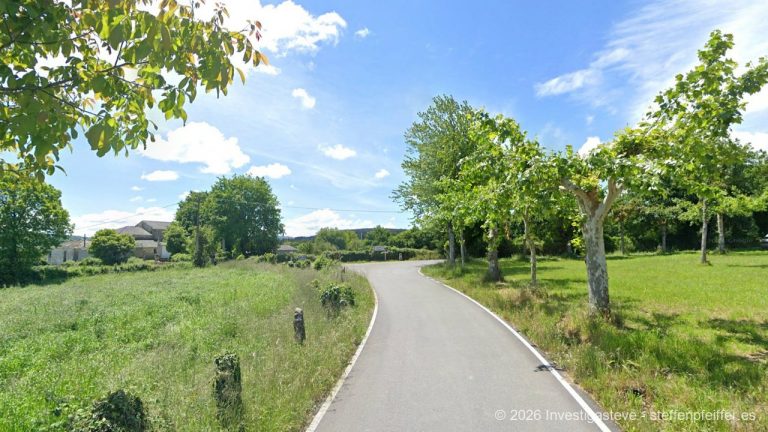
When you’ve left the arduous, almost relentless climb out of Olveiroa behind you—the stretch where the Galician sun or the whipping Atlantic wind puts your determination to a hard test—a small, stone refuge suddenly opens up before you: O Logoso. It isn’t a place of grand gestures or monumental architecture, but a place to pause, a tiny hamlet that nestles like a protective nest against the barren yet majestic slopes of the Galician ridgeline. You set your foot on the rough asphalt of the narrow village road and immediately feel the tension of the past miles fall from your shoulders. In O Logoso, the world seems to hold its breath for a moment. The soundscape is reduced to what matters: the distant, rhythmic ringing of cowbells, swinging through the valley of the Río Xallas like a calming mantra, and the soft whisper of the wind in the dense “xestas”—the yellow-blooming gorse that turns the hilltops into a glowing sea of color.
Up here, at around 300 meters above sea level, the air has a different consistency. It’s clearer, cooler, and often saturated with the moisture of the nearby ocean, which is still hidden behind the next ridges but whose salty promise already rides in every breeze. It smells of damp earth, the tart aroma of pine forests, and the slightly sweet scent of the heathlands. O Logoso is the first bastion of calm after the physical trial. As you approach the hamlet, you become more aware of the click of your pilgrim’s staff on the granite ground—a metallic sound that echoes in the place’s almost unnatural silence. This is the moment when the Camino to Fisterra reaches its first contemplative peak; here you aren’t pushed along by the crowd—here you’re simply allowed to be.
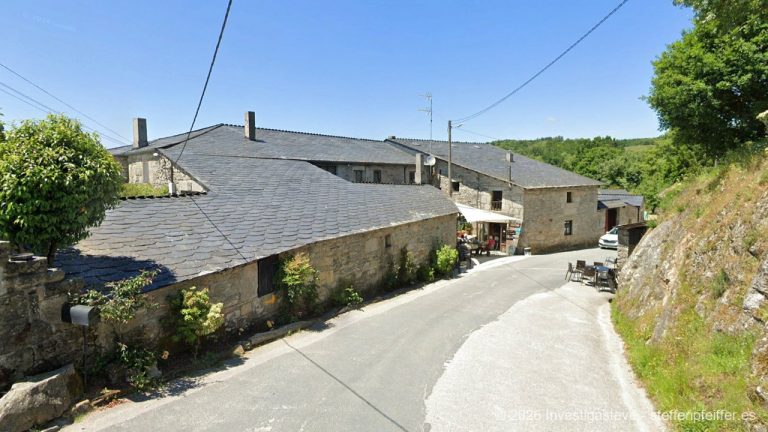
The atmosphere in O Logoso is shaped by an archaic plainness. The few houses, hewn from solid granite and covered with heavy slate roofs, speak of a life that has adapted to the elements for centuries. When the morning fog lazily lifts out of the valleys and the first sunbeams bathe the gray stone walls of the albergue in a warm, almost sacred light, you understand that you’re standing at a threshold. O Logoso isn’t just a geographic point on your map—it’s a psychological lock chamber. Here you sort out your thoughts; here you process the effort of the climb and prepare yourself mentally for the moment when your gaze can finally sweep far over the Ría de Corcubión. It’s the last bastion of total silence before the route leads you down into the bustling harbor towns—a place that invites you to cinch your backpack one more time and feel Galicia’s raw beauty in its purest, unvarnished form.
What This Place Tells You
The history of O Logoso—often referred to as “Ulgoso” in old documents—is a story of steadfastness, faith, and the unshakable duty of hospitality in a harsh environment. If you walk through the few lanes today, you can hardly believe that this hamlet was already an essential anchor point on the road to the end of the world in the early 13th century. A decisive historical turning point is the year 1209. At a time when pilgrimage to Santiago was experiencing its first great flowering, a priest named Stephanus of Ulgoso chose a radical act of piety: he donated his private Hospital and the associated church to the Cabildo, the cathedral chapter of Santiago de Compostela. This donation, documented in the famous “Tumbo C” of the cathedral archive, was far more than a bureaucratic transaction. It laid the foundation for a centuries-long tradition of “hospitalitas.”
In the dark halls of the Middle Ages, O Logoso was a lifesaver. The stage through the Dumbría highlands was considered one of the most dangerous and exhausting on the entire Way of St. James—marked by sudden weather changes, rushing rivers, and the constant risk posed by wild animals. The hospital of Ulgoso offered shelter, warmth, and a simple meal for those “pauperum transeuntium,” the poor passers-by who risked everything to visit the apostle’s tomb and then Cape Fisterra. Even if the original buildings of the Church of San Marcos now survive only as a topographical memory or in the form of scattered stone fragments, the spirit of this care is deeply rooted in the ground of O Logoso. You can feel it in the weight of the granite blocks and in the way the place braces itself against Atlantic storms.
The centuries after the Reformation and secularization were times of isolation and slow decline for O Logoso. The once-important pilgrimage hub shrank into a tiny shepherd and farming village, where people lived off what the barren soil and livestock on the exposed ridgelines could provide. Many residents left their homeland in the 19th and 20th centuries, driven by the hope of a better life in America—a wave of emigration that left deep wounds in the social fabric. But with the renaissance of the Camino to Fisterra beginning in the late 1990s, O Logoso experienced an almost mystical rebirth. From the ruins of the past, a modern infrastructure emerged—one that remains conscious of its historical responsibility. Today, the story of the place is no longer written in ink on parchment, but through the exhausted faces of pilgrims who stop here and find in the simplicity of stone exactly what they need: a connection to the past and strength for the future. O Logoso tells you that true strength often lies in remoteness—and that an oasis doesn’t always need palm trees; sometimes a firm ground under your feet and a roof that defies the wind is enough.


Camino Distances
After a steady climb over the ridgelines—often accompanied only by wind turbines and the rush of the pines—the path opens up and leads you straight into the stony heart of O Logoso.
Addresses & tips in O Logoso
Overnight & Arriving
Arriving in O Logoso means trading exertion for a deep regeneration you can almost feel physically. Accommodation options focus on the private Albergue O Logoso, a place that by now enjoys an almost legendary reputation among pilgrims. When you step over the threshold, you leave the world of wide, often wind-swept hills and enter a space that immediately wraps you in a cozy warmth. The interior of the hostel is a masterful symbiosis of traditional Galician granite and warm natural wood—a choice of materials that doesn’t just convince aesthetically, but also conveys a sense of safety and grounding. Up here, you fall asleep with the certainty that nature is right outside the door, yet the walls are thick enough to keep any storm out.
Arriving in O Logoso is a process of slowing down. There are no city noises here, no honking cars, and no glaring billboards that could disturb your sleep. The only “disturbance” is the deep silence of the Galician night, which feels especially intense up here on the hilltop. The albergue often offers spacious outdoor areas and terraces where you can sit late in the afternoon while your legs finally get to rest. You watch as the sun slowly sinks behind the distant mountains of Monte Pindo, painting the sky in dramatic violets and golds. In moments like these, a very particular kind of community forms; because capacity is limited, the atmosphere feels family-like, and conversations emerge that go far beyond the usual “Where are you from?”
A special feature of spending the night in O Logoso is the immediate connection to the surroundings. You feel the weather, you smell the rain before it arrives, and you hear nature waking up early in the morning. The albergue is designed to give the hiker maximum comfort while preserving rustic authenticity. Clean common areas, well-equipped sanitary facilities, and an atmosphere of genuine, unvarnished hospitality make this tiny hamlet one of the most sought-after stops on the stage. It’s the ideal place to recharge, sort your gear, and simply feel grateful for the firm ground under your feet before the path continues the next day toward the sea.
Food & Drink
The culinary experience in O Logoso is as honest and down-to-earth as the landscape surrounding the hamlet. The albergue’s restaurant serves as the place’s social and gastronomic heart, offering exactly what a body weakened by the climb is craving: hearty, homemade Galician food. There are no pretentious menus here—just dishes that taste like tradition and home. The undisputed king of the table is “Caldo Galego.” In steaming bowls, cabbage, potatoes, beans, and often a piece of “unto” (Galician pork fat) come together into a substantial elixir that immediately brings you back to life. You sit at heavy wooden tables, the clatter of spoons mixing with the pilgrims’ murmuring, and the stew’s aroma drives away even the last chill of the mountain wind.
The pilgrim’s menu is especially worth highlighting, often impressing with products sourced directly from the region. The bread here is usually still baked by hand, with a crusty rind and a soft crumb that’s ideal for mopping up the last traces of homemade sauces. Local cheeses—often with a slightly tangy note—and meat dishes gently braised for hours form the basis for a feast that brings both fullness and peace of mind. Dinner in O Logoso is more than nourishment; it’s a ritual of community. When the wine flows into glasses and stories from the last miles are exchanged, language barriers disappear.
A special highlight you shouldn’t miss is breakfast at early dawn. When the scent of fresh coffee and toasted bread drifts through the house while the fog still lies heavy over the gorse fields outside, you mentally prepare for the day ahead. If you’re lucky, you’ll get a piece of “Tarta de Santiago” as a sweet finish. Up here, far from mass production in the big cities, this almond cake often still has its own rustic texture and a delicate citrus note. It’s a meal that doesn’t shine through decoration, but through honest quality and the warmth with which it’s served—a culinary embrace that sends you strengthened on your way.
Supplies & Resupply
O Logoso is a place of radical reduction, and that applies especially to its infrastructure. For every pilgrim, it’s crucial to understand that this hamlet is an oasis in what is otherwise an infrastructural desert. There is no supermarket, no pharmacy, and no ATM here. If you arrive in O Logoso, you have to rely on the services of the albergue—a fact that underscores the place’s character as a true refuge. Depending on this single point sharpens your focus on what matters: a roof over your head, a working water source, and a warm meal aren’t givens here, but precious goods.
You should absolutely use O Logoso to refill your water supplies at the available fountains or at the albergue. The coming miles toward Hospital and the long descent afterward to Cee can be physically demanding in heat or during unexpected weather shifts, and reliable drinking-water sources are scarce. At the hostel you’ll usually find a small emergency basics selection—from blister plasters to energy bars to fruit for the road. But this absence of commercial abundance is an integral part of the experience; it forces you to make do with what you carry and encourages mindfulness in how you manage your own resources.
Shopping: No shops available. The next places to stock up are Cee (approx. 11 km) or Dumbría (detour required).
Food: The restaurant at Albergue O Logoso is the only place to eat in the surrounding area. The quality is good, and prices are pilgrim-friendly.
Overnight stay: Focused on the private Albergue O Logoso (advance booking strongly recommended in high season).
Public services: No offices or banks. A pilgrim stamp (sello) and Wi-Fi are available at the albergue for guests.
In summary, you could say O Logoso is an “all-or-nothing station.” If you pass through here, you should use the opportunity to rest and resupply, because the topographical position makes the hamlet a strategic hub on the stage. It’s the place where you take one more deep logistical breath before you make the final leap toward the Atlantic coast.
Don’t Miss
The panoramic view from Monte Castelo: Shortly before the village entrance and directly behind the hamlet, spectacular views open up over the Río Xallas valley; especially when the sun is low, the hills’ shadows look like monumental sculptures.
The granite architecture of the albergue: Notice the craftsmanship precision with which the old walls were restored; the small religious niches in the exterior walls are silent witnesses to deeply rooted folk piety.
The sea of yellow gorse: In spring and early summer, blooming xestas transform the entire area into a glowing, fragrant color spectacle that bathes the rugged landscape in an almost magical atmosphere.
The “Camino of Stars”: Because light pollution is minimal, the night sky above O Logoso has a clarity you rarely find in Europe—the view into the Milky Way here is a spiritual experience in its own right.
The ruins of memory: Keep an eye out for the sparse remnants of the historical pilgrim care; even if little physical evidence remains, the energy of the 800-year-old Hospital is still present in the place’s silence.
Insider Tips and Hidden Places
Beyond the main route that only briefly brushes the village, O Logoso hides small treasures that reveal themselves only to the walker who’s willing to slow the pace. One such spot is the small resting area immediately west, just behind the albergue grounds. There you’ll often find inconspicuous stone benches or low walls, away from the pilgrim flow, with a completely unobstructed view to the west. It’s the perfect place for an evening meditation when the sun sinks behind distant ridges and only the wind’s rushing in the pines can be heard. Here you feel Galicia’s vastness so intensely that time seems to stand still for a moment.
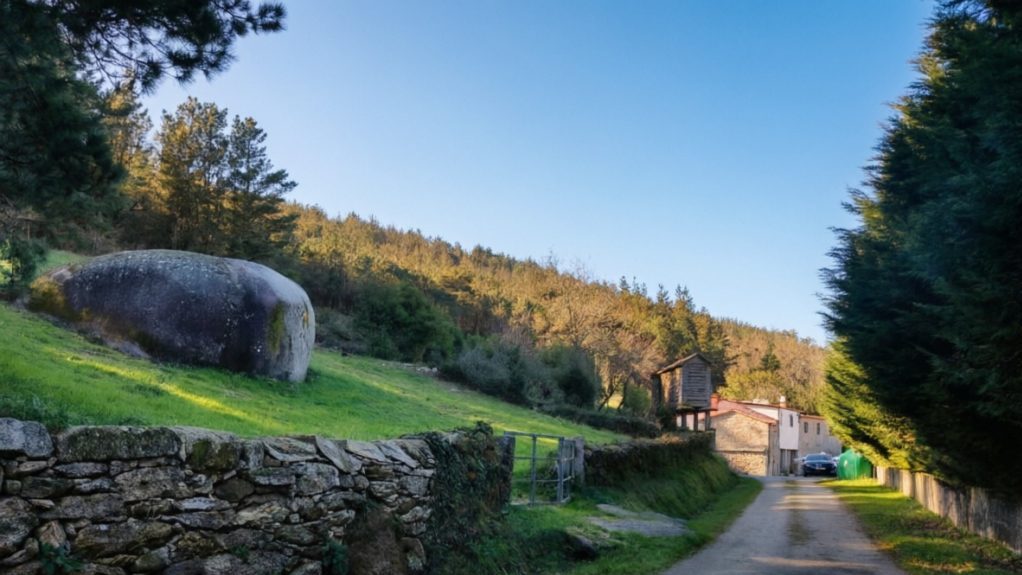
Another almost undiscovered path circles the hamlet through the adjacent pasturelands. These narrow ways are often framed by ancient, lichen-covered stone walls that have marked the boundaries of small plots for generations. A short walk there lets you experience the centuries-old cultural landscape up close. You feel the granite’s rough texture, smell the aroma of fresh moss and damp grass, and get a sense of the hard work it took to wrest survival from this ground. It’s a place of absolute grounding—far from the digital world and everyday worries.
A special kind of insider tip is watching the modern wind farms on the distant ridgelines—especially when Galician fog rolls in. The majestic turbines then look like modern guardians of the coast, rotating silently in the haze. For photographers, this contrast between O Logoso’s archaic granite world and futuristic energy generation offers an almost surreal motif. It tells of Galicia’s constant transformation—a land with roots deep in the Middle Ages, yet boldly looking to the future.
Last but not least, you should talk with the people who run the hostel. This is often how you learn about hidden water sources nearby or old tales about the “meigas,” the Galician witches said to dwell in the mists of Monte Castelo. These local stories add an extra, mystical layer to the landscape that no official guidebook includes. O Logoso is a place of nuances; if you listen and look closely, you’ll find more than just a place to sleep—you’ll find the soul of a land that draws its greatest strength from silence.
Moment of Reflection
In O Logoso, a silence settles over you that’s almost physically tangible. Up here, suspended between forested valleys and the nearby coast, the Camino is reduced to its absolute essence. You’ve reached a point where the physical effort of the climb can give way to a deep inner calm. This place asks you a quiet but pressing question: Are you ready to let go of the ballast of the past days? Often we carry not only pounds in our backpack, but also expectations, fears, and the noise of our civilization. With its radical simplicity, O Logoso invites you to strip all of that off for one night.
Do you stay in the safety of this small granite oasis to let the experiences of the past weeks sink in—or does the certainty that the sea is now almost within reach already pull you onward, restless? O Logoso shows you that you don’t need much to be happy: firm ground under your feet, a wide view, and the silence to hear your own thoughts again. It’s the calm before the last big leap to the coast. Use this place as a mirror for your soul. When you lift your gaze to the stars here at night, you may realize that the path doesn’t end in Santiago and it doesn’t end in Fisterra either—it runs straight through you, and O Logoso is the place where you learn to breathe deeply again.
Camino of the Stars
This place lies on the Camino to Fisterra, on the stage from Olveiroa to Fisterra (CFM 3a). The sequence of places is:
Olveiroa → O Logoso → Hospital → Cee → Corcubión → Redonda → Amarela → Estorde → Sardiñeiro → Fisterra
Did you feel that very special moment of first “breathing out” after the climb out of Olveiroa in O Logoso’s meditative seclusion? Maybe you heard a story on the albergue terrace that changed how you see the path, or you took a photo of the starry sky that captures this place’s magic. Share your personal impressions and experiences with us—no matter what language. Your experiences make this small but significant hamlet come alive even more for other pilgrims!
About the Author