A first look – Entry & Atmosphere
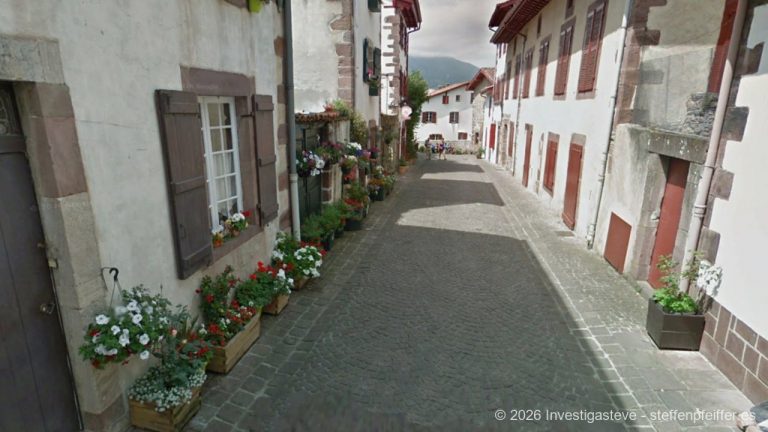
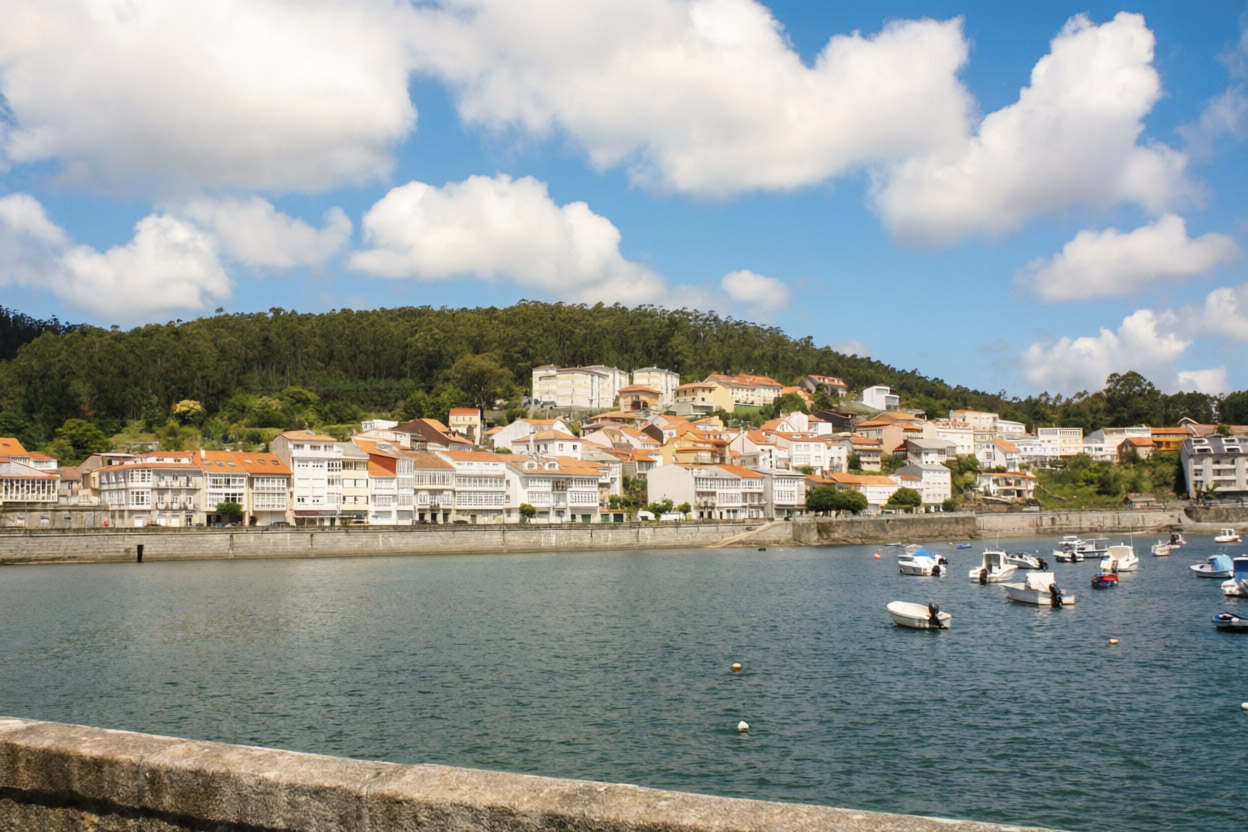
When you crest the ridge behind Cee and the path dips slowly, almost reverently, towards the glittering ría, the texture of your journey changes in a way you feel physically in your spinal cord. Corcubión does not welcome you like a simple fishing village; it greets you with the understated elegance of an impoverished nobleman who has never shed his pride. The air here has a dense, almost oily quality – saturated with the bitter aroma of heavy sea salt, damp seaweed, and the metallic tang of the nearby harbor, mingled with the sweet scent of camellias blooming in the hidden gardens of the grand manors. Your steps on the cobblestones of the old town sound different than on the dusty paths of the suburbs: it is a hollow, rhythmic sound reflected by the massive granite facades of the “pazos,” reminding you that you are no longer just a wanderer here, but a guest in a historical monument.
The atmosphere in Corcubión is dominated by a deep, maritime melancholy, which nevertheless gains an almost sacred warmth through the golden light of the late afternoon. You hear the rhythmic clattering of the rigging of the boats rocking in the harbor – a metallic singing carried across the promenade by the wind – underlaid by the polyphonic cries of the seagulls circling over the ría. To stand here is to feel the weight of centuries. The tactile contrast between the harsh cold of the granite stones and the sudden warmth drifting from the open doors of the small tabernas is the sensory hallmark of this place. Corcubión is the last civilizational resting point before the wilderness of the Costa da Morte finally devours you. It is a place of pause, where the clicking of your trekking poles on the stone pavement seems like an echo from a time when the Counts of Altamira still held sway here and the world on the horizon was still considered a flat disk.
What this place tells
The history of Corcubión is a chronicle of power, resistance, and the relentless sea. While many places on the St. James Way derive their significance purely from the legend of Saint James, Corcubión was for centuries the administrative and secular gravitational center of the region. We enter here the former domain of the Counts of Altamira, who from here in the 15th and 16th centuries not only controlled trade but also formed the political counterweight to the clerical power center of Santiago de Compostela. In the narrow streets, you still feel today the tension between the secular splendor of the noble families and the spiritual strictness of the church. The architecture tells of wealth acquired through sea trade and fishing, but also of the constant threat from pirates and invaders. In 1492, the year of the fall of Granada and the discovery of America, Corcubión was already a flourishing port whose ships sailed far beyond the horizon.
The architectural centerpiece is the Church of San Marcos, a building at the intersection of Romanesque and Gothic. When you stand before its portal, you see the traces of extensions and renovations that document the eras like the growth rings of an old oak. Inside, the image of Saint Mark watches over, whose veneration here is known far beyond the borders of Galicia. But the true stories are told by the “Casas de Pedra” (stone houses) and the “Galerías” – those typically Galician glass fronts, which are particularly magnificent here. They served to capture the rare sunlight while simultaneously defying the lashing winter storms of the Atlantic. Corcubión has survived wars and crises; in 1809, the town was almost completely burned down during the Napoleonic invasion, yet as if by a miracle and the irrepressible will of the inhabitants, it rose anew from the ashes every time.
The fishing tradition here is not a museum concept, but a lived identity. For generations, the men of Corcubión have wrested their prey from the “Costa da Morte,” while the women mended the nets in the dark winter nights and waited for the return of the cutters. This hardness is reflected in the physiognomy of the place: defiant walls, narrow windows, and a construction style that stands against the wind. In Corcubión, the myths of the Celts, who once built their “Castros” (hill forts) here, merge with the Christian pilgrimage tradition and maritime modernity. When you wander through the harbor today, you step in the footsteps of traders, inquisitors, and captains whose names have long since passed, but whose legacy lives on in every carved stone and every weathered coat of arms on the facades. Corcubión is the stony memory of a coast that has learned to face death with beauty and constancy.
Camino Distances
In the following table, you will find the distances for the current stage on the Camino Fisterra y Muxía (CFM 3a) towards Cape Finisterre:
| Previous location | Distance (km) | Next location | Distance (km) |
|---|---|---|---|
| Cee | approx. 1.8 km | Vilar (San Roque) | approx. 1.0 km |
| Estorde | approx. 4.5 km | Fisterra (Center) | approx. 12.2 km |
Addresses & tips in Corcubión
| Accommodation | 24 |
| Restaurants | 9 |
| Bars & Cafés | 7 |
| Shopping | 5 |
| Health | 5 |
| Sights | 7 |
| Services | 5 |
Opening hours
Opening hours
Show all 62
Opening hours
Opening hours
Opening hours
Opening hours
Opening hours
Opening hours
Opening hours
Opening hours
Opening hours
Opening hours
Opening hours
Opening hours
Opening hours
Opening hours
Opening hours
Opening hours
Opening hours
Opening hours
Opening hours
Opening hours
Opening hours
Opening hours
Opening hours
Opening hours
Show all 24
Opening hours
Opening hours
Opening hours
Opening hours
Opening hours
Opening hours
Opening hours
Opening hours
Show all 9
Opening hours
Opening hours
Opening hours
Opening hours
Opening hours
Opening hours
Opening hours
Opening hours
Show all 7
Opening hours
Opening hours
Opening hours
Opening hours
Opening hours
Opening hours
Opening hours
Opening hours
Opening hours
Opening hours
Show all 7
Opening hours
Opening hours
Opening hours
Opening hours
Overnight Stay & Arrival
Arriving in Corcubión marks a psychological milestone on the path to the end of the world. After you have perhaps crossed the vast, lonely passages of the inland, arriving in this urban jewel feels like a return to a cultivated order. You notice that you are reaching the core when the modern suburbs of Cee finally give way to the historical stone walls of Corcubión. It is an arrival for the senses: the coolness of the sea strikes you, and the ground beneath your feet becomes firmer as you work your way through the labyrinth of the old town to the harbor. Arriving here means not just simply putting down your backpack, but bringing it to a place that radiates dignity.
The accommodation options in Corcubión are characterized by quality and historical awareness. There are no impersonal bed castles here. The pilgrim hostels, such as the “Albergue San Roque” operated by AGACS or the municipal accommodation, are often housed in carefully restored buildings whose wooden floorboards creak underfoot and breathe the history of generations. When you sink into your bed in the evening, surrounded by thick granite walls that have locked out the heat of the day, a form of security sets in that can only be found in places that have offered protection for centuries. The haptic experience of old wood and cool stone acts as a grounding for the overstimulated wanderer’s spirit.
Those seeking more privacy will find refuges of unique beauty in the small pensions and boutique hotels along the marked path and the promenade. Staying here means being awakened in the morning by the first light reflecting in the ría and flooding into the rooms through the “galerías”. It is a ritual awakening: the distant chugging of the departing fishing boats is your alarm clock, and the scent of fresh coffee mixing with the salty morning air prepares you for the final kilometers to Fisterra. Many pilgrims consciously choose Corcubión as their penultimate stop to enjoy the “aristocratic silence” before surrendering to the hustle and bustle at the Cape.
The psychological moment of staying in Corcubión is marked by the certainty that one will soon complete the “wild” part of the journey. One is in a protected bay, a natural harbor that was already considered a place of refuge in the Middle Ages. This security is transferred to sleep. The night in Corcubión is deep and quiet; only the occasional cry of a night gull or the soft gurgling of the water against the harbor wall accompany your dreams. When you set out in the morning, you do so with the clarity of a person who has lived in history. Arriving in Corcubión is thus not an end, but a solemn preparation for the grand finale at the ocean.


Eating & Drinking
Dining in Corcubión means signing a love letter to the Atlantic and the Galician hinterland at the same time. The local gastronomy is radically honest and benefits from the immediate proximity to the fish market of Cee and its own fishing grounds in the ría. An absolute must for every pilgrim is the “Navajas” (razor clams), which are often prepared here with a perfection that is second to none. Cooked on the grill with the finest olive oil, plenty of garlic, and a squeeze of lemon, they unfold an aroma that concentrates the entire intensity of the sea in one bite. The meat is firm, sweetish, and carries the mineral note of the Galician coast within it. With it, one serves the heavy, dark farmhouse bread, the crust of which is so hard that one literally has to fight for it, while the inside soaks up the sauces like a sponge.
In addition to the treasures of the sea, Corcubión also offers the hearty classics of the region. The “Pulpo á Feira” , served on traditional wooden plates with coarse sea salt and smoky pimentón, is the ultimate power food here for tired hikers’ legs. If you are lucky, you catch a day when fresh “Zamburiñas” (scallops) are served in a juicy tomato-onion sauce. The haptic pleasure of loosening the shell and tasting the interplay of spiciness and freshness is a reward that makes you forget every kilometer of the day. The restaurants and tabernas around the Plaza de la Constitución offer an atmosphere of casual warmth, where pilgrims and locals huddle together at long wooden tables.
In Corcubión, people prefer to drink a cool, sparkling Albariño or a strong local Ribeiro, which is often still traditionally served from the “cunca”, the white ceramic bowl. The bowl lies cool and heavy in the hand, and the wine unfolds a completely different, earthier aroma in it than in a glass. For dessert, the “Tarta de Santiago” must not be missed, the almond flavor of which is often varied here with a nuance of lemon or a dash of local orujo liqueur. Eating in Corcubión is not just satisfying hunger; it is a ritual feast of deceleration that nourishes the body and strengthens the soul for the spiritual encounter at the Cape. One leaves the table with the feeling of having absorbed the power of the region directly into oneself.
Supply & Logistics
Corcubión functions logistically as the “civilized gateway” to the Costa da Morte. Despite its historical character, the town offers a first-class infrastructure specially tailored to the needs of long-distance hikers and cultural tourists. In the town center, you will find everything essential for the remainder of the St. James Way: well-stocked supermarkets, small shops with regional specialties, and a pharmacy whose staff are experienced in dealing with the typical ailments of pilgrim feet. It is advisable to stock up here on supplies for the upcoming, often lonelier stages to Muxía or for your stay at the Cape, as prices and selection in Corcubión are often more moderate than directly at the tourist hotspot of Fisterra. The connection to public transport is surprisingly good for such a history-steeped place. The bus stop on the coastal road regularly connects Corcubión with Santiago de Compostela, A Coruña, and of course Fisterra. This is particularly important for those who need to shorten a stage due to injury or are planning an excursion to the administrative town of Cee, which is only a few minutes’ walk away. Furthermore, Corcubión is an ideal point for luggage transport services; bags are reliably deposited here in hostels and hotels, allowing hikers to explore the beauty of the old town without the weight on their shoulders.
Shopping: Several medium-sized supermarkets and specialized fish shops offer a full selection for self-catering.
Gastronomy: A high density of excellent fish restaurants, tapas bars, and cafés along the promenade and in the old town.
Accommodation: A choice between communal and private hostels, pensions, and upscale boutique hotels in historical buildings.
Public facilities: Tourist information at the harbor, post office, banks with ATMs, and a medical center are available.
The logistical infrastructure in Corcubión is designed to keep your back free for your inner processes. The mobile network works excellently here, and most accommodations offer fast Wi-Fi to organize the onward journey. Practical services such as laundry facilities are also professionally coordinated here. Corcubión is a place that works so that you can pilgrim. You leave the place with the good feeling of being physically and logistically well-equipped for the grand finale at the ocean. It is the logistics of reliability in the midst of a landscape of unpredictability.
Don’t miss
Church of San Marcos: Admire the Gothic-Romanesque architecture and the impressive altarpieces of this historical sanctuary.
The Galerías on the promenade: Observe the play of light in the typical Galician glass fronts that characterize the face of Corcubión.
Old town labyrinth: Lose yourself in the steep, narrow alleys and discover the hidden coats of arms on the facades of the old noble houses.
Harbor promenade: Stroll along the ría at sunset and enjoy the view of the rocking fishing boats and distant Cee.
Pazo de los Altamira: Behold the remains of the former seigneurial splendor, which bear witness to the administrative importance of the place.
Camellia gardens: In spring, look for the blooming camellias in the private courtyards, which lend the place an almost exotic touch.
Insider tips and hidden places
Away from the marked yellow arrows, Corcubión hides corners of almost eerie beauty that reveal themselves only to the patient explorer. One of these places is the small, almost forgotten viewpoint above the cemetery. While most pilgrims take the direct path to San Roque, a narrow path behind the stone walls leads to a plateau from which you can overlook the entire Ría de Corcubión like on a map. From up here, the church towers of San Marcos look like toys, and one understands the strategic location of the place as a guardian over the bay. It is a place of absolute silence, where only the distant roar of the surf and the wind in the eucalyptus trees can be heard – perfect for a journal intermezzo or a silent meditation.
Another insider tip is the tiny chapel in one of the backyards of the old town, which is rarely open. However, if you are lucky enough to catch a glimpse inside, you will see a simplicity that almost moves one to tears: a simple crucifix, the smell of cold wax and old stone. It is a space that needs no cathedral to be holy. In the crevices of the walls of this chapel, one often finds tiny notes with requests or names that pilgrims have left there over decades – a silent, collective memory of longing. Corcubión is rich in such invisible lines of force; one only has to be ready to slow down and lift one’s gaze from the ground.
For culinary explorers, there are tiny bars in the side streets away from the promenade that have no menu. Here you eat what the mother of the house has just cooked – often these are “chinchos” (small fried fish) or a simple “Caldo Gallego”. These places are the true treasure chambers of hospitality. You sit on wobbly stools, converse with the locals using hands and feet, and hear stories about the sea that are in no travel guide. It is this unfiltered encounter that makes Corcubión a place that possesses far more depth than its aristocratic facade suggests.
Finally, it is worth exploring the small path along the rocks south of the harbor at low tide. Here one often finds rare seashells or smooth-polished pottery shards that could bear witness to past shipwrecks. Corcubión is a place of small finds. Anyone who wanders along the shore with a lowered gaze often finds more than just pretty stones; one finds fragments of a maritime history that the ocean has patiently washed up here. These small, insignificant discoveries are what make a stay in Corcubión a personal treasure hunt before turning towards the metaphysical finale at the Cape.
The Captain’s Forgotten Loop – A Bonus Circular Route for Explorers
Anyone who truly wants to understand Corcubión should take the time for a “spiritual extra mile” that hardly any official guide documents. Your morning begins not with a hasty departure towards Fisterra, but with a conscious walk along the harbor promenade, where the first ray of sunlight bathes the masts of the fishing cutters in a glowing copper. You pass the Guardia Civil building, a symbol of order on this once lawless coast, and head towards the “Buen Camino Corcubión”. The smell of freshly roasted coffee and warm tostadas mixes here with the salty morning breeze – it is the place where you strengthen yourself physically and mentally for a journey of discovery that leads you deep into the defensive history of the ría. In addition, with the operators Chuchuna and Belén, as well as their daughters Lola and Ainhoa, you will find true people of the heart who make the day even more unforgettable with their coastal charm.
Your path leads you further to the cemetery, a place of silence, where you turn left and leave the civilization of the town behind to immerse yourself in the wooded solitude towards Playa de Quenxe. The following passage to the Faro de Cee is a haptic and visual experience of rare intensity. To your left, the defiant silhouette of the Castillo del Cardenal emerges down the slope; although the gates of this private fortress remain closed, you can admire the massive stone walls from the elevated road, which once struck fear into pirates and invaders. Your gaze involuntarily wanders across the glittering water of the ría to the opposite shore to Ameixenda, where the Castillo del Príncipe responds as an architectural echo. You can literally feel the historical tension between these two stony guardians who controlled access to the harbor like an iron gate. The path to the lighthouse of Cee is lined with wild gorse, whose scent in the midday sun acts almost intoxicatingly, while the distant rumble of the surf sets the beat for your steps.
Arriving at the Faro de Cee, the world widens in a way that takes your breath away. You stand at a point that does not mark the end of the world but seems to be its gravitational center. Before you, the ría spreads out in its full glory, and on the horizon rises Monte Pindo, the sacred granite Olympus of the Celts, whose jagged peaks often appear like petrified giants in the changing light. It is a moment of absolute overview, in which the auditory experience of the screaming seagulls and the splashing waves against the cape forms a unity. After you have absorbed this energy, the road leads you back to the junction, but this time you choose the ascent to the left, into the agricultural heart of the Parroquia Redonda. The transition from maritime to rural Galicia takes place here within a few hundred meters.
Having arrived in Redonda, a visit to the Romanesque church of San Pedro is a ritual must-stop before you move on to the “Banco Azul”. This simple blue bench is far more than a seat; it is a box seat over infinity. From here, you overlook almost the entire zone, from the roofs of Corcubión to the first foothills of the Cape. The psychological effect of this broad view is immense: you recognize the paths you have come and the paths that still lie ahead of you. It is the ideal place for a meditative rest, seasoned with the cool forest air blowing down from the hills of Toba. The way back finally leads you along the road to the Albergue San Roque, which lies like a hidden treasure by the wayside.
The Albergue San Roque, housed in a charming old school building and lovingly managed by the AGACS, is the epitome of authentic pilgrim culture. Here, the original principle of hospitality is still highly valued: the overnight stay and the communal dinner are regulated via donativo (a voluntary contribution based on what one can afford), which creates an atmosphere of freedom and gratitude. When you sit at the long tables in the evening with pilgrims from all over the world while the hospitaleros tell stories about the way, you feel a connection that goes beyond national borders. You have the choice to spend this night in the protective community of the old school or to descend back to the harbor of Corcubión via the narrow field path that winds picturesquely down the slope. No matter how you decide, this loop has cleansed you and prepared you for tomorrow, when the path will finally carry you towards the lighthouse of Fisterra via Amarela. My personal author’s recommendation is to plan the day so that you snag one of the coveted beds in the albergue in the late afternoon and can show the other pilgrims something new from your photo safari that they have not yet experienced, and above all, in summer there is certainly the opportunity to show the other pilgrims the beauty of Redonda including the Banco Azul, as a preview of what awaits them the next day until Fisterra.
Moment of Reflection
In Corcubión, you stand at an invisible border that is far more than a geographic coordinate. It is the place where worldly history and the individual pilgrimage collide. While you sit on the granite steps of San Marcos and watch the tide tirelessly smooth the sand of the ría, an inevitable question arises: What does “nobility” mean to me on this path? We often pilgrimage with the ambition to learn humility, yet Corcubión reminds us that dignity and pride are also part of our journey. The Counts of Altamira have left their traces in stone, but what traces have you left within yourself over the past weeks?
The clerical power struggle between Santiago and Fisterra, which determined the fate of this region for centuries, finds its secular echo in Corcubión. Here you understand that the St. James Way was always also a political and economic instrument. But for you as a pilgrim, this story is reduced to the moment of decision: Do you belong to the institution or do you belong to the path? The aristocratic silence of the place invites you to discover your own “inner nobility”. Do you have the strength to continue your journey to the very end, even though the goal of Santiago already lies behind you? Corcubión gives you permission to be proud of your blisters, your sweat, and your exhaustion. It is the nobility of endurance.
Perhaps you recognize here that the true transformation does not only happen at the milestone 0.0, but in these quiet moments of aristocratic preparation. The purity of the atmosphere in Corcubión invites you to wash your inner images. What of the expectations you had at the beginning of the journey was truly yours? And what of it was just the noise of the world? When you leave Corcubión and continue the path towards Fisterra, you take something of the constancy of the “pazos” with you. You no longer walk as someone who is searching, but as someone who has already found – namely the ability to be completely with oneself in the silence. Corcubión is the noble guardian of your inner contemplation, a granitic promise that every path ultimately leads to a deep, inner peace.
Camino of the Stars
This place is located on the St. James Way Fisterra and Muxía (CFM 3a), on the stage from Olveiroa to Fisterra. The sequence of places is:
Olveiroa → Hospital → O Logoso → Cee → Corcubión → Redonda → Amarela → Estorde → Sardiñeiro → Fisterra
Have you also experienced this moment of complete clarity in the aristocratic silence of Corcubión, while the sun sank behind the church towers of San Marcos? Or did you have an encounter in one of the hidden tabernas that changed your perspective on the St. James Way?
Share your personal impressions, your photos of the “galerías” or your tips for the best rest in this noble hamlet with us. Have you dared the “forgotten loop” to the Faro de Cee and enjoyed the moment at the Banco Azul when the world seemed to stand still beneath you? Or did you have an encounter in the Albergue San Roque that fundamentally changed your understanding of pilgrimage? Share your experiences of this rarely chosen extra tip with us. Your story makes this guide a living compass for all explorer souls. Write us a comment and tell us your story!
About the Author