Stage 01 – Santiago de Compostela – Negreira
 investigasteve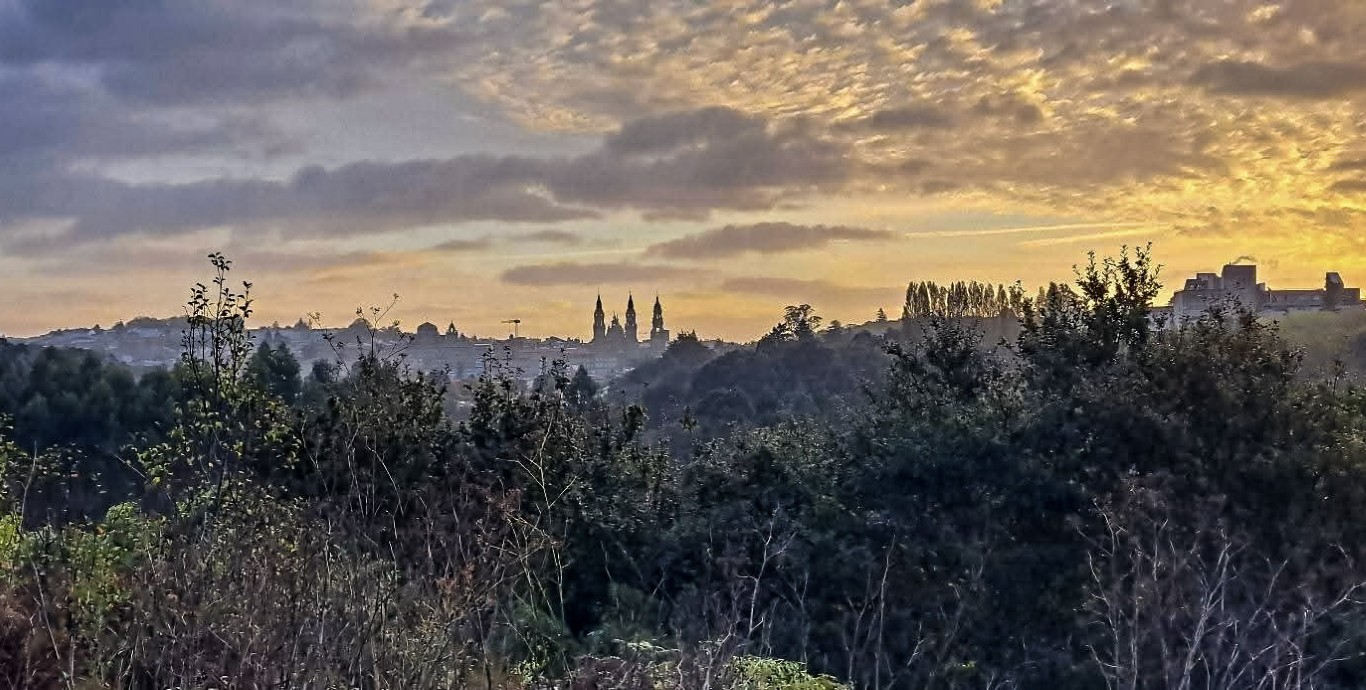
A new day on the trail – Entering the stage
The morning in Santiago de Compostela carries a different light, an almost material heaviness that settles like a delicate veil over the granite facades of the old town. While the first rays of sun bathe the towers of the cathedral in a pale gold, the cool, incense-laden breath of the night still hangs in the narrow alleys of the Rúa do Vilar. It is a strange moment of transition: while the masses of arriving pilgrims flow with exhausted euphoria onto the Praza do Obradoiro, you deliberately turn your back on the destination you have longed for over weeks. This departure from the sanctuary is no end, but a ritual exhalation, a journey into the “extension” that stretches far beyond religious duties toward the endless ocean. You feel the hard stone beneath your soles, which here in Santiago possesses an almost holy smoothness, polished by millions of feet, and you realize that your own journey is gaining a new quality – away from the collective arrival, toward the individual search for the end of the world.
The step out of the city leads you through the Rúa das Hortas, past the silent statues of the cardinal virtues, while the rhythmic clicking of your trekking poles echoes on the wet cobblestones. It is a sound that reminds you of the inevitability of moving forward. The Camino de Fisterra y Muxía is no mere appendage, but the psychological necessity to digest what has been experienced before being released back into the world. With every meter the cathedral grows smaller behind your back, a stony weight falls from your shoulders. Your gaze widens for the green hills of Galicia that now receive you. Here, where civilization slowly sinks below the horizon, the actual metamorphosis begins: you are no longer an arriver, but a wanderer between worlds, driven by the longing for the salty taste of freedom that waits for you somewhere out there, behind the dense eucalyptus forests.
Route and elevation profile
- Distance: 20.6 km
- Elevation: ↑ 480 m / ↓ 520 m
- Difficulty: Moderate – The stage challenges you with the steep climb to Mar de Ovellas and the subsequent descent, but offers moderate total distances.
- Special features: Significant descent to Ponte Maceira, urban suburbs at the beginning, followed by a deep immersion into the Galician agricultural landscape.
The topographical dramaturgy of this first day initially leads you gently out of the basin of Santiago. After leaving the urban area, the path climbs steadily, with the oak forest and the first eucalyptus groves forming a protective barrier against the noise of the city. The most difficult section awaits you after Augapesada: the climb to the Alto do Mar de Ovellas is short but intense. Here, the path tests your determination as you work your way up serpentine after serpentine, taming your breath to the rhythm of your steps and keeping your gaze fixed on the trail until the panorama opens up at the top.
The descent to Ponte Maceira is not technically difficult but requires attention on the partly uneven forest paths. It is a transition from the heights down into the fertile valley of the Rio Tambre. The profile of the stage reflects the inner process – the letting go in the city is followed by the physical exertion of the climb, which brings you completely back into your body, and finally the relaxed walk toward Negreira. The terrain alternates between paved side roads, graveled forest tracks, and soft forest floor, providing a welcome change for the feet after the long stone passages of the French Way
Variants and small detours
On this first stage, there are hardly any significant official variants, as the route is topographically clearly dictated by the valleys and mountain passes. Nevertheless, the attentive pilgrim has the opportunity shortly after leaving Santiago to explore small paths off the main route that lead deeper into the Sarela Valley. These unofficial paths often run closer to the riverbank and offer an even more intense silence, but they are poorly marked and require a good sense of direction. Those seeking solitude can briefly leave the yellow arrows here, but should always keep the church tower of San Figueroa in sight as a rough orientation.
Another, more psychological variant is the choice of a resting place in Ponte Maceira. While most pilgrims linger directly at the large stone bridge, it is worth walking a few hundred meters upstream. There, you will find hidden little access points to the water, far away from the hustle and bustle of day-trippers. These small detours cost almost no time but massively change the perception of the stage: they turn a guided path into a personal project of discovery and underline the character of this journey as a path of individual freedom.


Description of the path – with all your senses
The path begins with the hard contrast between the smooth granite slabs of the old town and the rough asphalt of the suburbs. You pass the Parque da Alameda, and the scent of old oak wood and damp grass mingles with the first coffee of the morning wafting from the bars. Your hands firmly grip the handles of your poles, which create a metallic echo on the stone. It is a gradual farewell: Santiago lets you go only slowly. In Sarela da Baixo, the texture of the ground changes; for the first time, you feel the soft resistance of earth and roots. The Sarela River ripples to the left, a gentle gurgling that finally replaces the urban noise. Here it smells of fern and decaying leaves, a deep, earthy scent that tells you: you are back out in nature.
After the first few kilometers through small hamlets like Quintáns, you reach the open terrain of Galicia. The air becomes cooler, carried by a fine, almost invisible drizzle, the “sirimiri,” which settles like a cooling film on your skin. It is a haptic experience that is inseparably linked to this stretch of land. You hear the distant ringing of cowbells, an irregular rhythm that underlines the timelessness of the rural structure. The eucalyptus trees now begin to line the path. Their ethereal, sharp scent clears your airways and acts almost like aromatherapy for the tired pilgrim spirit. The silvery leaves rustle in the wind like low whispers – an auditory carpet that accompanies you through the hills.
Arriving in Augapesada, your body prepares for the first real test. The historical stone bridge in the village is a silent witness to centuries of pilgrimage. You feel the coldness of the old stone when you pause briefly to retighten your shoes. The ascent to the Alto do Mar de Ovellas begins abruptly. Your breath becomes heavier, the blood throbs in your temples, an inner rhythm that overlays all other sounds. The effort is honest; it burns in the calves and lets the sweat flow under the backpack. But once at the top, the wind that sweeps over the pass rewards you and carries the heat away. The look back at Santiago, which is now only a distant inkling in the valley, marks the final break with yesterday.
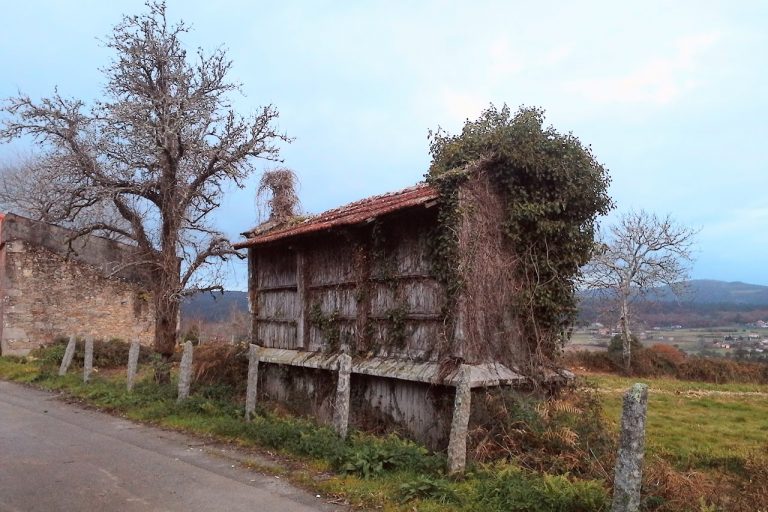
The descent leads you through dense forests where the light breaks only sparingly through the canopy. The world here is bathed in a deep green that glows almost unnaturally. The crunching of damp gravel under your soles is the only sound in this green cathedral. You pass Trasmonte, where the smell of fresh manure and burnt eucalyptus wood hangs in the air – the authentic olfactory of Galician country life. Your fingers glide over rough stone walls overgrown with thick, soft moss as you pass. It is a world of textures in which the hard and the soft constantly alternate.
Then Ponte Maceira approaches, and with it the dominating sound of this stage: the thundering roar of the Rio Tambre. From afar, you can hear the power of the water as it rolls over the weirs and under the mighty medieval bridge. When you step onto the bridge, you feel the vibration of the water in your legs. The haptic impression of the rough granite railing under your hands connects you with the master builders of the 14th century. Here, the water is not just an element, but a primal force that washes away everything old. The mist from the river cools your face and mingles with the scent of damp algae and stone.
Behind the bridge, the path leads through a piece of woodland that seems like something out of a fairyland. Ancient oaks and chestnuts form a tunnel in which time seems to stand still. The ground here is particularly soft, almost springy, which makes every step a pleasure. You hear the distant screeching of birds of prey circling over the fields. It is a deep, almost meditative silence, interrupted only by rhythmic breathing and the clicking of the poles. The psychology of the path changes here from effort to contemplation. You have now arrived completely in the here and now.
Shortly before Negreira, the landscape opens up again. The view falls on the wide meadows of the Tambre Valley. The sun, which is now lower, casts long shadows over the path. It smells of freshly mown grass and nearby civilization. The anticipation of the end of the stage mixes with a quiet melancholy over the kilometers already covered. You feel the friction of the socks in the hiking boots, a sign of the work done. In Barca, you pass small gardens where lemon and orange trees grow – an almost Mediterranean contrast to the deep green of the forests before.
The last kilometer to Negreira leads over a paved road that reminds your feet again of the hardness of the modern world. But the spirit is wide. You hear the distant hum of cars, but it no longer really reaches you. Your senses are sharpened for the small details: the play of light in the puddles, the distant smell of grilled meat from the town’s kitchens, the feeling of exhaustion that is now turning into a deep satisfaction. You enter through the monumental gate in Negreira, and the historical ground greets you with an almost palpable dignity.
Negreira itself receives you with a busy liveliness. The bars are filled with pilgrims and locals, a tangle of voices that seems almost overwhelming after the silence of the forest. But amidst the hustle and bustle, you preserve the peace of the path. The smell of pimientos de Padrón and strong Galician wine hangs heavy and promising in the air. When you finally put down your backpack, you feel an almost painful lightness in your shoulders – the physical equivalent of the psychological baggage you left behind in the Sarela Valley today.
The day ends as it began: with a special light. In Negreira, the sky often turns a dramatic purple in the evening, while the first stars appear over the mountains. You sit in front of your hostel, the cool evening air on your skin, and review the five-dimensional impressions of the day. The rushing of the water, the scent of eucalyptus, the hardness of the ascent, and the softness of the moss – all of this merges into a single, great experience. You have taken the first step toward the end of the world, and it has already changed you.
You realize that this path is no mere mileage, but a dialogue with the landscape and with yourself. The historical depth of the places you passed today, from the cathedral to the bridge of Ponte Maceira, gives your actions a meaning that goes far beyond sport. You are part of a chain that has never broken. With this thought in mind and the feeling of pleasant fatigue in your legs, you close the circle of this first day. The way to Fisterra has begun, and it promises to be much more than just a hike.
Refreshments, Accommodation & Supplies
The gastronomic supply on this stage is excellent, with Ponte Maceira serving as an absolute culinary fixture. Here, the small bars directly by the river offer the perfect opportunity for a “pulpo” break or a strengthening “empanada” while listening to the roar of the Tambre. In Augapesada, you should definitely stock up on water once more before the steep climb begins, as there are no further wells in the area of Mar de Ovellas. The quality of food in the small village shops is high; products often come directly from the immediate surroundings.
In Negreira itself, you will find a wide range of accommodation options, ranging from the authentic, somewhat secluded Albergue Logrosa to central anchors such as the Albergue El Carmen. The atmosphere in the albergues here is palpably different from on the French Way: there is a deeper peace, a spirit of community among those who have decided on the “plus” of the journey. The private accommodations often offer very personal service and are ideal retreats to reflect on the first stage in peace. Negreira is functionally well-prepared for pilgrims, but nevertheless preserves its proud Galician character without touristy pandering.
The highlight today
The special feature of this stage is undoubtedly the ritual-psychological reversal. While the entire St. James Way is geared toward reaching the cathedral, today is the conscious act of detachment. It is the most difficult mental hurdle: to perceive Santiago not as an endpoint, but as a portal. This “exodus from the sanctuary” requires courage, for you are leaving the safety of the collective and embarking on a path that is less traveled and more primal. This stage teaches you that every destination is only the starting point for a new journey.
Another highlight is the architectural ensemble of Ponte Maceira. It is one of the most photogenic and history-steeped places in Galicia. Legend has it that the pursuers of the disciples of the Apostle James were stopped here by divine intervention when the bridge collapsed. When you walk across these stones, you set foot on the ground of legends. The combination of the raw power of the river, the elegant arch of the bridge, and the old mills on the bank creates an atmosphere that seems almost unreal. It is a place where the 1,200-year history of the way is materially condensed.
Finally, it is the landscape’s “wilding” that begins today. While the French Way often leads through wide, open landscapes, here you immerse yourself in the closed forest systems of Galicia. The eucalyptus groves are not just forestry monocultures, but olfactory guideposts for the pilgrim. The special light that falls through the silvery leaves and the constant presence of water in the form of streams, wells, and fine rain characterize the new image of your journey. Today, you learn to read Galicia with all your senses – as a land that often hides its beauty in detail and silence.
Reflection at the end of the stage
When you sit in Negreira in the evening, perhaps with a view of the Pazo de Cotón, the old manor house, you realize that the first stage was more than just 20.6 kilometers. Today, you have practiced the art of moving forward. In a world that is always looking for quick closures, you have decided to stretch the moment of arrival and walk toward the sea. The psychological metamorphosis has begun: the “pilgrim of Santiago” becomes the “pilgrim to the end of the world”. A sense of sovereignty is now setting in – you no longer walk because you have to, but because you want to.
Perhaps you realize tonight that the true spiritual depth of the St. James Way often only begins where the official ceremonies end. The silence of the path to Negreira has given you the space to let the impressions of the last few weeks sink in. The pain in your legs is a familiar companion, but the lightness in your head is new. You are ready for the ocean, even if it is still two days’ journey away. Today, you have laid the foundation for this final chapter, and it feels as solid as the granite arches of Ponte Maceira.
Camino of the Stars
This stage lies on the St. James Way to Fisterra and Muxía, on the stage from Santiago de Compostela to Negreira. The sequence of places is as follows:
Stage | Start | Destination | Distance (km) | Elevation | Difficulty | Intermediate points |
|---|---|---|---|---|---|---|
01 | Santiago | Negreira | 20.6 | ↑480/↓520 | moderate | Sarela da Baixo → Roxos → Augapesada → Trasmonte → Ponte Maceira |
Have you felt the moment when Santiago disappeared behind the horizon and the silence of the forest embraced you completely for the first time? Share your story of the departure into the extension with us. Was it a farewell for you or a real beginning? Your experiences belong to the stars on this special path to the end of the world.
About the Author