Islas Lobeira & Cabo Fisterra
At the burning altar of the West
A first look – Entry & Atmosphere
When you cross the last ridge before Fisterra, there where the path winds down in gentle curves to the harbor, something happens to the perception that can hardly be put into words. It is as if the curvature of the earth suddenly becomes tangible. Before you, the infinite, deep blue banner of the Atlantic spreads out, which on clear days ends so sharply at the horizon that you almost believe in the old fear of sailors that you could simply fall off the edge of the world. The air down here in the village tastes different than in the interior; it is heavy with the moisture of the sea, saturated with the harsh, almost metallic smell of algae, tar, and burnt diesel of the fishing boats. It is a scent that smells of adventure and, at the same time, of relentless finality. Your steps on the asphalt of the harbor feel strangely foreign after the hundreds of kilometers on gravel and forest floor, almost as if the body first had to learn again how to stand on firm, civilizational ground.
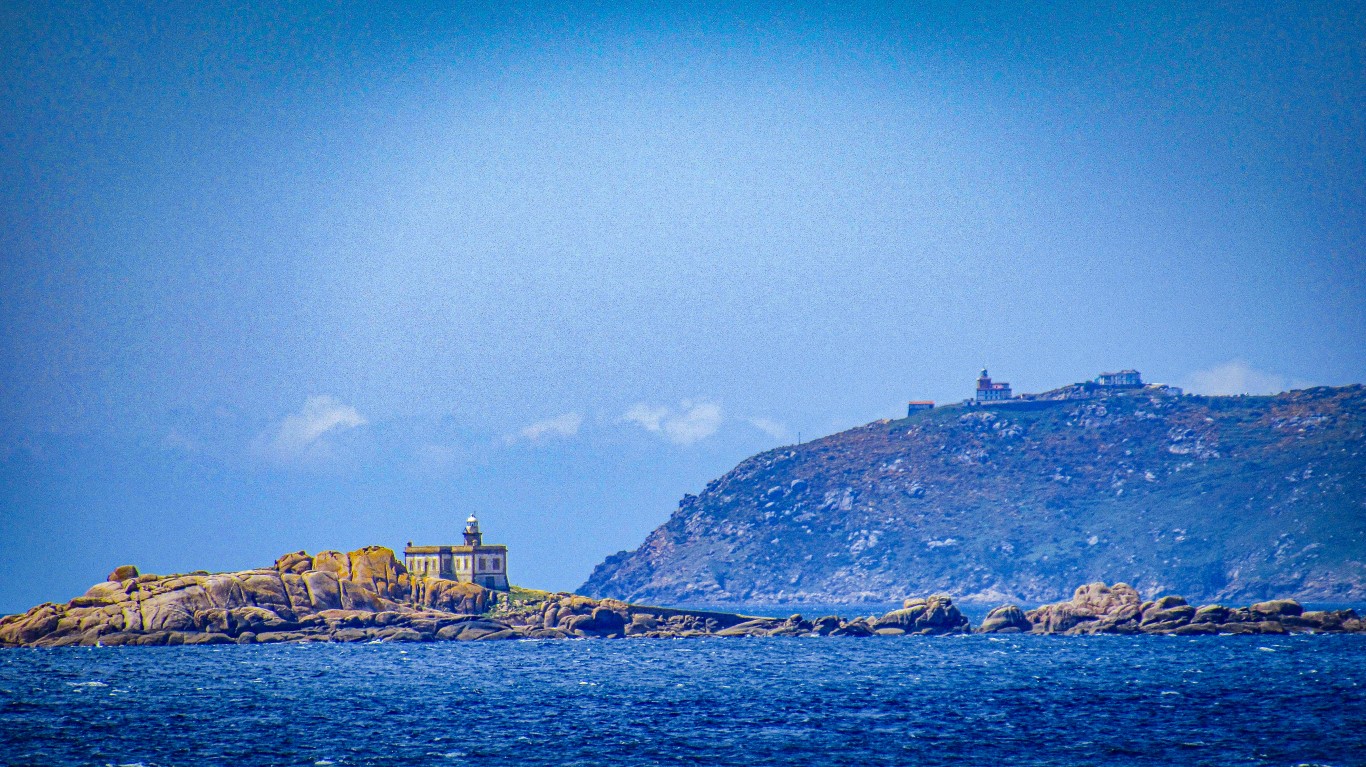
However, the actual pull comes from the headland, which bores like a bony finger two kilometers further into the ocean: Cape Fisterra with its legendary lighthouse. The path there, along the narrow road high above the cliffs, is a ritual transition. The wind, which here almost always lashes from the northwest, tugs at your clothing and dries the sweat of your last stage within seconds. You hear the distant, hollow roar of the surf hitting the granite caves deep below – a rhythm as old as time itself. When you finally stand before the lighthouse, where the stone post with the “Kilometer 0.0” marks the official final point, you feel a physical relief that can be almost painful. The salt patina on your face mixes with the feeling that there is no more “further”. Here, at the Faro, you are no longer just a wanderer; you are a witness to the end of the world, an observer of the burning sunset that bathes this place in an unreal gold and violet every evening.
What this place tells
Fisterra is not a mere place on the map; it is a palimpsest-like layering of myths, religions, and naked struggle for survival. Long before the first Christian pilgrims found their way to Galicia, the Celts and Phoenicians knew about the magical significance of this headland. Here stood the “Ara Solis”, the altar of the sun, where the ancient peoples celebrated the daily death and rebirth of the bringer of light. The Romans, led by Decimus Iunius Brutus in the 2nd century BC, stared here with sacred awe at the ocean and named the place “Finis Terrae” – the end of the world. For them, the cape was the border to chaos, to the unknown, to the realm of shadows. This archaic energy is still palpable today, especially when the mist, the “Brétema”, rises so densely from the sea that the lighthouse appears like a lonely island in the middle of nothingness.
The landmark of the cape, the Faro de Fisterra, was built in 1853 and has since been the brightest star on the Costa da Morte. Its history is a chronicle of shipwrecks and rescue. Before electric light and radar made shipping safer, this rock was a death sentence for countless sailors. On stormy nights, the “Vaca de Fisterra” (the Cow of Fisterra) sounds, a foghorn whose deep, wailing tone echoes for kilometers into the hinterland and reminds people that they are only guests at the edge of a powerful elemental force.
Yet Fisterra also tells the story of spiritual triumph over death. In the church of Santa María das Areas, located at the foot of the cape, one finds the image of the “Santo Cristo con Barba Dorada”. Legend has it that the crucifix was thrown overboard during a storm and washed ashore right here – a divine sign that finally integrated the place into the Christian canon.
The fishing tradition of Fisterra is the pulsating heart of the village. For centuries, people here lived in a symbiosis with the sea that was as hard as the granite of their houses. The narrowness of the alleys in the old fishing quarter, where the houses support each other to withstand the wind, bears witness to a community that could only survive through cohesion. When you walk through the harbor today and observe the fishermen mending their nets, you see faces into which the wind and salt have carved deep furrows – living chronicles of a time when every departure was a gamble with fate. Fisterra is the place where the legend of St. James merges with the daily bread of the fishermen and the curiosity of the ancient geographers.
Camino Distances
Here you will find the distances for the completion of the journey at Cape Finisterre (CFM 3a/4):
|
Previous Location |
Distance (km) |
Next Location |
Distance (km) |
|---|---|---|---|
|
approx. 5.4 km |
Fisterra (Town Center) |
approx. 0.0 km | |
|
Fisterra (Harbor) |
approx. 0.0 km |
Faro de Fisterra (Cape) |
approx. 3.1 km |
Addresses & tips in Fisterra
Opening hours
Opening hours
Opening hours
Opening hours
Opening hours
Opening hours
Opening hours
Opening hours
Opening hours
Opening hours
Opening hours
Opening hours
Opening hours
Opening hours
Opening hours
Opening hours
Opening hours
Opening hours
Opening hours
Opening hours
Opening hours
Opening hours
Opening hours
Opening hours
Opening hours
Opening hours
Opening hours
Opening hours
Opening hours
Opening hours
Opening hours
Opening hours
Opening hours
Opening hours
Opening hours
Opening hours
Opening hours
Opening hours
Opening hours
Opening hours
Opening hours
Opening hours
Opening hours
Opening hours
Opening hours
Opening hours
Opening hours
Opening hours
Opening hours
Opening hours
Opening hours
Opening hours
Opening hours
Opening hours
Opening hours
Opening hours
Opening hours
Opening hours
Opening hours
Opening hours
Opening hours
Opening hours
Opening hours
Opening hours
Opening hours
Opening hours
Opening hours
Opening hours
Opening hours
Opening hours
Opening hours
Opening hours
Opening hours
Opening hours
Opening hours
Opening hours
Opening hours
Opening hours
Opening hours
Opening hours
Opening hours
Opening hours
Opening hours
Opening hours
Opening hours
Opening hours
Opening hours
Opening hours
Opening hours
Opening hours
Opening hours
Opening hours
Opening hours
Opening hours
Opening hours
Opening hours
Opening hours
Opening hours
Opening hours
Opening hours
Opening hours
Opening hours
Opening hours
Opening hours
Opening hours
Overnight Stay & Arrival
Arriving in Fisterra is a highly emotional process that often takes hours, if not days, and is not completed simply by passing the town sign. When you pass the town sign, the first impulse is usually the search for the albergue in order to finally get rid of the burden of the backpack. The infrastructure in Fisterra is legendary and offers the right refuge for every pilgrim. The public and private albergues in the town center are often housed in historical buildings in which the scent of dried lavender fights against the damp sea air. It is a special feeling to lie in one of these dormitories while the wind whistles through the cracks of the old windows outside and you know: Tomorrow I do not have to go further.
For those seeking a ritual conclusion, there are hotels and pensions overlooking the Praia da Ribeira. Here you can observe in the morning over your first coffee how the mist clears over the masts of the fishing boats. An absolute highlight for many is staying at “O Semáforo”, the former keeper’s house directly at the lighthouse. Up there, surrounded by the raging elements, staying overnight becomes a borderline experience. You can feel the building trembling during heavy storms and feel as if you are on the bridge of a huge stone ship setting course for the sunset. As the hotel “O Semaforo” is often fully booked during the summer due to its location, the Hotel Áncora in the Rúa Alcalde Fernández, among others, is a great option in town. This family-run 1-star hotel offers more than the 1 star might suggest. All central points in the town are no more than 900 m away from here (with the exception of the lighthouse itself). However, the Mar de Fisterra at Playa Langosteira and the many other establishments also offer everything your heart desires, from luxury to peace and relaxation after the demanding St. James Way.
Arriving in Fisterra also means collecting the “Fisterrana”, the certificate issued at the pilgrim office at the harbor. It is the moment when the journey is certified in black and white. The atmosphere in the alleys is characterized by a deep, collective relief. Everywhere, pilgrims sit in the small bars, show each other their blisters, share the last supplies, and often just stare at the water for minutes. It is a mood between euphoria and melancholy, because the goal has been reached, but with it the structure that has determined life for weeks or months also ends.
Some pilgrims decide to pitch their tent at Praia de Mar de Fora to be even closer to the sea. There, on the wild west side of the cape, arriving is more radical. There are no cafés, no showers, only the sand and the surf. Those who spend the night here seek total confrontation with nature in order to internally conclude the path. Whether in the community of an albergue or in the solitude of the beach – arriving in Fisterra is the shedding of an old skin and the waiting for what may come after the end of the world.
Eating & Drinking
To eat in Fisterra means to submit to the absolute dominion of the sea. The gastronomic identity of the place is renegotiated daily at the harbor in the “Lonja”, the fish auction hall. An absolute must for every pilgrim are the “Longueiróns de Fisterra”, the local razor clams. They are usually prepared on the grill with plenty of olive oil, garlic, and a squeeze of lemon. The meat is firm, of a fine sweetness, and carries the pure aroma of the Atlantic within it. When you release the clam from the shell and taste the interplay of smoky grilled notes and the freshness of the sea, you understand why this place has always attracted gourmets.
Another centerpiece of the local cuisine is the “Pulpo á Feira”. In the pulperías around the harbor, the large copper kettles steam, in which the octopuses receive their perfect consistency. Served on wooden plates with coarse sea salt and hot pimentón, this is the ultimate power food after the long journey. With it, you drink a cool Albariño or a local Ribeiro from the “Cunca”, the white ceramic bowl. The acidity of the wine cuts perfectly through the olive oil and leaves the palate ready for the next bite. It is an honest, unpretentious cuisine that needs no decoration because the basic products are of unsurpassed quality.
Those who like it a bit more rustic should ask for “Pescado del día” (fish of the day). Whether it is a bulky wolffish, a delicate sole, or sardines – the preparation is often minimalistic so as not to mask the fish’s own flavor. For dessert, the “Tarta de Santiago” must not be missed, whose almond flavor is often varied here with a slight note of sea salt or a shot of local orujo. Eating in Fisterra is a ritual feast, a reward for the hardships of the path, which is best enjoyed while watching the boats enter the protective harbor.
Supply & Logistics
Fisterra is logistically the “base camp at the end of the world”. Despite its location at the extreme periphery, the village offers everything you need for the return journey or for staying. In the town center around the Plaza de la Constitución, there are several supermarkets that are well adjusted to the needs of pilgrims – from blister plasters and gas cartridges to regional specialties as souvenirs. The village’s pharmacies are experienced in dealing with the typical ailments of long-distance hikers and often offer competent advice for the regeneration of battered feet.
The connection to the outside world is primarily via bus connections to Santiago de Compostela and A Coruña. The bus stop at the harbor is the central hub for all those ending the adventure. It is advisable to buy tickets in good time, especially in high season, as the buses are often filled to the last seat with pilgrims stowing their backpacks in the cargo hold one last time. For those who want to continue the path to Muxía, Fisterra is an ideal starting point to top up supplies, as the following stages are significantly lonelier and poorer in supplies.
- Shopping: Several supermarkets (such as Coviran, Familia, and Froiz or smaller tiendas) offer everything for daily needs. In the souvenir shops in front of the harbor, you will also find a large selection of handcrafted jewelry made of stones, handmade or also scallop shells.
- Gastronomy: The density of restaurants is enormous (especially from the start of the season). Everything is available, from the inexpensive tapas bar to the upscale restaurant directly on the harbor wall.
- Accommodation: The choice ranges from the municipal albergue to boutique hotels. Many accommodations also offer luggage transfer services.
- Public facilities: The post office (Correos) opposite the town hall near the harbor is essential for shipping excess luggage. There are also several banks with ATMs and a tourist information office that helps with planning the onward journey.
In conclusion, it can be said that Fisterra, despite its island character, is a logistical island of the blessed. One can concentrate fully on the emotional conclusion here, as the practical needs of everyday life are covered in a very small space and in high quality.


Don’t miss
- The Kilometer Stone 0.00: The obligatory photo at the end of the world – a symbol for the physical final point of your journey.
- The sunset at the cape: Sit on the rocks behind the lighthouse and experience how the world bursts into flames while the pilgrim community silently bids farewell to the light.
- The Church of Santa María das Areas: A Romanesque jewel on the climb to the cape, which houses the “Santo Cristo con Barba Dorada”.
- The Praia de Mar de Fora: A wild, dangerous beach on the west coast, perfect for meditation and observing the raw power of the Atlantic.
- The Castillo de San Carlos: Today a fishing museum, this fortress offers deep insights into the maritime history and defense of the coast.
- The harbor market: Observe the unloading of the boats and feel the pulsating, real life of the Galician fishermen.
- The Chapel of San Guillermo: Ruins of an old hermitage high above the cape, which is associated with fertility rites and Celtic star observations.
Insider tips and hidden places
Away from the big hustle and bustle at the lighthouse, Fisterra hides places of an almost painful beauty. One of these places is “Monte Facho”, the summit above the village. While most pilgrims only take the road to the Faro, the ascent to Facho offers a view that spans almost 360 degrees. From up here, you see not only the cape, but the entire coastline of the Costa da Morte up to Monte Pindo. It is a place of absolute solitude where the wind blows so strongly that it wipes away every word and every thought. Up here, the remains of old signal fires still stand, which for thousands of years showed ships the way – a place that feels as if one were a piece closer to heaven than to earth.
Another hidden treasure is the small path that leads north along the cliffs from Praia de Mar de Fora. While the main beach is often visited, on this narrow path, you lose any trace of civilization after a few hundred meters. You hike through heather and gorse, while deep below the surf hits the granite with a violence that makes the ground tremble. Here, small rocky niches can be found in which pilgrims have left tiny stone towers or messages over the years – a private archive of longing and letting go, far away from the cameras at the lighthouse.
Especially magical is also the old cemetery of Fisterra, which was never officially occupied. The modernist architecture of the tomb houses, built like white cubes into the slope, was intended to allow the dead to look at the sea. Since the locals preferred to bury their dead under the protection of the church in the village, however, this cemetery stands empty – a monumental monument of silence and missed eternity. It is a surreal place that perfectly fits the melancholy of the end of the world and is best visited in the blue hour, when the shadows of the cubes become longer.
For the early birds, there is the small harbor beach “Praia da Ribeira” at low tide. When the water recedes, old pieces of wood or smooth-polished pottery shards often come to light, which could tell of past shipwrecks. Here, in the soft morning light, when the fishing boats have just set out, you have the harbor all to yourself. It is the ideal place to dip your toes into the ice-cold water and realize that the journey is now truly over. It is these small, unspectacular moments that make Fisterra in memory a place that is far more than a tourist attraction.
Moment of Reflection
When you sit on the jagged rocks behind the lighthouse, your legs dangling over the abyss while the Atlantic thrashes against the granite below with a primal force that makes the entire cliffhead tremble, you feel the radical finality of this place. Here, at the ancient “Ara Solis,” the altar of the sun, it is not just a trail that ends; here, the known world ends.
While Muxía was stylized as a place of spiritual encouragement through the Marian apparition, Fisterra remains the place of harsh, physical confrontation with the end. The Romans, who watched the daily death of the light-bringer in the sea with awe, gave the cape its name, yet the spiritual gravity of this place reaches much deeper into megalithic times. You stand at a point that has been considered a portal to the afterlife for millennia, and it is precisely this archaic power that gives Fisterra an independence that was a thorn in the side of the clergy in Santiago for centuries.
On the other hand, you stand as a visitor, as a stranger – as a pilgrim before the supposed end. Once the physical hardships are cast off, this point with the sunset, with the death of the light-bringer at the sea, is primarily on a mental basis. For what happens when you turn around? You have the burdens of the journey behind you, and the weight could so easily fall away – if one is ready to let go. But who likes to do that when you know you have a new perspective ahead of you, to be written anew like a blank sheet of paper.
So you stand at the cape or, for the final souvenir photo, at the 0.00 km marker stone, just as in Muxía. However, one detail, as small as it may seem, is very significant. In Muxía, a yellow arrow on the 0.00 km stone points towards Fisterra. For Muxía, alongside Fisterra, may simply be an end point on the coast, from which you would only emerge 5,000 kilometers later near New York by swimming. By boat, according to records, one goes from A Coruña back to England and Ireland. Pirates under their leader Harry Paye also moved to Poole in England after their raids. They truly made the coasts unsafe, looting and burning. In 1398, a valuable gold cross was stolen from the church of Santa Maria das Areas here in Fisterra.
But back to the 0.00 km stone in Fisterra. This one has no arrow. You have arrived. At least in Fisterra, opposite Monte Pindo with its Pico Sacro and, according to legends, the buried Reina Lupa, who sent the disciples of the Apostle to Dugium at the time. That is near Vilar de Duio, close to Fisterra. Where you stand, you stand for yourself alone – with the new path ahead of you. How you walk this path in life is for you to decide. Perhaps you will take two or three romantic sunsets to do so. You will find peace and space for reflection here and on the Costa da Morte.
Behind the romantic backdrop of the sunset, however, lies a story of tangible economic rivalry and clerical power politics. In the 15th and 16th centuries, a bitter legal dispute escalated between the clergy of Fisterra and the powerful cathedral chapter of Santiago de Compostela. It was about much more than salvation; it was about the “big money” – the substantial indulgence money and offerings that pilgrims left before the image of the Santo Cristo de Fisterra, the Christ with the golden beard. While Santiago claimed total financial sovereignty over all Jacobean sites, Fisterra fought like a Gallic village for its autonomy. The burden of pilgrim care at the actual geographical end point was so immense that local priests insisted on using the funds for their own pilgrim Hospital and the maintenance of Santa María das Areas. That a clerical court finally ruled in favor of Fisterra was a sensation and marked the beginning of a lasting institutional rift.
This historical rift is still felt in your pilgrim bag today. Santiago reacted to the legal defeat with a systematic downgrading of Fisterra. To secure the cathedral’s spiritual monopoly, Santiago de Compostela was cemented as the only true, canon-law-sanctioned goal. The journey to the cape was often presented only as a complementary, almost touristic appendage. Yet precisely herein lies the irony of history: while Santiago guards the official “Compostela,” Fisterra grants its own certificate with the “Fisterrana,” acting like a seal of this historical defiance. Fisterra did not have its identity handed to it; it fought for it against the resistance of the mighty power center. For you as a pilgrim, this means: in Santiago, you receive the grace of the institution, but in Fisterra, you receive the confirmation of your individual journey to the very edge.
Camino of the Stars
This place marks the official endpoint of the Camino Fisterra y Muxía (CFM 3a). At the same time, this is the starting point for stage 4 of the CFM from Fisterra to Muxía. The sequence of locations for stage CFM 3a is:
Olveiroa → Hospital → O Logoso → Cee → Corcubión → Redonda → Amarela → Estorde → Sardiñeiro → Fisterra.
For stage CFM 4, the sequence of locations is:
Fisterra → San Martiño de Arriba → Hermedesuxo → San Salvador de Duio → Buxán → Castrexe → Lires → Frixe → Guisamonde → A Canosa → Morquintián → Xurarantes → Muxía.
Did you feel the moment when the sun sank into the Atlantic at the cape and the burden of the journey fell away as if by magic? Have you performed your own ritual at the 0.00 kilometer stone or paused in the church of Santa María das Areas before the Christ with the golden beard? Share your experiences at the end of the world with us. Your photos of the sunset or your tips for the best albergue in Fisterra bring this guidebook to life for all subsequent pilgrims. Write us a comment and become part of the Fisterra community!
About the Author